

Introduction
Hello, this is Daily Hangul! 👋
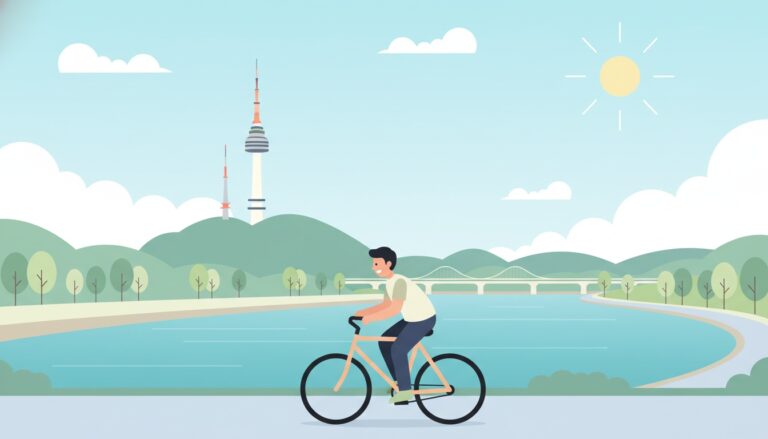
Imagine this: It’s a breezy afternoon in Seoul. You’ve arrived at the famous Han River Park (Hangang Park), ready to enjoy the vibes. You see locals riding bicycles, eating instant noodles (Ramyeon), and enjoying the sunset. You want to join in, so you approach the bike rental booth.
But wait—the menu is all in Korean, and the busy staff member is looking at you, waiting for your order. Panic sets in. Do you just hold up one finger? Do you need your passport?
Synthetic Episode (Based on Common Learner Experiences):
Many of my students have shared a similar story: They walked up to the rental booth and just said “Bike, please!” in English. While some staff understood, often there was confusion about how long (1 hour vs. 2 hours) and the ID deposit requirement. One student even walked away thinking they couldn’t rent one because the staff kept asking for a “Sinbunjuyeong” (ID card), and they didn’t understand the word.
Textbooks teach you complex grammar, but in this fast-paced situation, you need short, effective phrases to survive the “noonchi” (quick situational awareness) game. Today, let’s master the art of renting a bike like a local!
At a Glance: Today’s Takeaways
- Essential Phrases: Asking for price, requesting a rental, handling the ID deposit.
- Safe Zone: Use these with rental shop staff, convenience store clerks, or ticket booth agents.
- Level: A1 (Survival). Even if you are a total beginner, these 3 sentences will get you on a bike in under 2 minutes.
Table of Contents
- Today’s Deep Dive: Key Expressions
- Textbook vs. Real Korean
- Cultural Insight: The Deposit System
- Role Play: At the Yeouido Rental Booth
- Shadowing Challenge
- FAQ
- Wrap-up & Quiz
Today’s Deep Dive: Key Expressions
1. 한 시간 얼마예요? (Han sigan eolmayeyo?)
- Meaning: How much is it for one hour?
- Usage: Used when asking the price per hour. You can replace “Han sigan” (1 hour) with “Du sigan” (2 hours).
- Politeness: Polite (Honorific) – Safe to use with strangers/staff.
- Tutor’s Secret Note: Koreans speak fast. You might hear the staff answer just with the number, like “Cheon-won” (1,000 won). Don’t panic; just listen for the number.
- Pronunciation Clinic:
- [Han si-gan]: Make sure to pronounce the ‘n’ (ㄴ) clearly.
- [Eol-ma-ye-yo]: Link the sounds smoothly. Don’t chop it up like Eol-ma-ye-yo. Say it like Eolmayeyo.
- Examples:
- Travel: 한 시간 얼마예요? (Han sigan eolmayeyo?) – How much for one hour?
- Travel: 두 시간 얼마예요? (Du sigan eolmayeyo?) – How much for two hours?
- Shopping: 이거 얼마예요? (Igeo eolmayeyo?) – How much is this?
- Alternatives:
- More Casual: 얼마야? (Eolmaya?) – Only for close friends!
- More Formal: 이용 요금이 어떻게 됩니까? (Iyong yogeumi eotteoke doemnikka?) – How is the usage fee structured? (Too stiff for a park)
- Mini Quiz:
- Q: Fill in the blank: ______ 얼마예요? (How much for two hours?)
Click for Answer
두 시간 (Du sigan)
- Q: Fill in the blank: ______ 얼마예요? (How much for two hours?)
2. 자전거 빌리고 싶어요. (Jajeongeo billigo sipeoyo.)
- Meaning: I want to rent a bicycle.
- Usage: Standard phrase to express your intent at the counter.
- Tutor’s Secret Note: While this is grammatically perfect, in a noisy park, people often shorten this. But as a learner, using the full sentence ensures you are understood perfectly.
- Pronunciation Clinic:
- [Jajeongeo]: The ‘eo’ (어) sound is tricky. It’s like the ‘u’ in “cup,” not “o” in “go.”
- [Billigo]: Double ‘l’ sound. Pronounce it crisply.
- Examples:
- Travel: 자전거 빌리고 싶어요. (Jajeongeo billigo sipeoyo.) – I want to rent a bike.
- Daily: 책 빌리고 싶어요. (Chaek billigo sipeoyo.) – I want to borrow a book.
- Travel: 스쿠터 빌리고 싶어요. (Seukuteo billigo sipeoyo.) – I want to rent a scooter.
- Alternatives:
- Simpler: 자전거요. (Jajeongeoyo.) – Just saying “Bicycle, please.”
- More Formal: 대여하고 싶습니다. (Daeyeohago sipseumnida.) – I would like to rent.
- Mini Quiz:
- Q: To say “I want to rent a car,” replace ‘Jajeongeo’ with ‘Cha’ (Car).
Click for Answer
차 빌리고 싶어요. (Cha billigo sipeoyo.)
- Q: To say “I want to rent a car,” replace ‘Jajeongeo’ with ‘Cha’ (Car).
3. 신분증 맡겨야 해요? (Sinbunjeung matgyeoya haeyo?)
- Meaning: Do I have to leave my ID card?
- Sinbunjeung = ID Card
- Matgida = To entrust/deposit
- Usage: Essential question. Most places require an ID as a deposit.
- Tutor’s Secret Note: Warning! Don’t be surprised if they ask for this. It’s standard practice. They will give it back when you return the bike.
- Pronunciation Clinic:
- [Sin-bun-jeung]: ‘Jeung’ is a nasally sound.
- [Mat-gyeo-ya]: This is a tongue twister. Practice Mat-gyeo slowly.
- Examples:
- Rental: 신분증 맡겨야 해요? (Sinbunjeung matgyeoya haeyo?) – Do I need to leave my ID?
- Hotel: 짐 맡겨야 해요? (Jim matgyeoya haeyo?) – Do I need to check (deposit) my bags?
- General: 여권 맡겨야 해요? (Yeogwon matgyeoya haeyo?) – Do I need to leave my passport?
- Alternatives:
- Simpler: 신분증 필요해요? (Sinbunjeung piryohaeyo?) – Is ID needed?
- Mini Quiz:
- Q: Translate “Passport” to Korean.
Click for Answer
여권 (Yeogwon)
- Q: Translate “Passport” to Korean.
Textbook vs. Real Korean
| Context | Book Korean (Too Formal/Robotic) | Real Korean (Natural/Native) | Situation Checklist |
|---|---|---|---|
| Ordering | 자전거를 대여하고 싶습니다. (Jajeongeoreul daeyeohago sipseumnida) |
성인용 하나요. (Seonginyong hanayo) Meaning: “One for adults, please.” |
Use “Real” when the line is long. |
| Paying | 신용카드로 계산하겠습니다. (Sinyongkadeuro gyesanhagessseumnida) |
카드로 할게요. (Kadeuro halgeyo) Meaning: “I’ll do it with card.” |
“Real” is perfect for all shops. |
Unique Analysis: The Trust Culture (Shinbunjeung)
Why do they want my ID? Is it safe?
Foreigners are often shocked when a bike rental ajusshi (middle-aged man) takes their passport or driver’s license and puts it in a drawer.
- The Norm: In Korea, leaving an ID (Shinbunjeung) is the standard “deposit” for renting picnic mats, bikes, or batteries at the park.
- Safety: It is generally very safe. However, if you are uncomfortable leaving your Passport, ask if you can leave a Credit Card or a Phone Number instead (though this might require speaking more Korean).
Key Phrase for Negotiation:
* “여권 대신 보증금 낼게요.” (Yeogwon daesin bojeunggeum naelgeyo.)
* Meaning: I’ll pay a cash deposit instead of leaving my passport.
Real Life Scenario: Role Play
Setting: A sunny Saturday at Yeouido Han River Park rental booth. It’s noisy.
Characters: Tourist (You), Staff (Korean staff member).
Tourist: 안녕하세요! 한 시간 얼마예요?
(Annyeonghaseyo! Han sigan eolmayeyo?)
Meaning: Hello! How much for one hour?Staff: 3천 원이에요. 신분증 있으세요?
(Sam-cheon won-ieyo. Sinbunjeung isseuseyo?)
Meaning: It’s 3,000 won. Do you have an ID?Tourist: 네, 여기요. 자전거 빌리고 싶어요.
(Ne, yeogiyo. Jajeongeo billigo sipeoyo.)
Meaning: Yes, here. I want to rent a bike.Staff: 네, 선불입니다. 카드는 안 돼요.
(Ne, seonburimnida. Kadeuneun an dwaeyo.)
Meaning: Okay, it’s prepay. Cards aren’t accepted (hypothetical scenario, most take cards now!).Tourist: 아, 현금 있어요. 감사합니다.
(Ah, hyeongeum isseoyo. Gamsahamnida.)
Meaning: Ah, I have cash. Thank you.
💡 Culture Tip: Many small rental stalls prefer cash or bank transfer, though official kiosks take cards. Always carry some cash (Won) to the park!
Shadowing Challenge
Let’s practice to get the speed right. Repeat this 3 times!
“한 시간 얼마예요? 신분증 여기 있어요.”
(Han sigan eolmayeyo? Sinbunjeung yeogi isseoyo.)
- [ ] Slow speed (Focus on pronunciation)
- [ ] Normal speed (Focus on intonation)
- [ ] Real speed (Imagine the person behind you in line!)
Pronunciation Point: Connect “Sinbunjeung” and “Yeogi” smoothly. Don’t stop breathing in between.
FAQ (Frequently Asked Questions)
Q1: Can I use a credit card for the deposit?
* A: Usually, no. They need a physical item to ensure you return the bike. However, you can pay the rental fee with a card.
Q2: What if I return the bike late?
* A: You will pay a surcharge (chuga yoguem). Just say: “죄송해요, 늦었어요.” (Joesonghaeyo, neujeosseoyo – Sorry, I’m late).
Q3: Is there a helmet rental?
* A: Yes, usually free or very cheap. Ask: “헬멧 있어요?” (Helmet isseoyo?).
Conclusion & Action Item
To wrap up, renting a bike at the Han River is a must-do experience. Don’t let the language barrier stop you! Remember the magic combo: Price (Eolmayeyo) + Intent (Billigo sipeoyo) + ID (Sinbunjeung).
🚀 Today’s Mission:
Next time you watch a K-Drama or a Korea Travel Vlog on YouTube, look for a scene at the Han River. See if you can spot the rental booths in the background!
Tell me in the comments:
Have you ever ridden a bike in a foreign country? How did you communicate? 👇
Final Quiz
- How do you say “How much is it for one hour?”
a) Han sigan eolmayeyo?
b) Han sigan eodiyeyo?
c) Han sigan nuguyeyo? -
What does “Sinbunjeung” mean?
a) Credit Card
b) Cash
c) ID Card -
Fill in the blank: “I want to rent a bike.” -> 자전거 _____ 싶어요.
a) 사고 (sago – buy)
b) 빌리고 (billigo – rent)
c) 먹고 (meokgo – eat)
Answers: 1. (a), 2. (c), 3. (b)
Frequently Asked Questions (FAQ)
Q: What does "한 시간 얼마예요? (Han sigan eolmayeyo?)" mean in Korean and how do you pronounce it?
A: In Korean, "한 시간 얼마예요? (Han sigan eolmayeyo?)" is pronounced [see lesson guide] and means: How much is it for one hour?
Q: What does "자전거 빌리고 싶어요. (Jajeongeo billigo sipeoyo.)" mean in Korean and how do you pronounce it?
A: In Korean, "자전거 빌리고 싶어요. (Jajeongeo billigo sipeoyo.)" is pronounced [Clinic:] and means: I want to rent a bicycle.
Q: What does "신분증 맡겨야 해요? (Sinbunjeung matgyeoya haeyo?)" mean in Korean and how do you pronounce it?
A: In Korean, "신분증 맡겨야 해요? (Sinbunjeung matgyeoya haeyo?)" is pronounced [see lesson guide] and means: Do I have to leave my ID card?







