

Introduction
Hello, this is Daily Hangul!
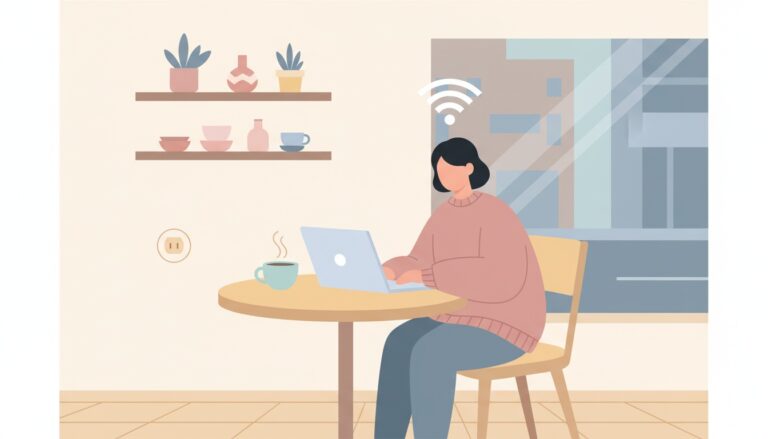
Imagine this: You are traveling in Seoul or on a business trip. Your phone battery is at 5%, and you urgently need to check a map or send an email. You rush into a beautiful cafe in Hongdae, order a coffee, and look around. You need Wi-Fi and a place to plug in your charger, but you don’t know how to ask without sounding rude.
Synthesized Case (Based on frequent learner feedback):
Many students tell us they just sit nervously, drinking their coffee while their battery dies because they are afraid to ask the staff. Or, they ask “Do you have electricity?” which sounds very strange to native speakers!
Textbooks often teach you how to order coffee, but they rarely teach you the “Survival Etiquette” inside the cafe. Today, we will learn the real expressions to survive in a Korean cafe: finding power outlets, getting Wi-Fi, and understanding the unique “Kagong” (studying in a cafe) culture.
At a Glance: Summary
- Today’s Expressions: Asking for Wi-Fi, finding outlets, requesting phone charging.
- Safe to Use: With cafe staff (part-timers) or when asking nearby customers.
- Level (B2): Essential for solving problems, not just basic ordering.
Table of Contents
- Deep Dive: Key Expressions
- Textbook vs. Real Korean
- Unique Analysis: The Receipt Secret
- Real-Life Role Play
- Shadowing Challenge
- FAQ
- Final Quiz
Deep Dive: Today’s Core Expressions
1. 와이파이 비밀번호 (Wi-Fi Password)
- Pronunciation: [wa-i-pa-i bi-mil-beon-ho]
- Meaning: Wi-Fi password.
- Usage & Register:
- Use Hasipsio-che (formal) or Haeyo-che (polite) to staff.
- Usually asked as a question: “What is the password?”
- Tutor’s Secret Note:
- Warning: Before you ask the staff, check your receipt (yengsujeung) or the wall first! Koreans might think you are unobservant if you ask immediately. The password is almost always printed on the receipt.
- Pronunciation Clinic:
- Koreans pronounce Wi-Fi as “Wai-Pai” (using the P sound, not F). If you say “Wi-Fi” with a strong ‘F’, they might not catch it instantly.
- Examples:
- (Travel) 와이파이 비밀번호가 뭐예요? (Wa-i-pa-i bi-mil-beon-ho-ga mwo-ye-yo?) – What is the Wi-Fi password?
- (Biz) 영수증에 와이파이 비번 있나요? (Yeong-su-jeung-e wa-i-pa-i bi-beon in-na-yo?) – Is the Wi-Fi password on the receipt?
- (Casual) 여기 와이파이 터져요? (Yeo-gi wa-i-pa-i teo-jyeo-yo?) – Does the Wi-Fi work here? (Lit: Does Wi-Fi burst here?)
- Alternatives:
- 비번 (Bi-beon) – Short for ‘Bimilbeonho’ (Casual/Common slang).
- Mini Quiz:
-
Click to see answer
The Korean word for receipt is 영수증 (Yeong-su-jeung).
-
2. 콘센트 (Outlet / Socket)
- Pronunciation: [kon-sen-teu]
- Meaning: Power outlet / Electric socket.
- Usage & Register:
- Used when looking for a seat with power access.
- Tutor’s Secret Note:
- This is Konglish (Korean-English). If you say “Outlet” (like a shopping mall) or “Socket,” staff may be confused. Stick to “Konsenteu.”
- Pronunciation Clinic:
- Emphasize the ‘teu’ at the end. It’s not silent.
- Examples:
- (Travel) 콘센트 있는 자리 있어요? (Kon-sen-teu it-neun ja-ri i-sseo-yo?) – Do you have a seat with an outlet?
- (Friend) 나 충전해야 돼. 콘센트 찾아보자. (Na chung-jeon-hae-ya-dwae. Kon-sen-teu cha-ja-bo-ja.) – I need to charge. Let’s look for an outlet.
- (General) 여기 콘센트 써도 돼요? (Yeo-gi kon-sen-teu sseo-do dwae-yo?) – Can I use this outlet?
3. 충전하다 (To Charge)
- Pronunciation: [chung-jeon-ha-da]
- Meaning: To charge (a battery/device).
- Usage & Register:
- Used when asking staff to charge your phone behind the counter (if you don’t have a charger).
- Tutor’s Secret Note:
- Many cafes provide this service for free, but bring your own cable just in case.
- Examples:
- (Cafe) 제 핸드폰 충전 좀 부탁드려요. (Je haen-deu-pon chung-jeon jom bu-tak-deu-ryeo-yo.) – Please charge my phone for me.
- (Biz) 혹시 충전기 있으세요? (Hok-si chung-jeon-gi i-sseu-se-yo?) – Do you happen to have a charger?
- (Daily) 배터리가 없어서 충전을 못 했어요. (Bae-teo-ri-ga eop-seo-seo chung-jeon-eul mot hae-sseo-yo.) – I couldn’t charge it because I had no battery.
Textbook vs. Real Korean
| Context | Textbook / Formal | Real Korean (Natural) |
|---|---|---|
| Asking for power | 전기를 사용할 수 있습니까? (Jeon-gi-reul sa-yong-hal su it-seum-ni-kka?) |
콘센트 자리가 어디예요? (Kon-sen-teu ja-ri-ga eo-di-ye-yo?) |
| Asking for Wi-Fi | 무선 인터넷 비밀번호가 무엇입니까? (Mu-seon in-teo-net bi-mil-beon-ho-ga mu-eot-ip-ni-kka?) |
와이파이 비번 뭐예요? (Wa-i-pa-i bi-beon mwo-ye-yo?) |
Why? “Using electricity” sounds like you are setting up a generator. Asking for the “seat with an outlet” is the natural way to secure power.
Unique Analysis: The “Receipt” Culture & Safety
🧐 Where is the Password?
In Korea, information is often printed on the receipt (영수증 – Yeongsujeung).
- Wi-Fi Password: Usually at the bottom.
- Restroom Code: Many cafes in Seoul have locked restrooms. The code (e.g., 1234*) is on the receipt.
Tip: When the staff asks “영수증 버려 드릴까요?” (Yeong-su-jeung beo-ryeo deu-ril-kka-yo? – Shall I throw away the receipt?), always say “아니요, 주세요!” (A-ni-yo, ju-se-yo! – No, please give it to me!) if you plan to use Wi-Fi or the restroom.
Real-Life Role Play
Situation: You are at a busy cafe in Gangnam. You have your laptop and need to work.
Customer: 저기요, 혹시 와이파이 비밀번호가 어디에 있나요?
(Jeo-gi-yo, hok-si wa-i-pa-i bi-mil-beon-ho-ga eo-di-e in-na-yo?)
Excuse me, where is the Wi-Fi password?
Staff: 영수증 하단에 적혀 있습니다.
(Yeong-su-jeung ha-dan-e jeok-hyeo it-seum-ni-da.)
It is written at the bottom of the receipt.
Customer: 아, 네 감사합니다. 그리고 콘센트 있는 자리가 있나요?
(A, ne gam-sa-ham-ni-da. Geu-ri-go kon-sen-teu it-neun ja-ri-ga in-na-yo?)
Ah, yes thank you. And are there any seats with outlets?
Staff: 네, 저기 창가 쪽 자리에 콘센트가 있어요.
(Ne, jeo-gi chang-ga jjok ja-ri-e kon-sen-teu-ga i-sseo-yo.)
Yes, there are outlets at the seats by the window over there.
💡 Culture Tip: In Korea, it is culturally acceptable to leave your laptop on the table while you go to the restroom. We call this the “CCTV Trust.”
Shadowing Challenge 🗣️
Repeat this sentence 3 times to sound like a local. Focus on the linking sound in 있나요 (in-na-yo).
“영수증에 와이파이 비번 나와 있나요?”
(Yeong-su-jeung-e wa-i-pa-i bi-beon na-wa in-na-yo?)
Is the Wi-Fi password shown on the receipt?
- [ ] Attempt 1 (Slow)
- [ ] Attempt 2 (Normal)
- [ ] Attempt 3 (Fast & Natural)
FAQ (Frequently Asked Questions)
Q1: Can I stay in a cafe for a long time to study?
Yes, this is called “Kagong” (Ca-fe Gong-bu). However, if you stay more than 2-3 hours, it is polite to order another drink.
Q2: Is it rude to ask staff to charge my phone?
Not at all. If you don’t have a charger, ask: “충전 좀 부탁드려도 될까요?” (Chung-jeon jom bu-tak-deu-ryeo-do doel-kka-yo?). Most will do it behind the counter.
Conclusion & Action Item
Today we learned how to secure your digital lifeline (Wi-Fi and Power) in a Korean cafe. Remember, the key is often in the receipt!
Mission: Next time you go to a cafe (even in your country), try to say “콘센트 있어요?” softly to yourself when looking for a seat.
Tell me in the comments: Have you ever been confused by a locked restroom door in Korea? 🚽
Final Quiz
- Which word means “Receipt” in Korean?
A) Me-nyu-pan
B) Yeong-su-jeung
C) Ji-gap -
How do Koreans pronounce “Wi-Fi”?
A) Wi-Fi (F sound)
B) Wai-Pai (P sound)
C) Wee-Pee -
Fill in the blank: To ask for an outlet, you say “_______ isseo-yo?”
Click to reveal answers
1. B (Yeong-su-jeung)
2. B (Wai-Pai)
3. Kon-sen-teu (콘센트)
Frequently Asked Questions (FAQ)
Q: What does "와이파이 비밀번호 (Wi-Fi Password)" mean in Korean and how do you pronounce it?
A: In Korean, "와이파이 비밀번호 (Wi-Fi Password)" is pronounced [wa-i-pa-i bi-mil-beon-ho] and means: Wi-Fi password.
Q: What does "콘센트 (Outlet / Socket)" mean in Korean and how do you pronounce it?
A: In Korean, "콘센트 (Outlet / Socket)" is pronounced [kon-sen-teu] and means: Power outlet / Electric socket.
Q: What does "충전하다 (To Charge)" mean in Korean and how do you pronounce it?
A: In Korean, "충전하다 (To Charge)" is pronounced [chung-jeon-ha-da] and means: To charge (a battery/device).







