

Hello, this is Daily Hangul!
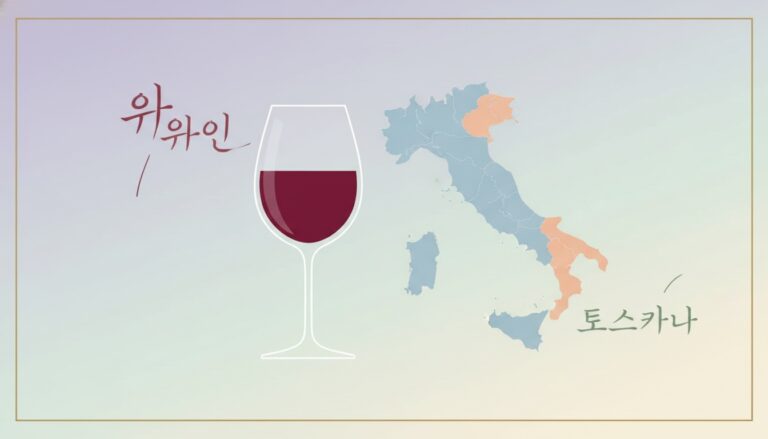
Welcome back to Daily Hangul! Imagine you are at a fancy wine bar in Hannam-dong or Gangnam, ready to impress your friends or colleagues. You see your favorite Italian wines on the menu, but when you try to order, the waiter looks confused. Why? Because Konglish (Korean-English) pronunciation follows different rules than Italian or English!
🧩 Synthetic Case Study: The “Chianti” Confusion
(Note: This is a synthetic example combining frequent mistakes made by English and Italian speakers learning Korean.)
A learner named “Alex” tried to order a “Chianti Classico” in Seoul. He said it with perfect Italian flair: “Chianti!” The staff hesitated. It wasn’t until Alex pointed at the menu that the staff said, “Ah! Ki-an-ti (키안티)?”
In Korea, loanwords have specific vowel and consonant structures. Today, we will learn how to discuss Tuscany wines so you can order with confidence and discuss taste like a local.
📝 At a Glance: Today’s Summary
- Topic: Talking about Italian Tuscany Wine (Grape varieties, taste, ordering).
- Safe Zone: Perfect for wine bars, restaurants, and casual gatherings with Korean friends.
- Level: C1 (Advanced Intermediate) – We move beyond simple ordering to discussing taste and preferences.
Key Expressions
- 품종 (Pumjong) – Grape Variety
- 바디감 (Badigam) – Body (mouthfeel)
- ~랑 잘 어울려요 (~rang jal eoulryeoyo) – Pairs well with ~
📑 Table of Contents
- Deep Dive: Essential Wine Vocabulary
- Textbook vs. Real Korean
- Unique Analysis: The “Konglish” Pronunciation Converter
- Role Play: Ordering in Hannam-dong
- Shadowing Challenge
- FAQ
- Quiz & Mission
🔍 Deep Dive: Essential Wine Vocabulary
1. 품종 (품종 / Pumjong)
- Meaning: Grape Variety / Breed
- Usage & Register:
- Used to ask what kind of grape is in the wine.
- Suitable for sommeliers or friends (Standard polite: 해요체/Haeyo-che).
- Tutor’s Secret Note:
- Koreans often ask about the “Pumjong” to guess the taste. If you know the word, you sound very knowledgeable.
- Warning: Don’t confuse it with ‘종류’ (Jongnyu – Category/Type). ‘Pumjong’ is specific to biology/crops.
- Pronunciation Clinic:
- [Pum-jong]: The ‘J’ is a bit harder, almost like ‘J’ in ‘Joy’.
- Examples:
- 이 와인의 품종이 뭐예요? (I wain-ui pumjong-i mwoyeyo?) – What is the grape variety of this wine?
- 저는 산지오베제 품종을 좋아해요. (Jeoneun Sanjiobeje pumjong-eul joahaeyo.) – I like the Sangiovese variety.
- 토스카나의 대표 품종이죠. (Toseukana-ui daepyo pumjong-ijyo.) – It is the representative variety of Tuscany.
- Alternatives:
- 포도 (Podo) – Grape (Simpler, casual)
- 블렌딩 (Beullending) – Blend (If it’s not a single variety)
- Mini Quiz:
-
Q: This wine is 100% Merlot _______. (Click to see answer)
Answer: 품종 (Pumjong)
-
2. 바디감 (바디감 / Badigam)
- Meaning: Body (Wine body) + Feeling
- Usage & Register:
- A unique Korean compound word: Body (English) + Gam (Sino-Korean for ‘Sense/Feeling’).
- Used universally in Korea to describe if a wine feels heavy or light.
- Tutor’s Secret Note:
- Koreans rarely just say “Body”. They almost always add “-gam”. Saying just “Body” might sound like you are talking about the human body!
- Pronunciation Clinic:
- [Ba-di-gam]: Make sure to pronounce ‘Gam’ clearly with a closed ‘m’ sound.
- Examples:
- 이 와인은 바디감이 묵직해요. (I wain-eun badigam-i mukjikaeyo.) – This wine has a heavy body.
- 바디감 있는 레드 와인 추천해 주세요. (Badigam inneun redeu wain chucheonhae juseyo.) – Please recommend a red wine with some body.
- 토스카나 와인은 산미와 바디감이 좋아요. (Toseukana wain-eun sanmi-wa badigam-i joayo.) – Tuscany wines have good acidity and body.
- Alternatives:
- 목넘김 (Mongneomgim) – Swallowing feel (Texture)
- 무게감 (Mugegam) – Weight (Literal weight)
- Mini Quiz:
-
Q: I like wines with a light _______. (Click to see answer)
Answer: 바디감 (Badigam)
-
3. ~랑 잘 어울려요 (~rang jal eoulryeoyo)
- Meaning: Goes well with ~ / Pairs well with ~
- Usage & Register:
- Used to discuss food pairing (Mariage).
- Use with friends or staff.
- Tutor’s Secret Note:
- This is the magic phrase to ask for food recommendations without using the difficult French word ‘Mariage’ (though Koreans use ‘Mariage’ too!).
- Pronunciation Clinic:
- [Eou-ll-yeo-yo]: The double ‘l’ (ㄹㄹ) linking sound is crucial. Flow it smoothly.
- Examples:
- 이거 스테이크랑 잘 어울려요. (Igeo seuteikeu-rang jal eoulryeoyo.) – This goes well with steak.
- 파스타랑 잘 어울리는 와인 있나요? (Paseuta-rang jal eoulrineun wain innayo?) – Is there a wine that pairs well with pasta?
- 산지오베제는 토마토 소스랑 잘 어울려요. (Sanjiobeje-neun tomato soseu-rang jal eoulryeoyo.) – Sangiovese goes well with tomato sauce.
- Alternatives:
- 궁합이 좋아요 (Gunghap-i joayo) – The chemistry/compatibility is good (Very native!)
- 조화가 좋아요 (Johwa-ga joayo) – The harmony is good
- Mini Quiz:
-
Q: Cheese ______ well with wine. (Click to see answer)
Answer: ~랑 잘 어울려요 (~rang jal eoulryeoyo)
-
📚 Textbook vs. Reality (Wine Edition)
| Context | 📖 Book Korean (Awkwardly Formal) | 🗣️ Real Korean (Natural) |
|---|---|---|
| Asking Variety | 이 와인의 포도 종류는 무엇입니까? (I wain-ui podo jongnyu-neun mueosimnikka?) |
이거 품종이 뭐예요? (Igeo pumjong-i mwoyeyo?) |
| Asking Origin | 이 와인은 이탈리아산입니까? (I wain-eun Italliasan-imnikka?) |
이거 이탈리아 와인인가요? (Igeo Itallia wain-ingayo?) |
| Ordering | 저는 이것을 주문하겠습니다. (Jeoneun igeoseul jumunhagesseumnida.) |
이걸로 주세요. (Igeollo juseyo.) |
💡 Situation Checklist:
* Sommelier in a 5-star hotel: Use slightly more formal language (ends in -seyo or -sipsio), but “Real Korean” phrases above are still safe.
* Casual Wine Bar: Definitely use the “Real Korean” column.
📊 Unique Analysis: The “Konglish” Pronunciation Converter
Foreign wine names are often “Koreanized” based on phonetics. If you use the native Italian pronunciation too strongly, the staff might not catch it. Here is how to adjust your accent for better communication.
| Italian/English | 🇰🇷 Korean Pronunciation (Romanized) | 📢 Pronunciation Tip |
|---|---|---|
| Sangiovese | 산지오베제 (Sanjiobeje) | Pronounce every syllable clearly. 5 syllables. |
| Chianti | 키안티 (Ki-an-ti) or 끼안띠 (Kki-an-tti) | Hard ‘K’ sound. Often written as ‘Kki-an-tti’ for emphasis. |
| Toscana | 토스카나 (To-seu-ka-na) | Add a vowel ‘eu’ after ‘s’. Don’t skip it! |
| Brunello | 브루넬로 (Beu-ru-nel-lo) | The ‘R’ becomes a soft ‘L/R’ hybrid. |
| Vintage | 빈티지 (Bintiji) | Used to refer to the year. |
🎬 Role Play: Ordering in Hannam-dong
Situation: You are at a trendy wine bar. You want a dry Tuscan red wine.
Staff: 어서 오세요. 와인 리스트 드릴까요?
(Eoseo oseyo. Wain riseuteu deurilkkayo?)
Welcome. Shall I give you the wine list?
You: 네, 감사합니다. 혹시 토스카나 와인 있나요?
(Ne, gamsahamnida. Hoksi Toseukana wain innayo?)
Yes, thank you. Do you happen to have any Tuscany wines?
Staff: 네, 여기 키안티 클라시코랑 브루넬로 있습니다.
(Ne, yeogi Kianti Keullasiko-rang Beurunello isseumnida.)
Yes, we have Chianti Classico and Brunello here.
You: 산미가 너무 강하지 않은 걸로 추천해 주세요.
(Sanmi-ga neomu ganghaji aneun geollo chucheonhae juseyo.)
Please recommend one where the acidity isn’t too strong.
Staff: 그럼 이 2018년 빈티지가 바디감도 좋고 맛있어요.
(Geureom i icheonsippal-nyeon bintiji-ga badigam-do joko masisseoyo.)
Then this 2018 vintage has good body and tastes good.
You: 좋아요. 이걸로 주세요.
(Joayo. Igeollo juseyo.)
Great. Please give me this one.
💡 Cultural Tip: In Korea, when pouring or receiving wine from someone older or senior, it is polite to support your arm (or the glass) with your other hand. It’s a sign of respect!
🗣️ Shadowing & Speaking Challenge
Instructions: Repeat this sentence 3 times. Focus on the word “Badigam”.
“저는 바디감 있는 토스카나 와인을 좋아해요.”
(Jeoneun badigam inneun Toseukana wain-eul joahaeyo.)
“I like Tuscany wine with some body.”
- [ ] Attempt 1 (Slowly check pronunciation)
- [ ] Attempt 2 (Natural speed)
- [ ] Attempt 3 (Imagine ordering confidently!)
❓ FAQ (Frequently Asked Questions)
Q1: How do I say “Dry” or “Sweet” in Korean?
A: It’s very simple! We use the English words.
* 드라이하다 (Deurai-hada) – To be dry.
* 스위트하다 (Seuwiteu-hada) or 달다 (Dalda) – To be sweet.
Q2: Can I just say “Red Wine”?
A: Yes! 레드 와인 (Redeu Wain) and 화이트 와인 (Hwaiteu Wain) are standard. We rarely use the literal Korean translation ‘적포도주’ (Jeok-podoju) in casual conversation anymore.
🎁 Wrap-up & Mission
Today we learned how to navigate an Italian wine list in Korea. Remember, the key is strictly pronouncing those loanwords (Sanjiobeje, Toseukana)!
🚀 Today’s Mission:
Next time you drink wine (even at home), look at the label and try to say the grape variety in the “Korean Way” (add vowels if needed!).
Question for you: What is your favorite Italian wine? Tell me in the comments using “~을/를 좋아해요”!
📝 Final Quiz
1. Which word means “Grape Variety”?
A) 종류 (Jongnyu)
B) 품종 (Pumjong)
C) 브랜드 (Beuraendu)
2. How do you say “This wine has good body”?
A) 이 와인은 몸이 좋아요. (I wain-eun mom-i joayo.)
B) 이 와인은 바디감이 좋아요. (I wain-eun badigam-i joayo.)
C) 이 와인은 무거워요. (I wain-eun mugeowoyo.)
3. Fill in the blank:
“Can you recommend a wine?” -> “와인 _______ 해 주시겠어요?”
Answers:
1. B
2. B
3. 추천 (Chucheon)
Frequently Asked Questions (FAQ)
Q: What does "품종 (품종 / Pumjong)" mean in Korean and how do you pronounce it?
A: In Korean, "품종 (품종 / Pumjong)" is pronounced [see lesson guide] and means: Grape Variety / Breed
Q: What does "바디감 (바디감 / Badigam)" mean in Korean and how do you pronounce it?
A: In Korean, "바디감 (바디감 / Badigam)" is pronounced [see lesson guide] and means: Body (Wine body) + Feeling
Q: What does "~랑 잘 어울려요 (~rang jal eoulryeoyo)" mean in Korean and how do you pronounce it?
A: In Korean, "~랑 잘 어울려요 (~rang jal eoulryeoyo)" is pronounced [see lesson guide] and means: Goes well with ~ / Pairs well with ~







