

Introduction
Hello, this is Daily Hangul!
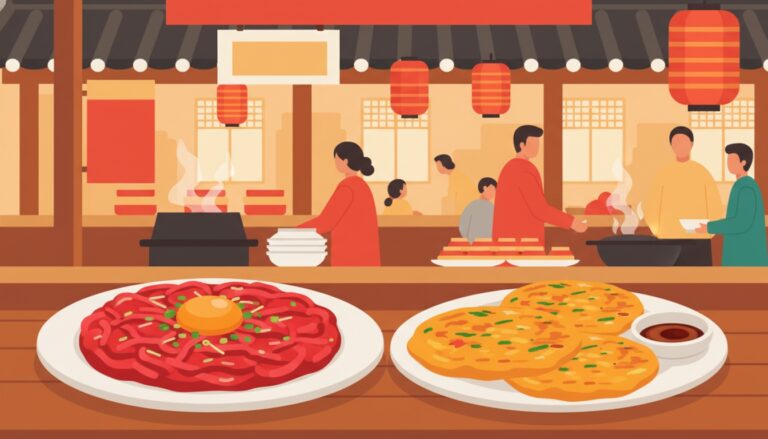
Imagine this: You’ve just stepped into Gwangjang Market (Gwangjang Sijang). It’s loud, energetic, and smells amazing—like sesame oil and sizzling mung beans. You finally find a seat at a famous Yukhoe (beef tartare) stall, but the lady (Imo) is moving so fast she hasn’t looked at you yet. You learned “Jeogiyo” in your textbook, but here, nobody seems to hear it.
Synthetic Case Study:
Note: This is a scenario compiled from common experiences shared by our foreign learners.
Many students tell us, “I sat down, but I was too scared to speak because everyone was shouting.” One student, ‘Mark’, ended up pointing at a random picture and got spicy chicken feet instead of the pancake he wanted because he didn’t know the specific word for quantity or how to get attention in a noisy market.
Textbook Korean is polite and structured, but Market Korean is all about speed, volume, and “Nunchi” (quick situational awareness). Today, we will learn how to order the famous Yukhoe and Bindaetteok with confidence!
At a Glance: Today’s Summary
- Core Expressions: Getting attention, Ordering specific quantities, Asking about payment timing.
- Safe Zone: Casual dining, street markets, busy restaurants (Not for formal business meetings).
- Level (B2): While the grammar is simple, the speed and confidence required make this intermediate level.
Table of Contents
- Today’s Deep Dive: Essential Market Phrases
- Textbook vs. Real Korean: The Noise Barrier
- Unique Analysis: The “Payment Timing” Flowchart
- Role Play: Survival at the Stall
- Shadowing Challenge
- FAQ
- Final Quiz
Today’s Deep Dive
1. 사장님 / 이모님 (Sajang-nim / Imo-nim)
- Meaning (English): Boss / Auntie (Used to call staff)
- Usage & Register:
- To whom: Staff at casual restaurants or market stalls.
- Tone: Loud and friendly.
- Tutor’s Secret Note:
- In a text book, you learn “Jeogiyo” (Excuse me). In a loud market, “Sajang-nim” (to a male or female owner) or “Imo-nim” (to an older female worker) works much better. It feels closer and more respectful of their labor.
- Warning: Do not call a young part-time worker “Imo-nim.” Stick to “Jeogiyo” or “Sajang-nim” if unsure.
- Pronunciation Clinic:
- Sajang-nim: Don’t stress the ‘nim’ too much. It flows like a wave: Sa-jang-nim.
- Examples:
- 사장님, 여기 주문 받아주세요! (Sajang-nim, yeogi jumun badajuseyo!) – Boss, please take our order here!
- 이모님, 물 좀 주실 수 있어요? (Imo-nim, mul jom jusil su isseoyo?) – Auntie, can we have some water?
- 사장님, 이거 얼마예요? (Sajang-nim, igeo eolmayeyo?) – Boss, how much is this?
- Alternatives:
- 저기요 (Jeogiyo): Standard, polite (can be too quiet).
- 여기요 (Yeogiyo): Literally “Here!” (Used when raising your hand).
- Mini Quiz:
- If the staff looks like a university student, you should probably avoid calling them [ ??? ].
Click for Answer
이모님 (Imo-nim)
- If the staff looks like a university student, you should probably avoid calling them [ ??? ].
2. 육회 하나, 빈대떡 하나 주세요 (Yukhoe hana, Bindaetteok hana juseyo)
- Meaning (English): Please give me one Yukhoe and one Bindaetteok.
- Usage & Register:
- To whom: The person taking the order.
- Tone: Polite request (Haeyo-che).
- Tutor’s Secret Note:
- Koreans often omit particles like ‘reul/eul’ (object markers) in spoken speech. Instead of “Yukhoe-reul hana juseyo,” we just say “Yukhoe hana.”
- Real Vibe: Say the menu name loudly, then the number.
- Pronunciation Clinic:
- Yukhoe: The ‘k’ and ‘h’ combine to make a strong aspirated sound. Pronounce it like [Yu-kwe] (유쾌).
- Bindaetteok: The ‘tt’ (ㄸ) is a tense sound. High pitch, strong tension.
- Examples:
- 육회 탕탕이 하나 주세요. (Yukhoe tangtangi hana juseyo.) – Please give me one beef tartare with live octopus.
- 고기 빈대떡 두 개 주세요. (Gogi bindaetteok du gae juseyo.) – Please give me two meat mung bean pancakes.
- 막걸리도 한 병 주세요. (Makgeolli-do han byeong juseyo.) – Please give me a bottle of Makgeolli too.
- Alternatives:
- 이걸로 주세요 (Igeollo juseyo): Please give me this one (while pointing).
- 반반 돼요? (Banban dwaeyo?): Can I get half and half? (Useful for some dishes).
- Mini Quiz:
- When ordering, the particle ‘reul/eul’ is often [ ??? ] in spoken Korean.
Click for Answer
omitted / dropped (생략)
- When ordering, the particle ‘reul/eul’ is often [ ??? ] in spoken Korean.
3. 선불인가요? (Seonbul-ingayo?)
- Meaning (English): Is it pay-in-advance?
- Usage & Register:
- To whom: Staff upon ordering.
- Tone: Polite question.
- Tutor’s Secret Note:
- Many market stalls require payment before you eat (Seonbul), unlike typical restaurants where you pay after (Hubul). Asking this shows you are a pro.
- Pronunciation Clinic:
- Seonbul: Ensure the ‘n’ (ㄴ) is clearly pronounced before the ‘b’ (ㅂ).
- Examples:
- 여기 선불이에요? (Yeogi seonbul-ieyo?) – Is it pre-pay here?
- 카드 계산 돼요? (Kadeu gyesan dwaeyo?) – Can I pay by card?
- 계좌이체 돼요? (Gyejwa-iche dwaeyo?) – Can I do a bank transfer? (Very common in markets).
- Alternatives:
- 계산은 어떻게 해요? (Gyesan-eun eotteoke haeyo?) – How do I pay?
- 나갈 때 내요? (Nagal ttae naeyo?) – Do I pay when I leave?
- Mini Quiz:
- The opposite of ‘Seonbul’ (Pre-pay) is [ ??? ].
Click for Answer
후불 (Hubul)
- The opposite of ‘Seonbul’ (Pre-pay) is [ ??? ].
Textbook vs. Real Korean
| Feature | Textbook Korean (Book Korean) | Real Market Korean (Real Korean) |
|---|---|---|
| Excuse Me | 저기요 (Jeogiyo) | 사장님! / 이모! (Sajang-nim! / Imo!) |
| Ordering | 육회를 1인분 주세요. (Yukhoe-reul il-inbun juseyo.) | 육회 하나요! (Yukhoe hanayo!) |
| Paying | 계산서 주세요. (Gyesanseo juseyo.) | 얼마예요? (Eolmayeyo?) or Just holding out a card. |
| Context | Quiet classroom setting. | Loud, chaotic, fast-paced. |
Situation Checklist:
* If it’s a quiet cafe → Use Textbook Korean.
* If it’s Gwangjang Market on a Friday night → Use Real Market Korean.
Unique Analysis: The “Nunchi” Calculator (Market Manners)
In a busy market, efficiency is politeness. Here is how to read the room:
- The Seat Scan: Do not wait to be seated. If you see an empty stool, make eye contact with the Imo and point to it while raising fingers for the number of people.
- The Order Speed: Do not look at the menu for 10 minutes while sitting. Decide quickly, or stand back until you decide.
- The Payment Dance:
- Stack of cash visible? → Likely Cash Only or Bank Transfer preferred.
- Card terminal visible? → Card is fine.
- Food given in a cup/paper? → 99% Seonbul (Pre-pay).
Real Scenario Role Play
Setting: A bustling stall at Gwangjang Market. You want to eat Yukhoe and Bindaetteok.
Characters:
* You: Hungry Traveler
* Imo: Busy Stall Owner
(You squeeze onto a small bench)
Imo: (Wiping table rapidly) 몇 분이세요? (Myeot bun-iseyo?) [How many?]
You: 두 명이요! 사장님, 여기 메뉴판 좀 주세요. (Du myeong-iyo! Sajang-nim, yeogi menyupan jom juseyo.) [Two people! Boss, menu please.]
Imo: (Points to wall) 벽에 있어요. 뭐 드릴까? (Byeog-e isseoyo. Mwo deurilkka?) [It’s on the wall. What can I get you?]
You: 육회 하나랑 고기 빈대떡 하나 주세요. (Yukhoe hana-rang gogi bindaetteok hana juseyo.) [One Yukhoe and one meat pancake, please.]
Imo: 술은 안 해? 막걸리? (Sur-eun an hae? Makgeolli?) [No alcohol? Makgeolli?]
You: 네, 막걸리도 한 병 주세요. 아, 혹시 선불인가요? (Ne, makgeolli-do han byeong juseyo. Ah, hoksi seonbul-ingayo?)
Imo: 응, 3만 5천 원. (Eung, sam-man o-cheon won.) [Yeah, 35,000 won.]
Cultural Tip:
* In markets, the staff might use casual language (Banmal) mixed with polite language. Don’t be offended; it’s part of the friendly “K-Grandma” vibe!
Shadowing & Speaking Challenge
Script (Repeat 3 times):
“사장님, 육회 하나랑 빈대떡 하나 주세요! 선불이에요?”
(Sajang-nim, Yukhoe hana-rang Bindaetteok hana juseyo! Seonbul-ieyo?)
Checklist:
* [ ] Did you project your voice loudly on “Sajang-nim”?
* [ ] Did you pronounce ‘Yukhoe’ as [Yu-kwe]?
* [ ] Did you ask about payment confidence?
FAQ (Frequently Asked Questions)
Q1: Can I really eat raw beef (Yukhoe)? Is it safe?
* A: Gwangjang Market is famous for high turnover, meaning the meat is very fresh. Thousands of locals eat it daily. However, if you have a sensitive stomach, stick to the Bindaetteok (cooked pancake).
Q2: Can I use a credit card at the market?
* A: Most established stalls (with tables) accept cards. However, small food carts in the middle of the aisle often prefer cash or bank transfer. Always carry about 50,000 KRW in cash just in case.
Q3: What if I don’t know the name of the food?
* A: Use the magic phrase: “이거 주세요” (Igeo juseyo – Give me this) while pointing. It never fails!
Conclusion & Action Item
Today, we learned how to navigate the energetic chaos of Gwangjang Market by using the right titles (Sajang-nim) and ordering efficiently.
Today’s Mission:
Go to a Korean restaurant (or imagine one) and practice saying “Sajang-nim!” out loud instead of just raising your hand. Feel the difference in attention!
Discussion:
Have you ever been too shy to order in a loud restaurant? Tell us your story in the comments!
Final Quiz
- Which title is best for a middle-aged female stall owner?
A) Agassi
B) Imo-nim
C) Sonsaeng-nim -
How do you say “Is it pay-in-advance?”
A) Hubul-ieyo?
B) Seonbul-ieyo?
C) Gongjjayeyo? -
Fill in the blank:
To order one Yukhoe, you say: “Yukhoe [ ??? ] juseyo.”
See Answers
1. B (Imo-nim)
2. B (Seonbul-ieyo?)
3. 하나 (hana)
Frequently Asked Questions (FAQ)
Q: What does "저기요" mean in Korean and how do you pronounce it?
A: In Korean, "저기요" is pronounced [Jeogiyo] and means: Standard, polite (can be too quiet).
Q: What does "여기요" mean in Korean and how do you pronounce it?
A: In Korean, "여기요" is pronounced [Yeogiyo] and means: Literally "Here!" (Used when raising your hand).
Q: What does "이걸로 주세요" mean in Korean and how do you pronounce it?
A: In Korean, "이걸로 주세요" is pronounced [Igeollo juseyo] and means: Please give me this one (while pointing).
Q: What does "반반 돼요?" mean in Korean and how do you pronounce it?
A: In Korean, "반반 돼요?" is pronounced [Banban dwaeyo?] and means: Can I get half and half? (Useful for some dishes).







