

Introduction
Hello, this is Daily Hangul! 👋
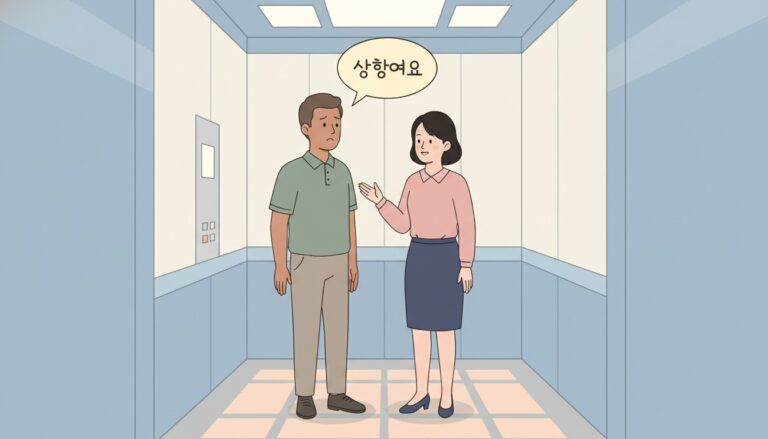
Elevators are universally awkward spaces. You’re trapped in a metal box with others, staring at the floor numbers changing slowly. But in Korea, this awkwardness is often amplified by hierarchy and strict etiquette.
Imagine this scenario: The elevator doors open, and you step in. Suddenly, your boss or an older neighbor enters. Do you speak? Do you stay silent? Where do you look?
Based on a synthetic example combining stories from several expats: Many learners report freezing in this moment. One learner, ‘Alex’, mentioned he stood in silence next to his team leader for 15 floors because he didn’t know if saying “Hello” again was necessary after seeing him in the morning. Result? The air was heavy, and he felt rude afterward.
Textbooks teach you grammar, but they rarely teach you Nunchi (eye-measure/sensing the vibe) in a fast-moving elevator. Today, we will learn how to break the ice—or maintain polite silence—safely.
Summary at a Glance
- Today’s Expressions: Essential greetings for entering, safe weather talk, and the polite way to exit first.
- Safe Zone: These are safe to use with colleagues, neighbors, and polite acquaintances.
- Level: B1 (Intermediate) – While the grammar is simple, knowing when to use these requires cultural context.
Table of Contents
- Today’s Key Expressions Deep Dive
- Textbook vs. Real Korean
- Analysis: The Silence vs. Talk Scale
- Real-Life Scenario: Office Building Role Play
- Shadowing & Speaking Challenge
- FAQ
- Wrap-up & Quiz
Today’s Key Expressions Deep Dive
1. 안녕하세요 (Annyeonghaseyo)
Meaning: Hello / Good morning / Good afternoon
Usage & Register:
* Who: Neighbors, colleagues, bosses.
* Tone: Polite formal (Haeyo-che/Hapnida-che).
Tutor’s Secret Note 🤫:
In an elevator, the sound is important, but the head nod (bow) is crucial. A loud greeting without a bow can seem aggressive. A silent bow is better than a loud greeting with a stiff neck. Warning: Do not force eye contact the entire time after greeting. Greet, smile, then look at the door.
Pronunciation Clinic:
* Many learners say “An-nyong”. Make sure to pronounce the ‘ng’ at the end of the first syllable clearly.
* [An-nyeong-ha-se-yo] -> Focus on smooth linking.
Examples:
1. (To a neighbor) 안녕하세요. (Annyeonghaseyo.) – Hello.
2. (To a boss) 안녕하십니까. (Annyeonghasimnikka.) – Hello (Very formal).
3. (Response) 네, 안녕하세요. (Ne, annyeonghaseyo.) – Yes, hello.
Alternatives:
* Formal: 안녕하십니까 (Annyeonghasimnikka – Military/Strict Business)
* Casual: None (Unless it’s a close friend, stick to polite forms in elevators).
Mini Quiz (Click to see answer)
Q: If your hands are full of groceries, how do you greet?
A: A polite verbal greeting with a slight head nod is sufficient. (Just ‘Annyeonghaseyo’ is fine!)
2. 날씨가 많이 춥죠? (Nalssiga mani chupjyo?)
Meaning: It’s quite cold, isn’t it?
Usage & Register:
* Who: Someone you’ve met a few times but aren’t close with.
* Tone: Polite Soft (Haeyo-che).
Tutor’s Secret Note 🤫:
Koreans love shared experiences. Complaining about the weather together creates an instant bond. The ending “-jyo?” seeks agreement. You aren’t asking for a weather report; you are saying, “I feel the cold, and I know you do too.”
Pronunciation Clinic:
* 춥죠 (chupjyo): The ‘p’ (ㅂ) and ‘j’ (ㅈ) merge. It sounds tense. Pronounce it like [Chup-jjo].
Examples:
1. 오늘 날씨가 정말 좋네요. (Oneul nalssiga jeongmal jonneyo.) – The weather is really nice today.
2. 비가 갑자기 많이 오네요. (Biga gapjagi mani oneyo.) – It’s suddenly raining a lot.
3. 날씨가 많이 춥죠? (Nalssiga mani chupjyo?) – It’s quite cold, isn’t it?
Alternatives:
* More Formal: 식사는 하셨어요? (Siksaneun hasyeosseoyo?) – Have you eaten? (A classic Korean greeting used like “How are you?”)
Mini Quiz (Click to see answer)
Q: Complete the sentence: “It’s hot, isn’t it?” -> 날씨가 많이 _____?
A: 덥죠 (deopjyo)
3. 먼저 들어가겠습니다 (Meonjeo deureogagetseumnida)
Meaning: I will go in first (I’m leaving first).
Usage & Register:
* Who: To colleagues/boss when getting off the elevator before them.
* Tone: Formal (Hapnida-che).
Tutor’s Secret Note 🤫:
This is the “Magic Exit Phrase.” If you just walk out silently, it feels cold. If you say “Goodbye” (Annyeonghi-gyeseyo), it can feel like you are leaving them forever. This phrase implies, “I am going to my work/home ahead of you.”
Pronunciation Clinic:
* 겠 (get): Tense sound. Short and sharp.
* 습니다 (seumnida): Pronounced [Seum-ni-da], not [Sub-ni-da].
Examples:
1. (Getting off at 4th floor, boss goes to 10th) 먼저 들어가겠습니다. (Meonjeo deureogagetseumnida.)
2. (Leaving work) 먼저 퇴근하겠습니다. (Meonjeo toegeunhagetseumnida.) – I’m leaving work first.
3. (Casual to senior peer) 먼저 갈게요. (Meonjeo galgeyo.) – I’ll go first.
Alternatives:
* Standard: 먼저 가보겠습니다 (Meonjeo gabogetseumnida – I will try going first).
* To a neighbor: 먼저 내릴게요 (Meonjeonaerilgeyo – I’ll get off first).
Mini Quiz (Click to see answer)
Q: You are leaving the elevator, but your boss is staying on. What do you say?
A: 먼저 들어가겠습니다 (Meonjeo deureogagetseumnida)
Textbook vs. Real Korean
| Situation | Textbook Korean (Book) 📚 | Real Korean (Street/Office) 🏢 | Context |
|---|---|---|---|
| Exiting | 안녕히 계세요. (Annyeonghi gyeseyo) | 먼저 들어갈게요/가볼게요. (Meonjeo deureogalgeyo/gabolgeyo) | Textbook is too final. Real Korean emphasizes order (I go first). |
| Greeting | 안녕하십니까? (Annyeonghasimnikka?) | 안녕하세요~ (Bow) (Annyeonghaseyo) | Unless it’s the CEO, a soft “Annyeonghaseyo” with a bow is more natural. |
Checklist:
* Business: Use “Meonjeo deureogagetseumnida.”
* Apartment: Use “Annyeonghi gyeseyo” (Stay peacefully) or “Sugo-haseyo” (Keep up the good work – to delivery/couriers).
Analysis: The Silence vs. Talk Scale 🌡️
Knowing when to speak is as important as what to say. Here is the Elevator Temperature Check:
- Total Stranger (No eye contact):
- Action: Silence. Look at phone or floor numbers.
- Expression: None.
- Neighbor/Acquaintance (Eye contact made):
- Action: Light bow (15 degrees).
- Expression: “안녕하세요” (Softly).
- Colleague/Boss (Shared space):
- Action: Clear bow. Hold the ‘Open’ button for them.
- Expression: “안녕하십니까” + Small Talk (Weather/Lunch) if the ride is long (>5 floors).
- Awkward Silence (Someone you know but nothing to say):
- Action: Just smile slightly.
- Expression: “식사는 하셨어요?” (Did you have lunch?) is the ultimate silence breaker.
Real-Life Scenario: Role Play 🎬
Setting: Office Building Elevator, 8:55 AM (Morning Rush).
Characters: Minji (New Employee/Foreigner), Manager Kim (Senior).
(Elevator opens. Manager Kim walks in. Minji is already inside.)
Minji: (Presses the ‘Open’ button quickly and bows)
안녕하세요, 부장님!
(Annyeonghaseyo, Bujangnim!)
Hello, Manager!
Manager Kim:
어, 민지 씨 안녕. 출근해요?
(Eo, Minji-ssi annyeong. Chulgeunhaeyo?)
Oh, Minji. Coming to work?
Minji:
네! 오늘 날씨가 갑자기 춥네요.
(Ne! Oneul nalssiga gapjagi chumneyo.)
Yes! The weather suddenly got cold.
Manager Kim:
그러게 말이야. 감기 조심해요.
(Geureoge mariya. Gamgi josimhaeyo.)
Tell me about it. Be careful not to catch a cold.
(Elevator arrives at Minji’s floor first.)
Minji:
(Bowing as she exits)
먼저 들어가겠습니다!
(Meonjeo deureogagetseumnida!)
I’ll go in first!
Manager Kim:
그래요, 이따 봐요.
(Geuraeyo, itta bwayo.)
Okay, see you later.
💡 Culture Tip: Notice Minji pressed the ‘Open’ button? Holding the door for a superior is excellent manners (Sense/Nunchi) in Korea.
Shadowing & Speaking Challenge 🗣️
Let’s practice the most useful exit phrase. Repeat this 3 times.
먼저 들어가겠습니다.
(Meonjeo deureogagetseumnida)
Checklist:
* [ ] 1. Slow speed (Focus on ‘Seum-ni-da’)
* [ ] 2. Normal speed (Imagine bowing)
* [ ] 3. Real speed (As you pretend to walk out)
Pronunciation Point: Don’t stop at “Meonjeo”. Connect it smoothly to “deureo…”.
FAQ (Frequently Asked Questions)
Q1: Can I ask “How are you?” (오늘 기분 어때요?) to my boss in the elevator?
A: It is rarely used. In Korea, asking about “feelings” can be too personal for a 30-second ride. Stick to “식사는 하셨어요?” (Did you eat?) or the weather. These are the Korean versions of “How are you?”
Q2: What if I don’t know the neighbor well? Do I still say hello?
A: If you make eye contact, a light bow and a small “안녕하세요” is polite. If they are looking at their phone, you can skip it. But ignoring a direct gaze is considered cold.
Wrap-up & Action Item
Elevator small talk is about acknowledgment, not deep conversation. A smile, a bow, and one polite phrase can change your image at work or home.
🚀 Today’s Mission:
Next time you enter an elevator (or any door) and see someone you know, try the “Eye Smile + Slight Bow” combo. Even if you don’t speak, the body language speaks volumes!
Comments: Have you ever had an awkward silence in a Korean elevator? Tell us your story below! 👇
Final Quiz
1. Which is the BEST phrase to say when you exit the elevator before your boss?
a) 안녕 (Annyeong)
b) 잘 가 (Jal ga)
c) 먼저 들어가겠습니다 (Meonjeo deureogagetseumnida)
d) 수고 (Sugo)
2. Which topic is safest for elevator small talk?
a) Politics
b) Weather
c) Salary
d) The boss’s divorce
3. Fill in the blank: To ask for agreement about the cold weather.
“날씨가 많이 ______?”
See Answers
1. c) 먼저 들어가겠습니다 (Meonjeo deureogagetseumnida)
2. b) Weather
3. 춥죠 (chupjyo)
Frequently Asked Questions (FAQ)
Q: What does "춥죠" mean in Korean and how do you pronounce it?
A: In Korean, "춥죠" is pronounced [chupjyo] and means: The 'p' (ㅂ) and 'j' (ㅈ) merge. It sounds tense. Pronounce it like [Chup-jjo].
Q: What does "겠" mean in Korean and how do you pronounce it?
A: In Korean, "겠" is pronounced [get] and means: Tense sound. Short and sharp.
Q: What does "습니다" mean in Korean and how do you pronounce it?
A: In Korean, "습니다" is pronounced [seumnida] and means: Pronounced [Seum-ni-da], not [Sub-ni-da].
Q: What does "안녕하세요~" mean in Korean and how do you pronounce it?
A: In Korean, "안녕하세요~" is pronounced [Bow] and means: (Annyeonghaseyo)







