

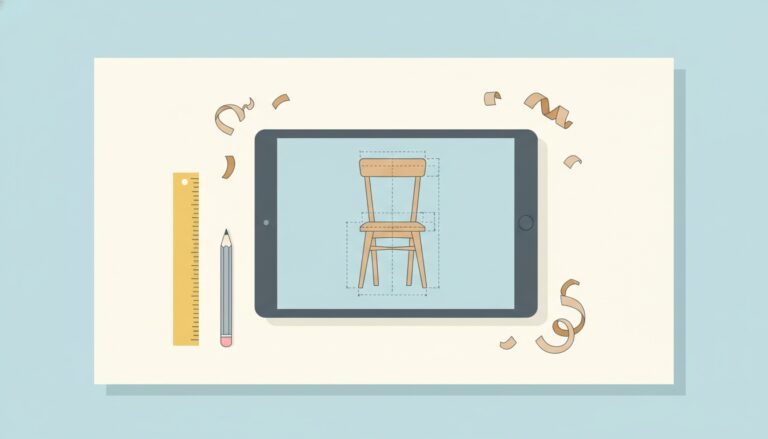
Hello, it’s Daily Hangul!
Are you interested in DIY furniture or woodworking? Maybe you’ve tried watching Korean YouTubers use SketchUp or even visited a local wood workshop (Mokgongbang) in Korea. It’s a fantastic hobby, but technical terms can be a huge barrier.
🛠️ The “Composite Case”: Why is this hard?
(This is a composite example based on common patterns observed among foreign learners in Korean hobby classes.)
Meet “Alex.” Alex wants to build a simple bookshelf. He opens SketchUp and asks his Korean instructor about the “size.” The instructor keeps asking for the “Chissu” (dimension) in “Milli” (millimeters), not the “Keugi” (size) in centimeters. Alex gets confused because the dictionary says both mean size. In technical fields like woodworking, specific vocabulary is key to safety and precision.
Today, we will learn the language of designing and planning furniture, so you can confidently draw your ideas!
📋 Summary: What You’ll Learn Today
- Essential Vocabulary: Chissu (Dimension), Domyeon (Blueprint), Sujeong (Modification).
- Safe Usage: Ideal for woodworking workshops, hardware stores, or discussing DIY plans with friends.
- Level (C1): While the words are specialized, knowing them allows you to participate in “Real Life” hobbies in Korea.
📑 Table of Contents
- Deep Dive: Core Expressions
- Textbook vs. Reality
- Unique Analysis: Asking for Feedback (Politeness Levels)
- Role Play: At the Workshop
- Shadowing Challenge
- FAQ & Quiz
🔍 Today’s Core Expressions Deep Dive
1. 치수 (Chissu)
- Meaning: Dimensions / Measurements
- Usage: Used when talking about the exact length, width, and height in a technical context (woodworking, tailoring, architecture).
- Tutor’s Secret Note: In daily life, we say ‘크기 (Keugi – size)’, but in a workshop, if you say ‘Keugi’, it sounds vague. ‘Chissu’ implies precision. Also, Korean woodworking almost exclusively uses millimeters (mm). If you just say “100”, everyone assumes 100mm.
- Pronunciation Clinic: [Chi-ssu] – The ‘ss’ is a tense sound (sang-siot). Pronounce it sharply and strongly.
Examples:
* 치수를 재다. (Chissu-reul jaeda.)
* To measure the dimensions. (Standard)
* 정확한 치수가 필요해요. (Jeonghwakhan chissuga piryohaeyo.)
* I need exact dimensions. (Workshop/Business)
* 치수가 안 맞아요. (Chissuga an majayo.)
* The measurements don’t fit. (Problem solving)
Alternatives:
* 사이즈 (Saijeu): Casual, loan word. Used for clothes or coffee cups, but less professional for furniture.
* 길이 (Giri): Length. More specific to one dimension.
👉 Mini Quiz (Click to see)
Fill in the blank: “Please check the dimensions.” -> “___ 좀 확인해 주세요.” (Answer: 치수)
2. 도면 (Domyeon)
- Meaning: Blueprint / Plan / Drawing
- Usage: Refers to the technical drawing you make on paper or SketchUp.
- Tutor’s Secret Note: Don’t confuse this with ‘그림 (Geurim – picture/painting)’. If you show your SketchUp file and say “Geurim”, it sounds like you drew art. ‘Domyeon’ sounds like you are ready to build.
- Pronunciation Clinic: [Do-myeon] – ‘myeon’ requires opening your mouth vertically. Connect ‘Do’ and ‘myeon’ smoothly.
Examples:
* 도면을 그리다. (Domyeoneul geurida.)
* To draw a blueprint. (Action)
* 스케치업으로 도면을 만들었어요. (Seukechieobeuro domyeoneul mandeureosseoyo.)
* I made the plan with SketchUp. (Explanation)
* 도면대로 잘라 주세요. (Domyeondaero jalla juseyo.)
* Please cut it according to the plan. (Requesting service)
Alternatives:
* 설계도 (Seolgyedo): Design map/plan. More formal/complex than Domyeon.
3. 간격 (Gangyeok)
- Meaning: Spacing / Interval / Gap
- Usage: Critical when placing shelves or legs in your design.
- Tutor’s Secret Note: A common mistake is using ‘사이 (Sai – between)’. While ‘Sai’ explains the location, ‘Gangyeok’ explains the distance. “Gangyeok is too narrow” is better than “Sai is too narrow.”
Examples:
* 선반 간격이 너무 좁아요. (Seonban gangyeogi neomu jobayo.)
* The shelf spacing is too narrow. (Critique)
* 50mm 간격으로 띄워 주세요. (O-sim-miri gangyeogeuro ttuiwo juseyo.)
* Please space them apart by 50mm. (Instruction)
* 다리 간격을 넓혀야 해요. (Dari gangyeogeul neolpyeoya haeyo.)
* We need to widen the leg spacing. (Modification)
⚖️ Textbook vs. Reality (Context Comparison)
| Context | Textbook Korean (Book Korean) | Reality Korean (Real Korean) |
|---|---|---|
| Making a plan | 설계하다 (Seolgyehada) “To design/architect” – Very formal. |
도면(을) 치다 (Domyeon-eul chida) “To hit the plan” – Industry slang often used by pros using software like CAD/SketchUp. |
| Measuring | 치수를 측정하다 (Chissu-reul cheukjeonghada) “To measure dimensions” |
치수(를) 재다 (Chissu-reul jaeda) “To measure” – Much more common in speech. |
💡 When to use what?
* Job Interview: Use Textbook Korean (Seolgyehada).
* Talking to the Workshop Boss: Use Real Korean (Domyeon chida) to sound like an insider.
🌡️ Unique Analysis: Politeness Thermometer
Situation: You finished your SketchUp drawing and want the instructor/carpenter to check it.
| Level | Distance | Expression (Korean / Romanization) | Nuance |
|---|---|---|---|
| Level 1 | Close Friends | 이거 어때? (Igeo eottae?) | “How’s this?” (Very casual) |
| Level 3 | Friendly Tutor | 도면 좀 봐주세요. (Domyeon jom bwajuseyo.) | “Please look at my plan a bit.” (Standard polite) |
| Level 5 | Strict Master | 도면 검토 부탁드립니다. (Domyeon geomto butakdeurimnida.) | “I request a review of the blueprint.” (Formal & Respectful) |
🚨 Tutor’s Tip: In a casual hobby class, Level 3 is perfect. Level 5 might make the instructor feel awkward or too distant.
🎭 Real Life Role Play: At the Gongbang (Workshop)
Setting: You (A) are at a woodworking class, showing your SketchUp file to the Instructor (B).
A: 선생님, 제가 그린 도면 좀 봐주시겠어요?
(Seonsaengnim, jega geurin domyeon jom bwajusigesseoyo?)
Teacher, could you please take a look at the plan I drew?
B: 네, 어디 봅시다. 음, 여기 선반 간격이 좀 좁은 것 같아요.
(Ne, eodi bopsida. Eum, yeogi seonban gangyeogi jom jobeun geot gatayo.)
Sure, let’s see. Hmm, I think the shelf spacing here is a bit narrow.
A: 아, 그럼 치수를 얼마나 수정하면 좋을까요?
(A, geureom chissureul eolmana sujeonghamyeon joeulkkayo?)
Ah, then how much should I modify the dimensions?
B: 높이를 300mm(삼백 미리)로 늘리는 게 좋겠어요.
(Nopireul sambaeng-miriro neullineun ge jokesseoyo.)
It would be good to increase the height to 300mm.
💡 Cultural Tip: In Korean workshops, numbers are read in Sino-Korean (Il, I, Sam…) and units are almost always English (Milli, Centi), but pronounced with a Korean accent.
🗣️ Shadowing Challenge
Mission: Imagine you are explaining your design concept. Listen and repeat 3 times!
Script:
“저는 심플한 책상을 만들고 싶어요. 다리 간격을 넓게 해서 편하게 앉을 수 있게요.”
(Jeoneun simpeulhan chaeksangeul mandeulgo sipeoyo. Dari gangyeogeul neolpge haeseo pyeonhage anjeul su itgeyo.)
- [ ] Attempt 1 (Slowly check pronunciation)
- [ ] Attempt 2 (Focus on intonation)
- [ ] Attempt 3 (Natural speed)
🔑 Pronunciation Key: ‘넓게’ is written as [Neolp-ge] but pronounced [Neol-kke]. The ㅂ gets silent, and ㄱ becomes tense!
❓ FAQ (Frequently Asked Questions)
Q1: Can I just say “Size” (사이즈) instead of “Chissu”?
A: You can, and people will understand, but 치수 (Chissu) is the “correct” word when you are holding a ruler or looking at a blueprint. Using Chissu makes you look serious about the craft.
Q2: How do I say “SketchUp” in Korean?
A: It’s 스케치업 (Seukechieop). Koreans use the software name directly.
* Ex: “스케치업 할 줄 아세요?” (Do you know how to use SketchUp?)
📝 Conclusion & Action Item
Today we built the foundation for your DIY furniture vocabulary! Precision in language leads to precision in woodworking.
🔥 Today’s Mission:
Find a piece of furniture in your room. Measure its width (Garro), length (Sero), and height (Nopi) and say the sentence: “이 가구의 치수는 [Number]mm 입니다.”
Tell me in the comments: What furniture do you want to build? (bed? chair? table?)
🧩 Final Quiz
- Which word is best for “Blueprint/Plan”?
a) 그림 (Geurim)
b) 도면 (Domyeon)
c) 사진 (Sajin) -
In a Korean workshop, what unit is standard?
a) Inch
b) Centimeter
c) Millimeter -
[Blank] Check: “Make the gap wider.” -> “___을 넓혀 주세요.”
⬇️ Click for Answers
1. b) 도면
2. c) Millimeter
3. 간격 (Gangyeok)
Frequently Asked Questions (FAQ)
Q: What does "치수 (Chissu)" mean in Korean and how do you pronounce it?
A: In Korean, "치수 (Chissu)" is pronounced [Clinic: [Chi-ssu] and means: Dimensions / Measurements
Q: What does "도면 (Domyeon)" mean in Korean and how do you pronounce it?
A: In Korean, "도면 (Domyeon)" is pronounced [Clinic: [Do-myeon] and means: Blueprint / Plan / Drawing
Q: What does "간격 (Gangyeok)" mean in Korean and how do you pronounce it?
A: In Korean, "간격 (Gangyeok)" is pronounced [see lesson guide] and means: Spacing / Interval / Gap







