

Introduction
Hello, this is Daily Hangul!
Have you ever watched a K-Drama and felt like something was missing in the subtitles? Perhaps two characters were arguing, and suddenly the atmosphere shifted, but the English subtitles just said, “You are rude.” Or maybe a boss looked at an employee without saying a word, and the employee immediately apologized.
Composite Case (Synthetic Case):
Many of our learners often ask, “Why did the characters suddenly become awkward even though they were laughing a minute ago?” or “Why is ‘Let’s have a drink’ translated as ‘I want to talk to you’?”
These questions arise because subtitles translate the words, but often miss the social context (nunchi, hierarchy, and bonding). Textbooks teach you grammar, but dramas show you society. Today, we will decode the hidden social cues in K-Dramas that will take your listening skills from B1 to B2!
At a Glance
- Today’s Expressions: Nunchi, Mareul nota, Hanjanhada
- Safe Zone: These are colloquial expressions mostly used between friends, colleagues, or when describing social situations.
- Level (B2): At this level, understanding why Koreans say something is just as important as what they say.
Table of Contents
- Deep Dive: 3 Key Drama Expressions
- Textbook vs. Real Life: The Art of Suggestion
- Analysis: The Speech Level Thermometer
- Role Play: After-Work “Hoesik” (Company Dinner)
- Shadowing Challenge
- FAQ & Quiz
Deep Dive: K-Drama Expressions
1. 눈치(를) 보다 (Nunchi(reul) boda)
- Meaning: To read the room / To walk on eggshells / To be self-conscious
- Usage & Register: Used commonly in casual to formal settings to describe someone’s behavior.
- Tutor’s Secret Note:
- In dramas, the ‘weak’ character (new employee, daughter-in-law) always does this. It’s not just ‘looking’; it’s scanning the atmosphere to avoid conflict.
- Warning: Don’t tell your boss, “눈치 보지 마세요” (Don’t read the room). It sounds like you are scolding them!
- Pronunciation Clinic:
- 눈치 [Nun-chi]: Pronounce ‘chi’ sharply.
- 보다 [Bo-da]: Soft ‘B’ sound, almost like a ‘P’ but without a puff of air.
- Examples:
- (Office) 부장님 눈치 보느라 퇴근을 못 했어요.
- Bujangnim nunchi boneura toegeuneul mot haesseoyo.
- (I couldn’t leave work because I was walking on eggshells around the manager.)
- (Dating) 내 눈치 보지 말고 먹고 싶은 거 말해.
- Nae nunchi boji malgo meokgo sipeun geo malhae.
- (Don’t be self-conscious around me; tell me what you want to eat.)
- (Friends) 너 왜 자꾸 걔 눈치를 봐?
- Neo wae jakku gyae nunchireul bwa?
- (Why do you keep caring about what he thinks?)
- (Office) 부장님 눈치 보느라 퇴근을 못 했어요.
- Alternatives:
- 눈치가 빠르다 (Nunchiga ppareuda): To be quick-witted / socially sharp.
- 분위기를 살피다 (Bunwigireul salpida): To check the atmosphere (more formal).
Mini Quiz (Click to see answer)
Fill in the blank: “Stop walking on eggshells!” -> “_______ 보지 마!”
Answer: 눈치 (Nunchi)
2. 말을 놓다 (Mareul nota)
- Meaning: To lower speech formality (literally: to put down the language) / To start speaking casually
- Usage & Register: Used when transitioning from strangers/seniors to friends/equals.
- Tutor’s Secret Note:
- This is the turning point in every K-Drama romance. When the lead says “우리 말 놓을까?” (Shall we speak casually?), the relationship status upgrades instantly.
- Pronunciation Clinic:
- 놓다 [No-ta]: The ‘ㅎ’ (h) in the batchim meets ‘ㄷ’ (d) to make a ‘T’ sound due to aspiration.
- Examples:
- (First Date) 저희 이제 말 놓을까요?
- Jeohui ije mal noeulkkayo?
- (Shall we drop the honorifics now?)
- (Argument) 왜 갑자기 말을 놓고 그래요?
- Wae gapjagi mareul noko geuraeyo?
- (Why are you suddenly speaking casually to me? Implying rudeness)
- (Friends) 편하게 말 놓으세요.
- Pyeonhage mal noeuseyo.
- (Please feel free to speak casually.)
- (First Date) 저희 이제 말 놓을까요?
- Alternatives:
- 말 편하게 하다 (Mal pyeonhage hada): To speak comfortably.
- 야자타임 (Yaja-time): A game where juniors speak casually to seniors for a few minutes.
3. 한잔하다 (Hanjanhada)
- Meaning: To have a drink (alcohol) / To hang out
- Usage & Register: Very common. Hanjan implies alcohol 90% of the time in dramas.
- Tutor’s Secret Note:
- When a character says, “Hanjan-halkkayo?” (Shall we have a drink?), they usually mean, “I want to bond with you,” “I have a secret,” or “I am sad.”
- Pronunciation Clinic:
- 한잔 [Han-jan]: Pronounce clearly. Linking happens naturally.
- Examples:
- (After work) 오늘 끝나고 한잔할까?
- Oneul kkeunnago hanjanhalkka?
- (Shall we have a drink after work today?)
- (Consoling) 속상한데 술 한잔하자.
- Soksanghande sul hanjanhaja.
- (I’m upset, let’s have a drink.)
- (Polite refusal) 저는 술을 잘 못해요.
- Jeoneun sureul jal mothaeyo.
- (I’m not very good at drinking alcohol.)
- (After work) 오늘 끝나고 한잔할까?
Textbook vs. Real Korean
Scenario: Suggesting to hang out/drink
| Type | Expression | Context |
|---|---|---|
| Book Korean | 술을 마시러 갑시다. (Sureul masireo gapsida) | Grammatically perfect, but sounds like a robot or a 1980s textbook. |
| Book Korean | 맥주 한 잔 드시겠습니까? (Maekju han jan deusigessseumnikka?) | Too formal unless you are serving a VIP guest. |
| Real Korean | 한잔 콜? (Hanjan Call?) | Very casual slang. Used among close friends. |
| Real Korean | 오늘 적셔! (Oneul Jeoksyeo!) | Slang meaning “Let’s get wet (with alcohol)!” Used in high-energy scenes. |
Unique Analysis: The Speech Level Thermometer
In K-Dramas, distance is measured by verb endings, not meters.
| Level | Ending | Example | Relationship Distance |
|---|---|---|---|
| The Wall | -Supnida / -Simnida | 반갑습니다 (Bangapseumnida) | Business, Military, Complete Stranger. High walls. |
| The Zone | -Yo | 반가워요 (Bangawoyo) | Colleagues, Polite acquaintances. Safe zone. |
| The Shift | Mixed | 반가워요… 근데 너… | Drama moment! One person is trying to break the wall. Tension rises. |
| The Bond | -Ya / -A / -Eo | 반갑다 (Bangapda) | Childhood friends, Lovers, or Angry enemies. Zero distance. |
Role Play: The “Pocha” (Street Bar) Scene
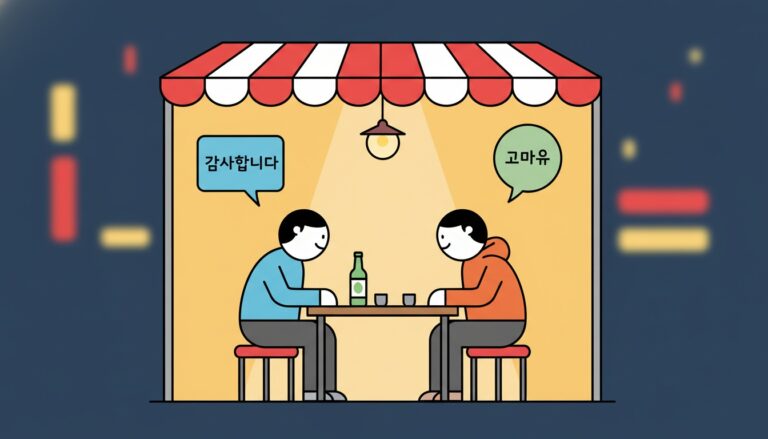
Setting: Late night at a street food tent (Pojangmacha). A Junior (Hoobae) and Senior (Sunbae) are drinking Soju.
Characters:
* Min-ji (Junior): Stressed employee.
* Dong-wook (Senior): Kind team leader.
Dialogue:
(1) Min-ji: (Sighs) 선배님, 저 오늘 진짜 힘들었어요.
(Seonbaenim, jeo oneul jinjja himdeureosseoyo.)
Senior, I really had a hard time today.
(2) Dong-wook: 알아. 김 부장님 눈치 보느라 고생했다.
(Ara. Kim bujangnim nunchi boneura gosaenghaetda.)
I know. You suffered walking on eggshells around Manager Kim.
(3) Min-ji: 진짜… 억울해요. 한잔 주세요.
(Jinjja… eogulhaeyo. Hanjan juseyo.)
Really… It’s so unfair. Please pour me a drink.
(4) Dong-wook: 그래, 마시고 털어버려. 오늘 내가 쏜다!
(Geurae, masigo teoreobeoryeo. Oneul naega ssonda!)
Yeah, drink and shake it off. Is is my treat today!
💡 Culture Tip:
Notice how Min-ji uses polite language (-yo), while Dong-wook uses casual language (-da/eo). This is typical office hierarchy. “내가 쏜다” (I’m shooting/treating) is a classic phrase when the senior pays.
Shadowing Challenge
Let’s practice a dramatic line common in romance dramas when a character decides to be brave.
Script:
이제 그만 눈치 보고 싶어. 우리 그냥 편하게 지내자.
(Ije geuman nunchi bogo sipeo. Uri geunyang pyeonhage jinaeja.)
I don’t want to walk on eggshells anymore. Let’s just be comfortable with each other.
Checklist:
* [ ] Listen to the rhythm (Pause after ‘sipeo’).
* [ ] Pronounce ‘Geuman’ smoothly (don’t stress ‘Geu’ too much).
* [ ] Repeat 3 times with emotion!
FAQ
Q1: Can I use “Oppa” or “Unnie” like in dramas?
A: Be careful! In dramas, it sounds romantic or friendly. In reality, at a workplace, call them by their title (Manager, etc.). Only use Oppa/Unnie with close friends or if they told you it’s okay.
* Example: 김 대리님 (Manager Kim – Safe) vs 지훈 오빠 (Jihun Oppa – Only if very close).
Q2: Does “Ramyun meokgo gallae?” really mean “Netflix and Chill”?
A: Yes, it has become a famous innuendo for “Do you want to sleep over?” thanks to the movie One Fine Spring Day. Don’t say this to a friend unless you actually just want to eat noodles!
Wrap Up
Summary:
K-Dramas are full of hidden social rules. Understanding Nunchi (reading the room), knowing when to Mal-eul nota (drop honorifics), and the bonding meaning of Hanjanhada (drinking) will make you understand the characters’ emotions much better.
Today’s Mission:
Watch one episode of a K-Drama today. Every time you hear a shift in speech level (polite to casual) or see someone “reading the room,” pause and shout “Nunchi!”
Have you ever been confused by a scene in a K-Drama? Tell me in the comments! 👇
Final Quiz
Click to start the quiz!
1. Which expression describes someone “reading the room” or being cautious of others’ moods?
A) Hanjanhada
B) Nunchi boda
C) Mareul nota
2. When a senior says “내가 쏜다” (Naega ssonda), what does it mean?
A) I am angry.
B) I am leaving.
C) I am paying (treating).
3. Fill in the blank:
“We are friends now. Let’s drop the honorifics!”
-> 우리 이제 _____ 놓자!
Answers: 1. (B), 2. (C), 3. 말 (Mal)
Frequently Asked Questions (FAQ)
Q: What does "눈치(를) 보다 (Nunchi(reul) boda)" mean in Korean and how do you pronounce it?
A: In Korean, "눈치(를) 보다 (Nunchi(reul) boda)" is pronounced [see lesson guide] and means: To read the room / To walk on eggshells / To be self-conscious
Q: What does "말을 놓다 (Mareul nota)" mean in Korean and how do you pronounce it?
A: In Korean, "말을 놓다 (Mareul nota)" is pronounced [see lesson guide] and means: To lower speech formality (literally: to put down the language) / To start speaking casually
Q: What does "한잔하다 (Hanjanhada)" mean in Korean and how do you pronounce it?
A: In Korean, "한잔하다 (Hanjanhada)" is pronounced [see lesson guide] and means: To have a drink (alcohol) / To hang out







