

Introduction
Hello, this is Daily Hangul!
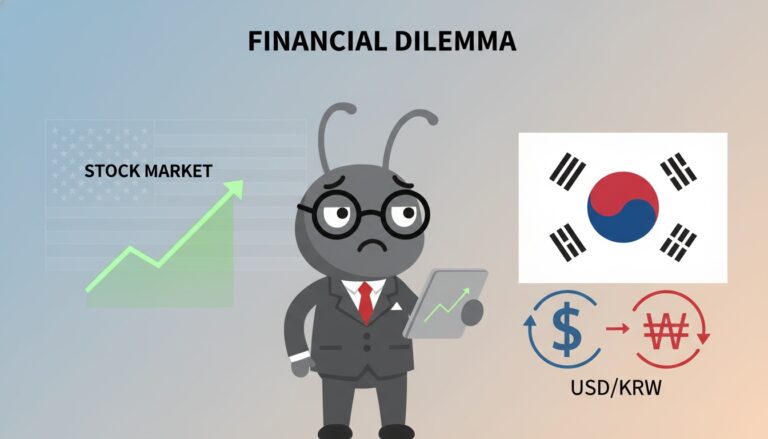
Have you ever heard the term “Seohak Ant” on the Korean news? If you are investing in stocks while living in Korea, or if you follow the Korean economy, this is a must-know concept.
Synthetic Case: Many advanced learners tell me, “I watched the Korean news, and they keep talking about ants (Gaemi) moving to America. Is this about biology?”
No! It is about money. Today, we are diving into the world of Seohak Ants (Western Ants)—Korean retail investors who invest in US stocks. This isn’t just vocabulary; it’s about understanding the deep anxiety Korean investors feel regarding currency risks and taxes.
Textbooks teach you “investment” (tuja), but they don’t teach you the panic of the exchange rate wiping out your profits. Let’s learn the real financial Korean spoken in Yeouido (Korea’s Wall Street).
At a Glance
- Today’s Expressions: Seohak Gaemi, Hwanchason, Yangdo Sodeukse
- Safe Zone: Business casual, financial news discussions, chatting with investor friends.
- Level: C2 (Advanced) – Essential for understanding economic news and tax laws in Korea.
Table of Contents
- Core Expressions Deep Dive
- Textbook vs. Real Korean
- Unique Analysis: The ‘Ant’ Universe
- Role Play: The Panic in May
- Shadowing Challenge
- FAQ
- Conclusion & Quiz
Core Expressions Deep Dive
1. 서학개미 (Seohak Gaemi)
- Meaning: “Western Ant” (Korean retail investors who invest in Western/US stock markets)
- Usage: Used in news, blogs, and casual conversation. Not derogatory; it’s a standard economic term now.
- Tutor’s Secret Note: The “Ant” (Gaemi) symbolizes the hardworking individual investor fighting against giant institutional investors. “Seohak” comes from “Seohak” (Western Learning) in history, but here it simply means “West/USA.”
- Pronunciation Clinic: Pronounce [Seo-hak-kkae-mi]. The ‘g’ in Gaemi often sounds slightly tensed like ‘kk’ due to the preceding ‘k’ sound.
- Examples:
- News: 서학개미들이 테슬라를 대거 매수했습니다.
- Seohak gaemideuri Teseullareul daegeo maesuhaetseumnida.
- (Western ants bought Tesla in bulk.)
- Friend: 나 완전 서학개미잖아. 밤마다 미장 봐.
- Na wanjeon seohak gaemijana. Bammada mijang bwa.
- (I’m a total Western Ant. I watch the US market every night.)
- Analysis: 서학개미의 힘이 환율에 영향을 미치고 있어요.
- Seohak gaemiui himi hwanyure yeonghyangeul michigo isseoyo.
- (The power of Western Ants is influencing the exchange rate.)
- News: 서학개미들이 테슬라를 대거 매수했습니다.
- Mini Quiz: (Click to see)
-
Domestic investors are called _____ Ants?
Donghak (동학)
-
2. 환차손 (Hwanchason)
- Meaning: Foreign exchange loss (Losses incurred due to exchange rate fluctuations)
- Usage: Financial reporting or complaining about losing money despite stock gains.
- Tutor’s Secret Note: This is the nightmare of every Seohak Ant. If the stock goes up 10%, but the Dollar/Won exchange rate drops 15%, you actually lose money. This situation is called 환차손.
- Pronunciation: [Hwan-cha-son]. Clear ‘n’ sound.
- Examples:
- Complaint: 주식은 올랐는데 환차손 때문에 마이너스야.
- Jusigeun ollanneunde hwanchason ttaemune maineu-seuya.
- (The stock went up, but I’m in the red because of exchange losses.)
- Strategy: 환차손을 방어하기 위해 환헤지를 했어요.
- Hwanchasoneul bang-eohagi wihae hwanhejireul haesseoyo.
- (I hedged the currency to defend against exchange losses.)
- News: 엔화 약세로 인한 환차손이 우려됩니다.
- Enhwa yaksero inhan hwanchasoni uryeodoemnida.
- (We are worried about exchange losses due to the weak Yen.)
- Complaint: 주식은 올랐는데 환차손 때문에 마이너스야.
- Antonym: 환차익 (Hwanchaik – Exchange gain)
3. 양도소득세 (Yangdo Sodeukse)
- Meaning: Capital Gains Tax
- Usage: Very formal term, but used commonly around May (tax season).
- Tutor’s Secret Note: In Korea, if you earn more than 2.5 million KRW (approx $2,000) profit from overseas stocks, you must pay 22% tax. This is often shortened to 양도세 (Yangdose).
- Pronunciation: [Yang-do-so-deuk-sse]. The final ‘se’ is pronounced strongly as ‘sse’.
- Examples:
- Worry: 5월은 해외주식 양도소득세 신고의 달이에요.
- Oworeun haoejusik yangdosodeukse singoui darieyo.
- (May is the month for reporting overseas stock capital gains tax.)
- Advice: 수익이 250만 원 넘으면 양도세 내야 해.
- Suigi ibaek-osipman won neomeumyeon yangdose naeya hae.
- (If your profit exceeds 2.5 million won, you have to pay capital gains tax.)
- Question: 양도소득세 절세 방법 있나요?
- Yangdosodeukse jeolse bangbeop innayo?
- (Is there a way to save on capital gains tax?)
- Worry: 5월은 해외주식 양도소득세 신고의 달이에요.
Textbook vs. Real Korean
| Context | Textbook (Book Korean) | Real Korean (Street/Internet) |
|---|---|---|
| Investor | 해외 주식 투자자 (Haeoe jusik tujaja) | 서학개미 (Seohak gaemi) |
| Loss | 환율 변동 손실 (Hwanyul byeondong sonsil) | 환차손 (Hwanchason) / 환율 크리 (Hwanyul-critical hit) |
| Market | 미국 증권 시장 (Miguk jeung-gwon sijang) | 미장 (Mijang) – Short for ‘Miguk Jang’ |
| Tax | 세금을 납부하다 (Segeumeul napbuhada) | 세금 토해내다 (Segeum tohaenaeda) – Literally “vomit out tax” (paying reluctantly) |
Tutor’s Tip: Using “Mijang” (US Market) instead of “Miguk Jeung-gwon Sijang” instantly makes you sound like a pro investor.
Unique Analysis: The ‘Ant’ Universe
In Korean financial slang, everyone is an “Ant” (Gaemi). Where do you belong?
| Type | Name (Korean/Romanization) | Target Market | Origin of Name |
|---|---|---|---|
| Domestic | 동학개미 (Donghak Gaemi) | Korean Stock Market (KOSPI/KOSDAQ) | Named after the Donghak Peasant Revolution (1894), symbolizing saving the domestic economy. |
| US/West | 서학개미 (Seohak Gaemi) | US Stock Market (NASDAQ/NYSE) | “Western Learning.” Investors moving capital to the West. |
| China | 중학개미 (Junghak Gaemi) | Chinese/Hong Kong Market | “Middle Learning” (China). |
Cultural Note: Using these terms shows you understand the history and trend of Korean retail investing.
Role Play: The Panic in May
Situation: Two friends, Min-su and Jason, are at a cafe in Gangnam. It is May, the tax season.
Jason: 민수야, 표정이 왜 그래? 무슨 일 있어?
(Minsu-ya, pyojeongi wae geurae? Museun il isseo?)
(Minsu, why the long face? Is something wrong?)
Min-su: 어제 양도소득세 고지서가 날아왔어. 작년에 번 돈 다 세금으로 나가게 생겼어.
(Eoje yangdosodeukse gojiseoga narawasseo. Jangnyeone beon don da segeumeuro nagage saenggyeosseo.)
(Yesterday, the capital gains tax bill flew in. Looks like all the money I made last year is going to taxes.)
Jason: 아 맞다, 너 서학개미지? 작년에 테슬라로 많이 벌었잖아.
(A matda, neo Seohak gaemiji? Jangnyeone Teseullaro mani beoreotjana.)
(Ah right, you’re a Western Ant, right? You made a lot on Tesla last year.)
Min-su: 벌긴 뭘 벌어. 지금 환율 떨어져서 환차손까지 계산하면 남는 게 없어.
(Beolgin mwol beoreo. Jigeum hwanyul tteoreojyeoseo hwanchasonkkaji gyesanhamyeon namneun ge eopseo.)
(Made money? Barely. The exchange rate dropped, so if you calculate the exchange loss, there’s nothing left.)
Jason: 아이고… 미장도 쉽지 않구나. 커피는 내가 살게.
(Aigo… Mijangdo swipji ankuna. Keopineun naega salge.)
(Oh my… The US market isn’t easy either. I’ll buy the coffee.)
Culture Tip: In Korea, when a friend loses money on stocks or pays heavy taxes, buying them a meal or coffee is a sign of sympathy.
Shadowing Challenge
Listen and repeat 3 times. This sentence helps you complain about exchange rates naturally.
“주식으로 10% 벌었는데, 환율 때문에 본전이야.”
(Jusigeuro sip-peosenteu beoreonneunde, hwanyul ttaemune bonjeoniya.)
“I made 10% on stocks, but because of the exchange rate, I just broke even.”
- Checklist:
- [ ] Did you pronounce ‘십퍼센트’ as [Sip-peo-sen-teu]?
- [ ] Did you emphasize ‘환율’ (Exchange rate)?
- [ ] Did you sigh deeply at the end? (Emotion is key!)
FAQ (Frequently Asked Questions)
Q1: Can I use “Seohak Ant” in a business meeting?
A: It depends. In a casual internal meeting or a marketing brainstorming session, yes. In a formal presentation to a board of directors, use 해외 주식 개인 투자자 (Individual Overseas Stock Investors) instead.
Q2: What is the exact tax deadline?
A: For Yangdo Sodeukse (Capital Gains Tax), you must report and pay by May 31st of the following year. Don’t miss it!
Q3: Does ‘Hwanchason’ apply to travel money too?
A: Yes! If you exchanged money for a trip but the rate changed unfavorably before you spent it, you can jokingly say, “여행 가기도 전에 환차손 입었어” (I suffered an exchange loss before even traveling).
Conclusion & Action Item
Today we explored the life of a Seohak Ant—dealing with exchange losses (Hwanchason) and dreading the capital gains tax (Yangdo Sodeukse).
Today’s Mission:
Next time you see news about the exchange rate (USD/KRW), try saying: “와, 환율 때문에 서학개미들 힘들겠다.” (Wow, Western Ants must be struggling because of the exchange rate.)
Tell me in the comments:
Are you a Seohak Ant, or do you prefer the safety of a savings account? 🐜🏦
Final Quiz
- What do you call a Korean investor who invests in US stocks?
A) Donghak Ant
B) Seohak Ant
C) Gangnam Ant -
What is the Korean term for “Capital Gains Tax”?
A) Bugagachise
B) Sodeukse
C) Yangdo Sodeukse -
Fill in the blank: Losing money due to exchange rate changes is called _____.
(Answer: 환차손 / Hwanchason)
Click to see answers
1. B, 2. C, 3. 환차손
Frequently Asked Questions (FAQ)
Q: What does "서학개미 (Seohak Gaemi)" mean in Korean and how do you pronounce it?
A: In Korean, "서학개미 (Seohak Gaemi)" is pronounced [Clinic: Pronounce [Seo-hak-kkae-mi] and means: "Western Ant" (Korean retail investors who invest in Western/US stock markets)
Q: What does "환차손 (Hwanchason)" mean in Korean and how do you pronounce it?
A: In Korean, "환차손 (Hwanchason)" is pronounced [Hwan-cha-son] and means: Foreign exchange loss (Losses incurred due to exchange rate fluctuations)
Q: What does "양도소득세 (Yangdo Sodeukse)" mean in Korean and how do you pronounce it?
A: In Korean, "양도소득세 (Yangdo Sodeukse)" is pronounced [Yang-do-so-deuk-sse] and means: Capital Gains Tax







