

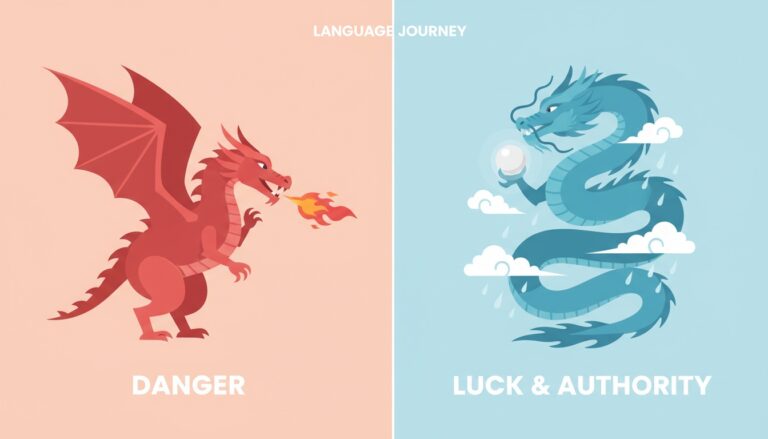
Why Korean Dragons Don’t Breathe Fire? 🐉 Debating Myths like a Pro
Hello, it’s Daily Hangul! 😊
Have you ever watched a Korean historical drama (Sageuk) and noticed the King wearing a red robe with a giant gold dragon embroidered on the chest? Or maybe you’ve seen the movie D-War?
I recently had a debate class with my advanced students, and one of them, Mark from the UK, was so confused. He said, “Teacher, why is the dragon the ‘good guy’? In my country, we have to slay the dragon to save the princess!”
That was a classic “Aha!” moment. 😲
If you want to have deep conversations in Korean—beyond just ordering bibimbap—you need to understand Cultural Symbolism. Today, we are going to learn how to discuss the fascinating differences between Eastern and Western dragons. Trust me, mastering these expressions will make you sound like a true intellectual in your next coffee chat!
Let’s dive into the mythical world! 🌊🔥
1. Today’s Core Expressions (Deep Dive)
To discuss mythology, you can’t just use basic words. Here are three “smart” words to upgrade your vocabulary.
1. 상징 (Sang-jing)
- Meaning: Symbol / Symbolism
- [Tutor’s Secret Note 🤫]: This is the key word for any intellectual debate. You don’t just say “It means power.” You say “It is a Sang-jing of power.” It instantly makes your Korean sound more sophisticated and academic.
- [Pronunciation Clinic 🗣️]: Make sure the ‘Jing’ is clear. It’s not ‘Zing’. pronounce it like the ‘J’ in ‘Jam’.
2. 길조 (Gil-jo)
- Meaning: Auspicious sign / Lucky omen
- [Tutor’s Secret Note 🤫]: In Korea, a dragon is a Gil-jo. Seeing one in a dream is the best luck possible (people usually buy lottery tickets the next day!). Use this word when you want to describe something that brings good fortune, not just “Good luck.”
- [Pronunciation Clinic 🗣️]: The ‘L’ in Gil flows into the ‘J’. It sounds a bit like Gil-jjo because of the tension.
3. 권위 (Gwon-wi)
- Meaning: Authority / Prestige
- [Tutor’s Secret Note 🤫]: Dragons represent the King’s Gwon-wi. If you are talking about business or politics, this word comes up a lot too. It carries a heavy, serious nuance.
2. Textbook vs. Real Korean (Context Comparison)
Don’t sound like a dictionary! Here is how to sound natural.
📘 Book Korean
“동양의 용과 서양의 용은 다릅니다.”
(Dongyang-ui yong-gwa seoyang-ui yong-eun dareumnida.)
“Eastern dragons and Western dragons are different.”
Verdict: Grammatically perfect, but a bit dry and robotic.
🎬 Real Korean (Debate Style)
“동양에서 용은 신성한 존재죠.”
(Dongyang-eseo yong-eun sinseong-han jonjae-jyo.)
“In the East, dragons are sacred beings, you know.”
Why it works: Using “-jyo” (you know/right?) invites agreement and makes the conversation flow naturally. Also, “Sinseong-han” (Sacred) hits the exact cultural nuance better than just saying “good.”
3. Real-Life Scenario: The Cafe Debate ☕
Situation: You are at a cafe in Hongdae discussing a fantasy movie with your Korean friend, Min-ji.
Alex: 서양에서는 용이 괴물이에요. 불을 뿜잖아요.
(Seoyang-eseoneun yong-i goemul-ieyo. Bul-eul ppum-janayo.)
In the West, dragons are monsters. They breathe fire, you know.
Min-ji: 정말요? 한국에서 용은 ‘길조’를 상징해요.
(Jeongmal-yo? Hanguk-eseo yong-eun ‘Gil-jo’-reul sang-jing-haeyo.)
Really? In Korea, dragons symbolize an ‘auspicious sign’.
Alex: 아, 그래서 왕의 옷에 용이 있군요?
(Ah, geuraeseo wang-ui ot-e yong-i it-gunyo?)
Ah, so that’s why there are dragons on the King’s clothes?
Min-ji: 맞아요! 왕의 ‘권위’를 나타내거든요. 그리고 물을 다스려요.
(Majayo! Wang-ui ‘Gwon-wi’-reul natanae-geodeunyo. Geurigo mul-eul daseuryeoyo.)
Exactly! It represents the King’s ‘authority’. And they control water (not fire).
[Daily Hangul’s Culture Tip 💡]
Did you notice Min-ji said dragons control water? In an agricultural society like old Korea, rain meant life. That’s why the Dragon (Water/Rain) was a good god. Western dragons often breathe fire (Destruction), which is why they were villains!
4. FAQ – Questions My Students Always Ask
Q1: Can I call my boss a “Dragon”?
A: Be careful! While “Dragon” is a good symbol, calling a person a “Dragon” might sound like you are calling them scary or fierce (like a “Dragon Lady” in English). However, if someone comes from a poor background and becomes successful, we say “Gae-cheon-e-seo yong natda” (A dragon rose from a small stream). That is a huge compliment!
Q2: Is the Dragon in the Zodiac the same?
A: Yes! The Year of the Dragon (Yong-tti) is considered very powerful. People born in this year are said to be energetic and charismatic. If you are a Dragon zodiac, brag about it!
5. Wrap-up & Today’s Mission
To summarize: Western Dragons = Fire & Monsters 👿, Korean Dragons = Water & Kings 👑.
🚀 Today’s Mission:
Next time you watch a K-Drama (especially a historical one), look for the Dragon symbol on the King’s chest or on the roof of a palace. When you see it, shout “Sang-jing!” (Symbol) to yourself!
⬇️ Pop Quiz (Scroll down for answers)
1. What is the Korean word for “Symbol”?
2. True or False: Korean dragons usually breathe fire.
Answers:
1. 상징 (Sang-jing)
2. False! They control water and rain.
See you in the next lesson! Annyeong! 👋
Frequently Asked Questions (FAQ)
Q: What does "길조 (Gil-jo)" mean in Korean and how do you pronounce it?
A: In Korean, "길조 (Gil-jo)" is pronounced [Clinic 🗣️] and means: Auspicious sign / Lucky omen
Q: What does "권위 (Gwon-wi)" mean in Korean and how do you pronounce it?
A: In Korean, "권위 (Gwon-wi)" is pronounced [see lesson guide] and means: Authority / Prestige







