

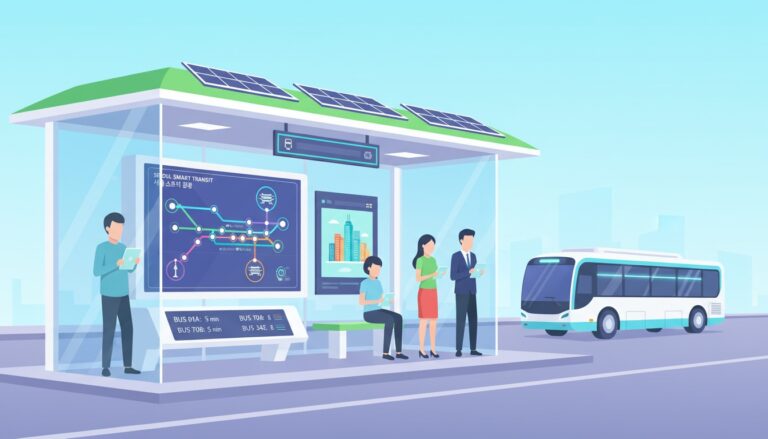
Stuck in Traffic? 🚗 Discussing Seoul’s Smart Transit Revolution Like a Pro!
Hello, everyone! This is Daily Hangul, your friendly neighborhood Korean tutor! 😊
Have you ever watched the K-Drama My Liberation Notes (나의 해방일지)? There’s that painful scene where the main characters have to travel hours from Gyeonggi-do to Seoul, exhausted by the commute. Watching that, did you feel their pain?
Today, we are stepping up our game. We aren’t just ordering bibimbap anymore; we are diving into the world of Urban Planning and Traffic Innovation! 🏙️
Recently, one of my advanced students tried to discuss “traffic jams” in a presentation but only used the word “many cars.” While true, it doesn’t quite capture the economic impact or the innovation Seoul is famous for. If you want to sound intelligent when discussing social issues or simply want to complain about traffic with sophistication, this lesson is for you!
1. Today’s Core Expressions (Deep Dive) 🧐
Let’s look at three powerful expressions to talk about traffic and city planning.
1. 교통 혼잡 비용 (Gyotong honjap biyong)
Meaning: Traffic Congestion Cost
- [Tutor’s Secret Note 🤫]
This is a very intellectual term. You won’t use this when chatting with a taxi driver, but you will use this in a business meeting, a university debate, or when writing an essay. It refers to the money lost due to time wasted in traffic. Using this makes you sound like an expert instantly! - [Pronunciation Clinic 🗣️]
Pay attention to [혼잡]. The ‘ㄴ’ and ‘ㅈ’ don’t blend much, but emphasize the [비용] (cost) clearly. It sounds like [Gyo-tong Hon-jap Bi-yong].
2. 대중교통 혁신 (Daejung gyotong hyeoksin)
Meaning: Public Transportation Innovation
- [Tutor’s Secret Note 🤫]
Koreans are very proud of their transit system (especially the transfer system!). When you use the word 혁신 (Innovation) instead of just “change” (변화), you acknowledge the advanced technology involved. It adds a positive, forward-thinking vibe to your sentence. - [Pronunciation Clinic 🗣️]
혁신 [Hyeok-sin]: Make sure the ‘k’ sound in ‘Hyeok’ is sharp and short.
3. 환승 할인 제도 (Hwanseung halin jedo)
Meaning: Transfer Discount System
- [Tutor’s Secret Note 🤫]
This is the “magic” of Seoul transit. It’s the system where you don’t pay double when switching from a bus to a subway. Mentioning this specifically shows you understand how Korea reduces traffic costs practically.
2. Textbook Korean vs. Real Korean 🇰🇷
Let’s compare how a textbook teaches you vs. how we actually talk in serious discussions or news.
📘 Book Korean (The “Safe” Way)
“차가 너무 많아서 돈이 많이 듭니다.”
(Cha-ga neomu mana-seo don-i mani deumnida.)
Meaning: There are too many cars, so it costs a lot of money.
Verdict: Grammatically correct, but sounds like a child explaining economics.
🔥 Real Korean (The “Pro” Way)
“교통 체증으로 인한 사회적 비용이 증가하고 있습니다.”
(Gyotong chejeung-euro inhan sahoe-jeok biyong-i jeung-ga-hago iss-seumnida.)
Meaning: The social costs caused by traffic congestion are increasing.
Verdict: This is how you impress a Korean professor or business partner. It shows you understand cause and effect!
3. Real-Life Scenario: The Urban Planning Meeting 🏢
Setting: A casual discussion among colleagues about solving the city’s traffic problems.
Min-ji: 요즘 출퇴근 시간에 길이 너무 막히지 않아요?
(Yojeum chultoegeun sigan-e gir-i neomu makiji anayo?)
(Isn’t the road too blocked during rush hour these days?)
You: 맞아요. 그래서 대중교통 혁신이 필요해요.
(Majayo. Geuraeseo daejung gyotong hyeoksin-i piryohaeyo.)
(That’s right. That’s why public transport innovation is necessary.)
Min-ji: 어떤 방식이 좋을까요?
(Eotteon bangsig-i joeulkkayo?)
(What method would be good?)
You: 버스 전용 차로를 늘려서 교통 혼잡 비용을 줄여야 해요.
(Beoseu jeonyong charo-reul neullyeoseo gyotong honjap biyong-eul juryeoya haeyo.)
(We need to expand exclusive bus lanes to reduce traffic congestion costs.)
[Daily Hangul’s Culture Tip 💡]
Did you notice “Bus Exclusive Lanes” (버스 전용 차로)? In Seoul, look for the Blue Lines on the road. Regular cars get fined heavily for entering these! Knowing this rule is essential for driving in Korea.
4. FAQ – Daily Hangul Answers! 🙋
Q1: Can I use “Traffic Hell” (교통 지옥) in a formal essay?
A: I wouldn’t recommend it! “교통 지옥 (Gyotong jiok)” is very common in casual conversation or dramatic news headlines, but for a formal essay or presentation, stick to 교통 체증 (Traffic Congestion) or 교통 대란 (Traffic Crisis). It sounds much more objective.
Q2: I heard the word “Jihok-cheol” in a drama. What is that?
A: Great catch! It’s a combination of 지옥 (Jiok – Hell) and 지하철 (Jihacheol – Subway). It refers to the subway during rush hour when you are packed like sardines. While related to our topic, it’s a slang term describing the pain of commuters, not a policy term!
5. Wrap-up & Mission 🚀
Today, we moved beyond basic travel phrases and tackled Urban Planning! You learned how to discuss costs, innovation, and systems. You are now ready to debate the future of cities in Korean!
🌟 Today’s Mission:
Next time you are on a bus or subway (or watching a Korean vlog about travel), try to spot the Transfer Machine (card reader) and say to yourself: “This is the 환승 할인 제도 (Transfer Discount System)!”
📝 Pop Quiz (Scroll down for answers!)
1. How do you say “Traffic Congestion Cost” in Korean?
2. What color represents the Bus Exclusive Lane in Seoul?
.
.
.
.
.
Answers: 1. 교통 혼잡 비용 (Gyotong honjap biyong), 2. Blue (파란색)
Frequently Asked Questions (FAQ)
Q: What does "혁신" mean in Korean and how do you pronounce it?
A: In Korean, "혁신" is pronounced [Innovation] and means: instead of just "change" (변화), you acknowledge the advanced technology involved. It adds a positive, forward-thinking vibe to your sentence.
Q: What does "혁신" mean in Korean and how do you pronounce it?
A: In Korean, "혁신" is pronounced [Hyeok-sin] and means: Make sure the 'k' sound in 'Hyeok' is sharp and short.
Q: What does "교통 대란" mean in Korean and how do you pronounce it?
A: In Korean, "교통 대란" is pronounced [Traffic Crisis] and means: . It sounds much more objective.
Q: What does "지하철" mean in Korean and how do you pronounce it?
A: In Korean, "지하철" is pronounced [Jihacheol - Subway] and means: . It refers to the subway during rush hour when you are packed like sardines. While related to our topic, it's a slang term describing the







