

Conquer Korean Mountains & Hearts: Essential Phrases for Hiking Clubs ⛰️
1. Intro: Why Just Walking Isn’t Enough
Hello, everyone! It’s Daily Hangul here! 😊
Today, I want to talk about the “national pastime” of Korea. If you’ve lived in Korea or watched K-Dramas, you know exactly what I’m talking about. Yes, it’s Hiking (Deungsan, 등산)!
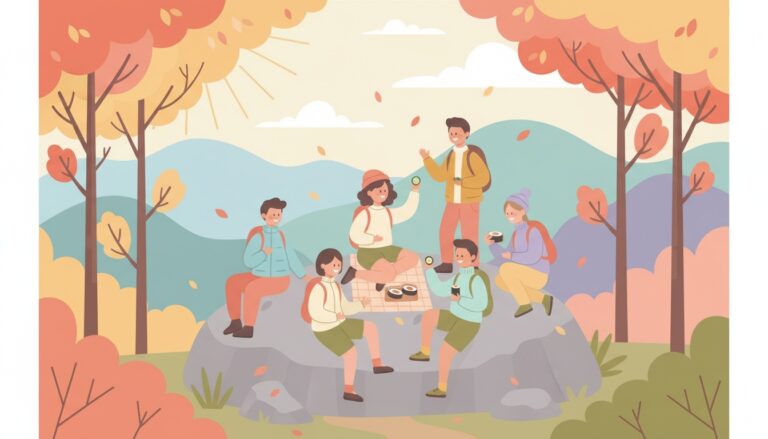
I remember one of my students, Sarah, who joined a hiking club to make Korean friends. She was physically fit and climbed up Mt. Bukhansan easily. But at the peak, she felt awkward because everyone was sharing snacks and laughing, while she sat alone because she didn’t know how to join the conversation. 😭
In dramas like Work Later, Drink Now, you often see characters bonding (or fighting!) while hiking. Why? Because in Korea, hiking isn’t just exercise; it’s a social event. To truly survive a Korean hiking club, you need more than strong legs—you need the right words.
Today, let’s learn the real expressions that will turn you from a “foreigner who hikes” into a “beloved club member.”
2. Today’s Core Expressions (Deep Dive)
Here are 3 phrases to make you sound like a pro member.
1. 등산은 처음이라 잘 부탁드려요.
(Deungsan-eun cheoeum-ira jal butak-deuryeoyo.)
* Meaning: It’s my first time hiking, so please look after me/help me out.
* [Tutor’s Secret Note 🤫]: Even if you are an expert hiker in your home country, showing humility is key in Korea. Using “잘 부탁드려요” (Please look after me) instantly disarms people. It makes the sunbae (senior members) want to take care of you, give you water, and share their cucumbers!
* [Pronunciation Clinic 🗣️]: Be careful with ‘Cheoeum (처음)’. It’s not ‘Chum’. Open your mouth vertically for the ‘eo (어)’ sound.
2. 조금만 더 힘내세요!
(Jogeum-man deo him-naeseyo!)
* Meaning: Cheer up! / Just a little more strength!
* [Tutor’s Secret Note 🤫]: You use this when you see someone struggling uphill. In a club, hiking is a team sport. If you pass someone and say this warmly, you earn 100 social points. It’s the magic phrase that builds camaraderie.
3. 뒷풀이 가시나요?
(Dwipuri gasinayo?)
* Meaning: Are you going to the after-party?
* [Tutor’s Secret Note 🤫]: This is the most important phrase. Honest truth? Many Koreans hike just for the Dwipuri (eating and drinking afterwards). It usually involves Pajeon (green onion pancake) and Makgeolli (rice wine). Asking this shows you are interested in bonding with the group, not just walking.
* [Pronunciation Clinic 🗣️]: Dwipuri (뒷풀이) sounds like [Dwi-pu-ri]. The ‘t’ in ‘dwi’ is silent or very soft when followed by ‘p’.
3. Textbook vs. Real Korean
Let’s upgrade your Korean from “Robot” to “Local.”
| Type | Expression | Nuance |
|---|---|---|
| Book Korean 🤖 | 등산 동호회에 가입하고 싶습니다. (Deungsan donghohoe-e gaip-hago sipseumnida.) |
“I wish to join the hiking club.” (Sounds like a job interview.) |
| Real Korean 🦊 | 저도 같이 타도 될까요? (Jeodo gachi tado doelkkayo?) |
“Can I ride (the mountain) with you guys?” (Natural & Casual. ‘San-eul tada’ means to hike.) |
Why? In spoken Korean, we often say “산을 타다” (ride the mountain) instead of just “등산하다.” It sounds much more seasoned!
4. Real Life Scenario (Role Play)
📍 Background: Sunday morning at the entrance of Mt. Gwanaksan. You are meeting the club leader.
Min-su (Leader): 안녕하세요! 오늘 처음 오셨죠? (Hello! You’re new today, right?)
You: 네, 안녕하세요! 등산은 처음이라 잘 부탁드려요. (Yes, hello! It’s my first time, please look after me.)
Min-su: 걱정 마세요. 우리 천천히 갈 거예요. 장비는 다 챙겨 오셨네요? (Don’t worry. We’ll go slowly. You brought all your gear?)
You: 네, 준비 다 됐어요. 오늘 뒷풀이 가시나요? (Yes, I’m ready. Are you going to the after-party today?)
Min-su: (Laughs) 하하, 당연하죠! 막걸리 한잔해야죠. 출발합시다! (Haha, of course! We have to drink Makgeolli. Let’s go!)
[Culture Tip 💡]
The “Sharing” Culture: When you reach the peak or take a break, everyone opens their backpacks. It is polite to bring small snacks (chocolates, cherry tomatoes, cucumbers) to share with others. Don’t just eat your own sandwich alone!
5. FAQ – Ask Daily Hangul!
Q1: Can I call the other members “Oppa” or “Unni” right away?
A: Whoa, hold on! 🛑 Even if it’s a hobby club, start with “[Name]-nim” or “Heowon-nim” (Member). Once you share Makgeolli at the Dwipuri and agree to drop honorifics, then you can use Oppa/Unni/Hyung/Noona.
Q2: Do Koreans really shout “Ya-ho!” at the top of the mountain?
A: In old cartoons? Yes. In reality? Not really anymore. It disturbs the peace and scares the wildlife. Instead, people usually say “와, 경치 대박이다!” (Wow, the view is daebak/amazing!).
6. Wrap-up & Today’s Mission
Hiking in Korea is 30% walking and 70% socializing (and eating). Don’t be afraid to speak up; hikers are generally very friendly people!
🔥 Today’s Mission:
Go to Instagram and search for the hashtag #등산스타그램 (Hiking-stagram). Look at the photos and try to find a picture of Dwipuri (food). Comment “맛있겠다!” (Looks delicious) on one of them!
🔽 Pop Quiz (Scroll down for answers)
Q. What is the most natural way to ask if there is a party after the hike?
- 식사하셨습니까?
- 뒷풀이 가시나요?
- 집에 언제 가요?
.
.
.
.
.
Answer: 2. 뒷풀이 가시나요? (Are you going to the after-party?)







