

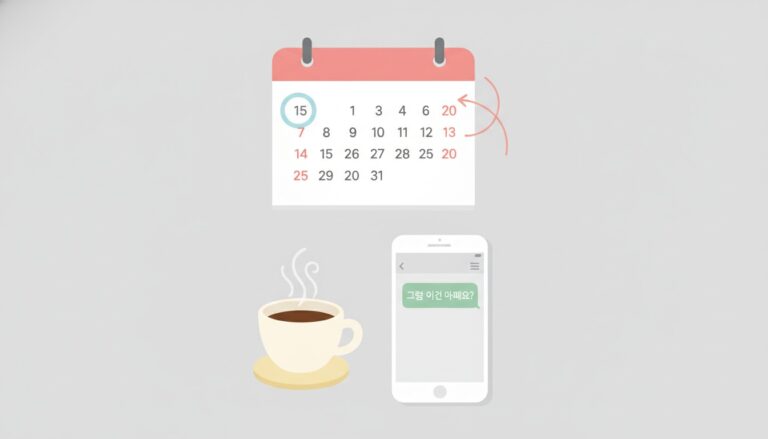
Rescheduling Date? Don’t Just Cancel! How to Propose ‘Plan B’ in Korean Like a Local
Hello, it’s Daily Hangul! 😊
Have you ever been in this situation? You are chatting with a Korean friend or a potential date. They ask to meet up on Friday, but you are busy. So you reply, “Sorry, I’m busy on Friday.” And then… silence. The conversation dies.
Why? Because you forgot the Golden Rule of Korean social etiquette: The Ping-Pong Rule! 🏓
One of my students, Mark, actually “ghosted” a girl by accident this way. He thought he was just stating a fact, but to a Korean ear, rejecting a plan without suggesting an alternative sounds like, “I don’t want to see you.” Ouch, right?
Today, I will teach you the magic phrases to keep the conversation (and the relationship) alive. We are learning how to say, “Then, how about this?”
Today’s Core Expressions: The “Plan B” Kit
Here are the top 3 ways to suggest an alternative time or plan. These are essential for survival in Korea!
1. 그럼 [Time]은/는 어때요?
(Geureom [Time]-eun/neun eottaeyo?)
Meaning: Then, how about [Time]?
- Geureom (그럼): Then / In that case
- Eottaeyo? (어때요?): How is it? / How about?
[Tutor’s Secret Note 🤫]
This is your bread and butter. The word “Geureom” is crucial here. It signals, “I really want to meet you, so since Plan A failed, here is Plan B.” Without “Geureom,” you might sound a bit abrupt. Use this with friends or colleagues!
[Pronunciation Clinic 🗣️]
Be careful with 어때요 (Eottaeyo). It is not “Oh-tae-yo.” The ‘tt’ (ㄸ) is a tense sound. Tense your throat and say it sharply like a popping sound! Eo-TTAE-yo!
2. 아니면 [Activity] 할까요?
(Animyeon [Activity] halkkayo?)
Meaning: Or, shall we do [Activity]?
[Tutor’s Secret Note 🤫]
Use this when you want to change the plan, not just the time. For example, if dinner is too heavy, you can suggest coffee. “Shall we…?” (~l kkayo?) is a very soft, considerate way to suggest something. It makes you look like a very well-mannered person with good Nunchi (social sense).
3. [Time]도 괜찮으세요?
([Time]-do gwaenchaneuseyo?)
Meaning: Is [Time] also okay for you?
[Tutor’s Secret Note 🤫]
This is slightly more polite. By adding “-do” (also), you are acknowledging their original suggestion while gently pushing yours. It’s perfect for business meetings or talking to someone older.
Textbook Korean vs. Real Korean
Let’s look at why you shouldn’t just trust the dictionary.
📚 Book Korean:
“다른 시간은 없습니까?”
(Dareun siganeun eopseumnikka?)
Meaning: Do you not have another time?
- Why it feels weird: This sounds like an interrogation by a detective or a very stiff hotel receptionist. If you say this to a friend, they might laugh.
🎭 Real K-Drama Korean:
“그날은 좀 힘들 것 같고… 다음 주는 어때요?”
(Geunareun jom himdeul geot gatgo… daeum juneun eottaeyo?)
Meaning: That day seems a bit difficult… so how about next week?
- Why it works: Notice the “soft rejection” (himdeul geot gatgo – seems difficult) followed immediately by the “Plan B” (eottaeyo). This is the natural flow!
Real Life Scenario: Rescheduling a Coffee Date ☕
Situation: You are texting your Korean friend, Minji. She wants to meet on Friday, but you have work.
Minji: 금요일 저녁에 시간 있어요? (Do you have time on Friday evening?)
You: 아, 금요일은 야근해야 해요. ㅠㅠ 그럼 토요일은 어때요?
(Ah, Geumyoireun yageunhaeya haeyo. ㅠㅠ Geureom Toyoireun eottaeyo?)
[Ah, I have to work overtime on Friday. (Crying face) Then, how about Saturday?]
Minji: 토요일 좋아요! 몇 시에 볼까요?
(Toyoil joayo! Myeot sie bolkkayo?)
[Saturday is good! What time shall we meet?]
You: 점심 먹을까요?
(Jeomsim meogeulkkayo?)
[Shall we have lunch?]
[Culture Tip 💡]
Did you see the “ㅠㅠ”? In Korean text messages (KakaoTalk), using emoticons like ㅠㅠ (crying eyes) or 😂😂 softens the blow of a rejection. It shows you are genuinely sad that you can’t make it!
FAQ: Questions My Students Always Ask
Q1: Can I use “어때요? (Eottaeyo?)” with my boss?
A: Be careful! “어때요?” is polite, but for a boss or a very senior client, it’s safer to use “어떠세요? (Eotteoseyo?)”. It’s the honorific version.
* Boss: “How about Tuesday?”
* You: “Tuesday is great. (Hwayoil eotteoseyo? – How is Tuesday for you?)”
Q2: I heard people say “Call! (콜!)” in dramas. What is that?
A: Haha, yes! If someone suggests a plan and you agree, you can say “Call! (콜!)”. It comes from poker terminology (calling a bet) and means “Deal!” or “I’m in!” Use this only with close friends!
Today’s Wrap-up
Remember, in Korea, a rejection must always come with an alternative! Don’t be a “No-Show” to the heart.
🔥 Today’s Mission:
Next time you are chatting and can’t make an appointment, do not just say “No.” Try typing: “그럼 [Day]은 어때요?”
Pop Quiz! 📝
Which is the most natural way to say “Then, how about tomorrow?” to a friend?
A) 내일 없습니다. (Naeil eopseumnida.)
B) 그럼 내일은 어때요? (Geureom naeireun eottaeyo?)
C) 내일 하십시오. (Naeil hasipsio.)
(Scroll down for the answer!)
.
.
.
.
.
Answer: B! You got this! See you in the next lesson! 👋
Frequently Asked Questions (FAQ)
Q: What does "어때요" mean in Korean and how do you pronounce it?
A: In Korean, "어때요" is pronounced [Eottaeyo] and means: . It is not "Oh-tae-yo." The 'tt' (ㄸ) is a tense sound. Tense your throat and say it sharply like a popping sound!







