

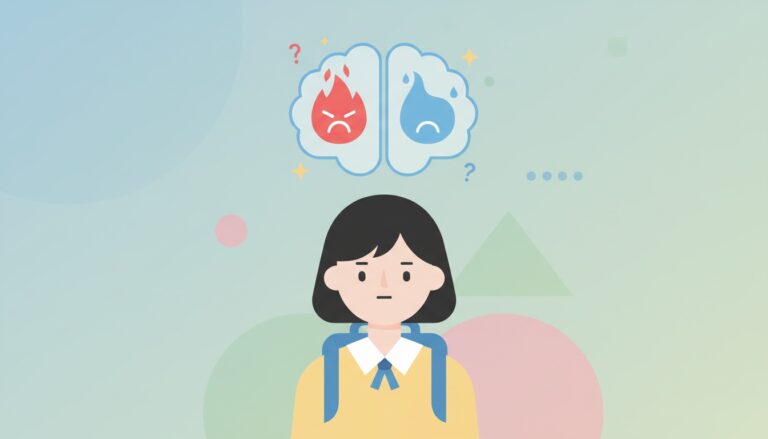
Why are K-Drama Teens So Moody? 🧠 Understanding ‘Sachunki’ (Puberty)
Introduction
Hello! It’s your favorite Korean tutor, Daily Hangul (DailyHangul.com)! 👋✨
Have you ever watched K-dramas like True Beauty, The Heirs, or All of Us Are Dead? You often see teenagers acting rebellious, emotional, or stressed, right? 😤😭
Today, we are diving into the world of Neuroscience and Cognition, but we will keep it simple and fun! We are going to learn expressions related to Adolescent Brain Development. In Korea, we often talk about this stormy period of growing up. Knowing these words will help you understand why characters act the way they do and let you talk about feelings and growing pains!
Let’s upgrade your Korean brain! 🧠💪
Core Expressions
Here are 4 key words to describe the teenage brain and growing up!
1. 사춘기 (Puberty / Adolescence)
- Pronunciation: [Sachunki]
- Meaning: Puberty / Adolescence
- Detail: This literally translates to the “period of thinking of spring” (a poetic way to say youth!). It refers to the time when the brain and body change rapidly. If a teenager is moody, Koreans say, “He has sachunki.”
- 💡 Pronunciation Tip: The ‘ch’ (ㅊ) and ‘k’ (ㅋ) are aspirated sounds. You must spit out a little burst of air when you say them! Say it like “Sa-chun-ki”.
2. 예민하다 (To be sensitive)
- Pronunciation: [Yeminhada]
- Meaning: To be sensitive / edgy
- Detail: During brain development, emotions can be wild. This word describes someone who gets annoyed easily or is over-reactive. You hear this a lot in dramas when a character snaps at someone.
- 💡 Pronunciation Tip: When speaking fast, the ‘h’ sound in ‘ha’ often becomes very soft or almost disappears. It sounds like [Yemin-ada].
3. 반항 (Rebellion)
- Pronunciation: [Banhang]
- Meaning: Rebellion / Defiance
- Detail: The teenage brain seeks independence! Banhang is when kids don’t listen to their parents or teachers. It’s a natural part of growing up.
4. 어른 (Adult / Grown-up)
- Pronunciation: [Eoreun]
- Meaning: Adult
- Detail: This is the goal of brain development! To become a mature eoreun. Note: Don’t confuse it with eorini (child)!
- 💡 Pronunciation Tip: The ‘eu’ (으) vowel is tricky. Smile widely and pull your tongue back slightly without touching the roof of your mouth. It’s distinct from the ‘u’ sound.
Real Conversation
Let’s see how two friends, Minji and Sora, talk about Minji’s younger brother who is going through brain changes!
Minji: 내 동생이 요즘 너무 예민해.
([Nae dongsaeng-i yojeum neomu yeminhae.])
My younger brother is so sensitive these days.
Sora: 벌써 사춘기가 왔어?
([Beolsseo sachunki-ga wasseo?])
Is puberty here already?
Minji: 응. 엄마 말도 안 듣고 반항만 해.
([Eung. Eomma maldo an deutgo banhang-man hae.])
Yeah. He doesn’t listen to mom and just rebels.
Sora: 걱정 마. 곧 멋진 어른이 될 거야.
([Geokjeong ma. Got meotjin eoreun-i doel geoya.])
Don’t worry. He will become a cool adult soon.
Culture Tip: “Jung-2-byeong” (Middle School Year 2 Disease) 🏫💊
In Korea, there is a very famous slang term related to adolescent brain development called 중2병 (Jung-ni-byeong).
It literally means “Middle School 2nd Year Disease” (around age 14-15). It’s not a real medical sickness! It refers to that specific time when teenagers think they are the coolest, saddest, or most misunderstood people in the world. They might act overly dark or pretentious.
If you see a character in a K-drama acting moody and mysterious for no reason, you can say: “Ah! It’s Jung-2-byeong!” 🤣
Conclusion & Quiz
Great job! Today we learned how to describe the stormy period of brain development in Korean. Remember, being sensitive (yeminhae) is just part of puberty (sachunki)!
📝 Mini Quiz
Let’s check your memory!
- Fill in the blank:
“My son is going through ____, so he is very moody.”
(A) Banhang (B) Sachunki -
True or False:
‘Eoreun’ means ‘Child’.
(O / X) -
Which word means ‘Sensitive’?
(A) Yeminhada (B) Haengbokhada
Answers:
1. (B) Sachunki
2. (X) – It means Adult. Child is ‘Eorini’.
3. (A) Yeminhada
See you next time! Annyeong! 👋💖
Frequently Asked Questions (FAQ)
Q: What does "사춘기 (Puberty / Adolescence)" mean in Korean and how do you pronounce it?
A: In Korean, "사춘기 (Puberty / Adolescence)" is pronounced [Sachunki] and means: Puberty / Adolescence
Q: What does "예민하다 (To be sensitive)" mean in Korean and how do you pronounce it?
A: In Korean, "예민하다 (To be sensitive)" is pronounced [Yeminhada] and means: To be sensitive / edgy
Q: What does "반항 (Rebellion)" mean in Korean and how do you pronounce it?
A: In Korean, "반항 (Rebellion)" is pronounced [Banhang] and means: Rebellion / Defiance
Q: What does "어른 (Adult / Grown-up)" mean in Korean and how do you pronounce it?
A: In Korean, "어른 (Adult / Grown-up)" is pronounced [Eoreun] and means: Adult







