

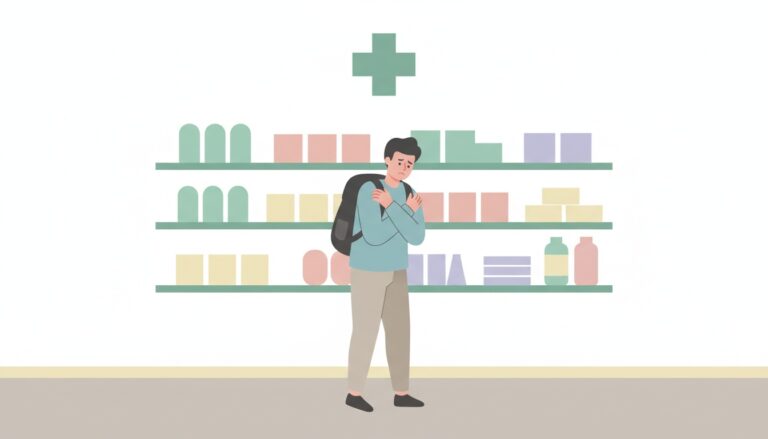
Introduction
Hello! It’s Daily Hangul (DailyHangul.com), here to upgrade your Korean skills! 🌟
Have you ever traveled to Korea and walked so much that your body ached? Or maybe you carried too many shopping bags full of K-beauty products? 🛍️ Being sick or in pain abroad can be scary, but don’t worry! Today, we will learn how to describe your symptoms at a pharmacy or a clinic.
In K-dramas, you often see scenes where a character puts a white patch on their neck or shoulder after a hard day of work. Today, you’ll learn exactly what to say in that situation! Let’s get healthy together! 💪
Key Expressions
1. 어깨가 아파요
- Pronunciation: [Eokkaega apayo]
- English Meaning: My shoulder hurts.
- Detail: This is the most standard way to say you are in pain. You can replace ‘어깨’ (eokkae – shoulder) with other body parts like ‘머리’ (meori – head) or ‘배’ (bae – stomach). It is polite but simple.
- 💡 Pronunciation Tip: The double consonant ‘ㄲ’ (kk) in ‘어깨’ is a tense sound. Tense your throat slightly to make a sharp ‘k’ sound without letting air out. Also, when saying ‘아파요’, the ‘p’ sound flows naturally.
2. 파스 있어요?
- Pronunciation: [Paseu isseoyo?]
- English Meaning: Do you have a pain relief patch?
- Detail: In Korea, ‘파스’ (Paseu) is a magical item! It refers to those adhesive pain relief patches (like Salonpas). It comes from the German word ‘Paste’. If you have muscle pain, this is the first thing you should ask for.
- 💡 Pronunciation Tip: ‘Paseu’ is two syllables: Pa-seu. Don’t say it like ‘Pass’. Make sure to pronounce the vowel ‘eu’ (으) at the end lightly.
3. 욱신거려요
- Pronunciation: [Uksingeoryeoyo]
- English Meaning: It throbs / It aches.
- Detail: This is a great expression to describe how it hurts. ‘욱신’ (uksin) is a word that mimics the feeling of a throbbing pain inside the muscle. Doctors will be impressed if you use this!
- 💡 Pronunciation Tip: The ‘si’ in ‘uksin’ sounds soft. Connect the sounds smoothly: [Uk-sin-geo-ryeo-yo].
Real Conversation
Here is a situation at a 약국 (Yakguk – Pharmacy). 🏥
💊 Pharmacist (A) vs. Tourist (B)
A: 어서 오세요. 어디가 불편하세요?
(Eoseo oseyo. Eodiga bulpyeonhaseyo?)
Welcome. What seems to be the problem?
B: 안녕하세요. 저 어깨가 아파요.
(Annyeonghaseyo. Jeo eokkaega apayo.)
Hello. My shoulder hurts.
A: 언제부터 아팠어요?
(Eonjebuteo apasseoyo?)
Since when has it hurt?
B: 어제부터요. 혹시 파스 있어요?
(Eojebuteoyo. Hoksi paseu isseoyo?)
Since yesterday. Do you happen to have pain patches?
A: 네, 여기 있어요. 이거 붙이세요.
(Ne, yeogi isseoyo. Igeo buchiseyo.)
Yes, here you go. Please apply this.
Cultural Tip: The Magic of ‘Paseu’ (파스) 🩹
In Korea, ‘Paseu’ (pain patch) is the go-to remedy for almost any muscle pain! You will see older people, students, and office workers using them. There are two main types:
1. Cool Paseu (쿨파스): For sudden injuries or swelling (cooling effect).
2. Hot Paseu (핫파스): For chronic pain or stiff muscles (warming effect).
If you visit a Korean convenience store (like CU or GS25), you can easily buy them 24/7. It’s a must-have item for your travel kit! 🎒
Conclusion & Quiz
Great job! Now you don’t have to endure the pain silently. Remember, “Eokkaega apayo”! Keep your body healthy so you can enjoy your Korean studies even more. 😊
📝 Mini Quiz
- Fill in the blank: “______가 아파요.” (My shoulder hurts.)
- True or False: You can only buy ‘Paseu’ (pain patches) at a big hospital.
⬇️ Answers
- 어깨 (Eokkae)
- False (You can buy them at pharmacies and convenience stores!)
Frequently Asked Questions (FAQ)
Q: What does "어깨가 아파요" mean in Korean and how do you pronounce it?
A: In Korean, "어깨가 아파요" is pronounced [Eokkaega apayo] and means: My shoulder hurts.
Q: What does "파스 있어요?" mean in Korean and how do you pronounce it?
A: In Korean, "파스 있어요?" is pronounced [Paseu isseoyo?] and means: Do you have a pain relief patch?
Q: What does "욱신거려요" mean in Korean and how do you pronounce it?
A: In Korean, "욱신거려요" is pronounced [Uksingeoryeoyo] and means: It throbs / It aches.







