

Introduction
Hello, everyone! It’s your friendly Korean tutor, Daily Hangul (DailyHangul.com)! 👋✨
Have you ever watched a K-Drama like Itaewon Class or Vincenzo? In those shows, the main characters often fight against powerful villains to correct unfair situations. That spirit is very similar to the concept of “Civil Disobedience”—refusing to follow unfair laws to bring about positive change!
Today, we aren’t just learning boring legal terms. We are going to learn how to express disagreement, talk about peace, and understand the power of citizens in Korea. These are powerful words that show you care about society! Ready to become a hero of your own story? Let’s go! 🚀
Key Expressions
Here are 4 key expressions to help you talk about standing up for what is right.
1. 반대해요
- Pronunciation: [Bandaehaeyo]
- English Meaning: I disagree / I oppose.
- Detail: This is the most standard way to say you are against something. Whether it’s a small decision at work or a big social issue, you use this word.
- 💡 Pronunciation Tip: The ‘h’ (ㅎ) sound in the middle is often very weak. It sounds almost like ‘Banda-aeyo’ when spoken quickly.
2. 평화
- Pronunciation: [Pyeonghwa]
- English Meaning: Peace
- Detail: Civil disobedience is all about non-violence. You will hear this word often in news reports about demonstrations.
- 💡 Pronunciation Tip: The ‘wa’ (화) sound combines ‘h’ and ‘wa’. Make sure your mouth forms a round ‘O’ shape at the start!
3. 시민
- Pronunciation: [Simin]
- English Meaning: Citizen
- Detail: You are not just a person (사람); in a society, you are a ‘citizen’ with rights and duties.
- 💡 Pronunciation Tip: The ‘S’ (시) here is soft, followed by ‘min’. It’s pronounced clearly as it is written.
4. 바꾸다
- Pronunciation: [Bakkuda]
- English Meaning: To change (something)
- Detail: The goal of any protest or civil movement is to change the world for the better.
- 💡 Pronunciation Tip: The double consonant ‘kk’ (ㄲ) requires you to tense your throat. It is a strong sound, stronger than a regular ‘k’.
Real-life Conversation
Imagine two friends, Minji and Alex, watching the news about a peaceful protest in Seoul.
Minji: 와, 저기 사람들 좀 봐. 정말 많다.
(Wa, jeogi saramdeul jom bwa. Jeongmal manta.)
Wow, look at those people over there. There are so many.
Alex: 사람들이 왜 모였어?
(Saramdeuri wae moyeosseo?)
Why did people gather?
Minji: 잘못된 법을 반대해요.
(Jalmotsdoen beobeul bandaehaeyo.)
They oppose the wrong law.
Alex: 경찰도 있네. 위험하지 않아?
(Gyeongchaldo inne. Wiheomhaji ana?)
There are police too. Isn’t it dangerous?
Minji: 아니, 걱정 마. 평화로운 시위야.
(Ani, geokjeong ma. Pyeonghwaroun siwiya.)
No, don’t worry. It is a peaceful protest.
Alex: 시민들의 힘이 대단하다!
(Simindeurui himi daedanhada!)
The power of the citizens is amazing!
Culture Tip: The Candlelight Vigil (촛불 집회) 🕯️
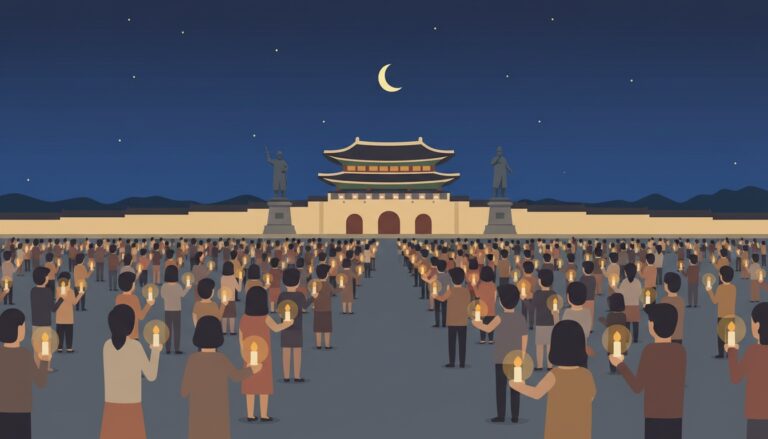
When you think of protests in Korea, don’t think of violence! Korea has a beautiful and unique culture called the Candlelight Vigil (촛불 집회 – Chotbul Jiphoe).
When Korean citizens want to express their anger or desire for change, they gather in large squares (like Gwanghwamun Square) at night holding candles (or LED candles these days!). It creates a stunning sea of light. It symbolizes that the “light of the citizens” can drive away the darkness of injustice. It is safe, peaceful, and often includes music and performances!
Conclusion & Practice
Today we learned how to speak up against injustice! Even if the topic seems heavy, using words like “Oppose” (반대해요) and “Peace” (평화) is useful in many daily situations too.
📝 Mini Quiz
Fill in the blanks with the words we learned today!
- I want to □□□ my phone number. (To change)
- We want world □□. (Peace)
- I □□□□ your idea. (Disagree/Oppose)
Answers:
1. 바꾸다 (Bakkuda)
2. 평화 (Pyeonghwa)
3. 반대해요 (Bandaehaeyo)
See you next time! 안녕! 👋
Frequently Asked Questions (FAQ)
Q: What does "반대해요" mean in Korean and how do you pronounce it?
A: In Korean, "반대해요" is pronounced [Bandaehaeyo] and means: I disagree / I oppose.
Q: What does "평화" mean in Korean and how do you pronounce it?
A: In Korean, "평화" is pronounced [Pyeonghwa] and means: Peace
Q: What does "시민" mean in Korean and how do you pronounce it?
A: In Korean, "시민" is pronounced [Simin] and means: Citizen
Q: What does "바꾸다" mean in Korean and how do you pronounce it?
A: In Korean, "바꾸다" is pronounced [Bakkuda] and means: To change (something)







