

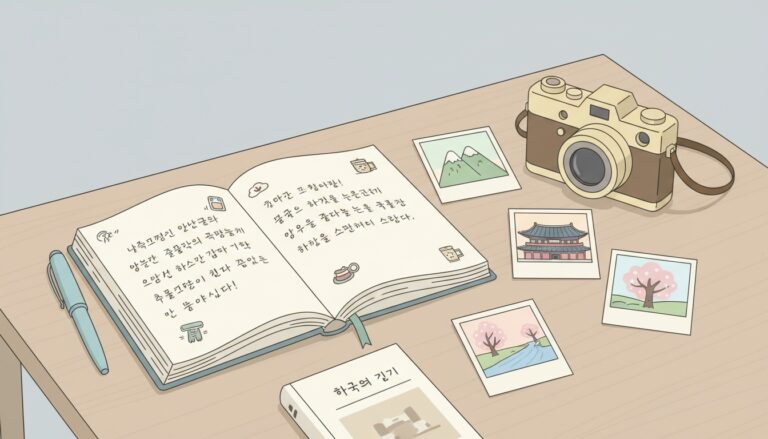
Reviewing K-Travel Content: Write Like a Pro! 📝✈️
Annyeonghaseyo! It’s Daily Hangul, your guide to mastering Korean! 👋✨
Do you enjoy watching Korean travel reality shows like Youth Over Flowers (꽃보다 청춘) or reading travel essays? Have you ever watched a K-Drama set in a beautiful location and wanted to write a review about it on Instagram or your blog?
Today, we are going to learn how to express your opinions and write a simple critique for travel books or movies. This is a super useful skill if you want to share your thoughts with Korean friends or on social media! Let’s become travel critics today! 🎬📚
🌟 Core Expressions
Here are 4 key expressions to make your reviews sound professional and emotional!
1. 감동적이었어요 (It was touching/moving)
- Pronunciation: [Gamdongjeogieosseoyo]
- Meaning: It was touching / It was moving
- Detail: Use this when a book or movie touched your heart. It’s perfect for describing emotional travel stories where the traveler overcomes hardships.
- 💡 Pronunciation Tip: In 감동 (Gamdong), make sure the ‘m’ sound is clear. When saying 적이었어요 (jeogieosseoyo), link the sounds smoothly like ‘jeo-gi-eo-sseo-yo’.
2. 대리 만족을 느꼈어요 (I felt vicarious satisfaction)
- Pronunciation: [Daeri manjogeul neukkyeosseoyo]
- Meaning: I felt vicarious satisfaction / I lived vicariously through it
- Detail: This is a must-know phrase for travel reviews! Since we can’t travel everywhere, we watch shows to feel satisfied through someone else’s experience. Koreans use this phrase all the time for travel vlogs.
- 💡 Pronunciation Tip: 만족을 (manjogeul) involves a liaison. The ‘k’ sound at the bottom of 족 moves over to 을, sounding like [man-jo-geul].
3. 영상미가 뛰어나요 (The visual beauty is outstanding)
- Pronunciation: [Yeongsangmiga ttwieonayo]
- Meaning: The cinematography/visuals are outstanding
- Detail: If you watch a travel documentary with beautiful scenery, you can use this phrase. 영상미 (Yeongsangmi) means ‘beauty of the video’.
- 💡 Pronunciation Tip: 뛰어나요 (ttwieonayo) starts with a double consonant ‘tt’ (ㄸ). Tense your tongue and release the air sharply without breathing out too much air!
4. 강력 추천해요 (I strongly recommend it)
- Pronunciation: [Gangnyeok chucheonhaeyo]
- Meaning: I strongly recommend it
- Detail: Want to tell others to read or watch it? Use this! In text messages or online comments, you can shorten this to 강추 (Gangchu)! 👍
- 💡 Pronunciation Tip: 강력 (Gangnyeok) is tricky! Due to nasalization rules, the ‘ry’ sound changes to an ‘n’ sound. So it sounds like [Gang-nyeok], not [Gang-ryeok].
🗣️ Real-Life Conversation
Let’s see how friends talk about a travel movie (like Little Forest).
A: 어제 본 여행 영화 어땠어?
(Eoje bon yeohaeng yeonghwa eottaesseo?)
Meaning: How was the travel movie you watched yesterday?
B: 진짜 좋았어! 풍경이 너무 예뻐서 영상미가 뛰어났어.
(Jinjja joasseo! Punggyeong-i neomu yeppeoseo yeongsangmiga ttwieonasseo.)
Meaning: It was really good! The scenery was so pretty, the visuals were outstanding.
A: 나도 보고 싶다. 내용은 재미있어?
(Nado bogo sipda. Naeyong-eun jaemiisseo?)
Meaning: I want to watch it too. Is the content interesting?
B: 응, 주인공이 여행하며 성장하는 모습이 감동적이었어. 너한테 강력 추천해!
(Eung, juingong-i yeohaenghamyeo seongjanghaneun moseubi gamdongjeogieosseo. Neohante gangnyeok chucheonhae!)
Meaning: Yes, seeing the main character grow while traveling was touching. I strongly recommend it to you!
🇰🇷 Culture Tip: “Review Culture” in Korea
Did you know that Koreans are very serious about reviews (후기, Hugi)? 🧐
Before traveling or buying a book, most Koreans search for reviews on Naver Blogs or Instagram. A good review usually includes detailed photos and personal feelings like “healing” (힐링). The word 힐링 (Healing) is huge in Korea—travel literature is often consumed to ‘heal’ the stress of daily city life. If you use the word “Healing” in your review, you will sound just like a local!
📝 Wrap-up & Practice
Today we learned how to critique travel content. Now you can share your favorite K-Travel shows with the world!
Let’s practice! Fill in the blanks:
- This movie has beautiful scenery. The ______ is outstanding.
(이 영화는 풍경이 아름다워요. ______가 뛰어나요.) -
I can’t travel right now, so I felt ______ through this book.
(지금 여행을 못 가서, 이 책으로 ____ ____을 느꼈어요.)
[Answers]
1. 영상미 (Yeongsangmi)
2. 대리 만족 (Daeri manjok)
Keep practicing, and see you next time! Annyeong! 👋❤️
Frequently Asked Questions (FAQ)
Q: What does "감동적이었어요 (It was touching/moving)" mean in Korean and how do you pronounce it?
A: In Korean, "감동적이었어요 (It was touching/moving)" is pronounced [Gamdongjeogieosseoyo] and means: It was touching / It was moving
Q: What does "대리 만족을 느꼈어요 (I felt vicarious satisfaction)" mean in Korean and how do you pronounce it?
A: In Korean, "대리 만족을 느꼈어요 (I felt vicarious satisfaction)" is pronounced [Daeri manjogeul neukkyeosseoyo] and means: I felt vicarious satisfaction / I lived vicariously through it
Q: What does "영상미가 뛰어나요 (The visual beauty is outstanding)" mean in Korean and how do you pronounce it?
A: In Korean, "영상미가 뛰어나요 (The visual beauty is outstanding)" is pronounced [Yeongsangmiga ttwieonayo] and means: The cinematography/visuals are outstanding
Q: What does "강력 추천해요 (I strongly recommend it)" mean in Korean and how do you pronounce it?
A: In Korean, "강력 추천해요 (I strongly recommend it)" is pronounced [Gangnyeok chucheonhaeyo] and means: I strongly recommend it







