

Introduction
Annyeonghaseyo! Hello, everyone! It’s your friendly Korean tutor, Daily Hangul! 😊
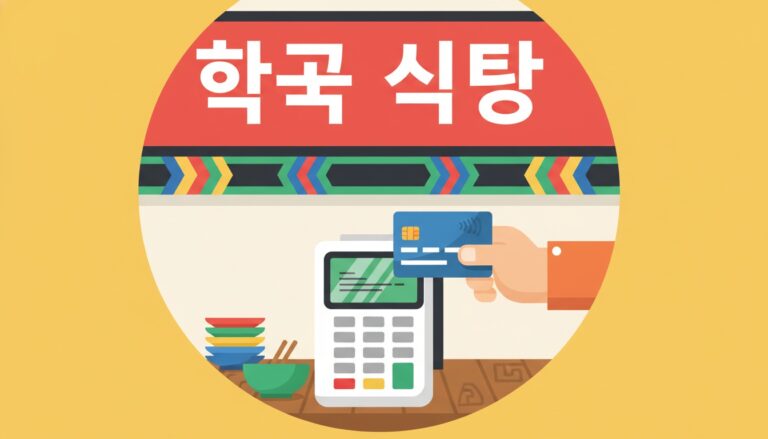
Imagine this: You’ve just finished a delicious meal of Samgyeopsal (pork belly) in Seoul. Your stomach is full, and you are happy. You go to the counter to pay with your credit card, but the cashier says something and points to the machine. Panic? No need! 🙅♀️
Today, we will learn exactly what to do when you need to enter your PIN or handle the payment terminal. This is a super useful skill because you’ll do it every day in Korea! You might have seen this in K-Dramas where the main character coolly pays for dinner (or fights over the bill! 😉).
Let’s get started!
Key Expressions
Here are the 3 most important phrases you will hear or say at the checkout counter.
1. 비밀번호 눌러 주세요.
- Pronunciation: [Bimilbeonho nulleo juseyo]
- English Meaning: Please enter your password (PIN).
- Explanation:
- Bimil (비밀) means “secret” and Beonho (번호) means “number.” Together, it’s your PIN!
- Nulleo juseyo (눌러 주세요) means “please press.”
- In Korea, foreign cards often require a PIN, even for small amounts.
- 💡 Pronunciation Tip:
- In Nulleo (눌러), the ‘ll’ sound is strong. Make sure your tongue touches the roof of your mouth firmly, like the ‘l’ in “love.”
2. 여기 서명해 주세요.
- Pronunciation: [Yeogi seomyeonghae juseyo]
- English Meaning: Please sign here.
- Explanation:
- If your card doesn’t need a PIN, they might ask for a signature.
- Seomyeong (서명) means “signature.”
- You can often just scribble a quick line on the electronic pad!
- 💡 Pronunciation Tip:
- When saying Seomyeong-hae (서명해), the ‘h’ sound is soft. It almost sounds like connecting the words: [Seomyeong-ae].
3. 영수증 드릴까요?
- Pronunciation: [Yeongsujeung deurilkkayo?]
- English Meaning: Shall I give you the receipt?
- Explanation:
- Yeongsujeung (영수증) is “receipt.”
- If you don’t need it, you can simply say “Aniyo (No).”
- 💡 Pronunciation Tip:
- Yeong (영) starts with a ‘y’ sound. It’s not just “young,” try to make it softer. The final ‘ng’ in Jeung (증) is a nasal sound.
Real-life Dialogue
Let’s see how this works in a real restaurant situation!
Situation: You (B) are paying for your meal at the counter with the Staff (A).
A (Staff): 25,000원입니다. (It is 25,000 won.)
B (You): 카드로 할게요. (I’ll pay by card.)
A (Staff): 네, 비밀번호 눌러 주세요. (Okay, please enter your PIN.)
B (You): (Enters PIN) 여기요. (Here you go.)
A (Staff): 결제됐습니다. 영수증 드릴까요? (Payment is complete. Shall I give you the receipt?)
B (You): 아니요, 괜찮아요. 감사합니다! (No, it’s okay. Thank you!)
Culture Tip 🇰🇷
“Insert Your Own Card!”
In many modern Korean shops and cafes, the card reader faces the customer. Instead of handing your card to the cashier, you might be expected to insert the IC chip into the machine yourself!
Also, remember: No Tipping! 🚫💸
The price you see is the final price. You don’t need to add a tip for the service, even if the staff was amazing. Just a warm “Gamsahamnida” (Thank you) is enough!
Review & Quiz
Great job today! You are now ready to pay like a local. Let’s check what you remember.
Quiz:
1. What is the Korean word for “Secret Number” (PIN)?
(Hint: B_ _ _ _ b_ _ _ _)
2. If the staff says
Frequently Asked Questions (FAQ)
Q: What does "비밀번호 눌러 주세요." mean in Korean and how do you pronounce it?
A: In Korean, "비밀번호 눌러 주세요." is pronounced [Bimilbeonho nulleo juseyo] and means: Please enter your password (PIN).
Q: What does "여기 서명해 주세요." mean in Korean and how do you pronounce it?
A: In Korean, "여기 서명해 주세요." is pronounced [Yeogi seomyeonghae juseyo] and means: Please sign here.
Q: What does "영수증 드릴까요?" mean in Korean and how do you pronounce it?
A: In Korean, "영수증 드릴까요?" is pronounced [Yeongsujeung deurilkkayo?] and means: Shall I give you the receipt?







