

Introduction
Hello! It’s Daily Hangul (DailyHangul.com), here to upgrade your Korean skills! 👋✨
Have you ever watched legal K-Dramas like Extraordinary Attorney Woo or corporate thrillers like Start-Up? 🎬 In those dramas, characters often face sudden crises or changing rules! 😱
Even if you aren’t a lawyer, knowing how to talk about problems, changes, and checking facts is super useful for business Korean or even when traveling (like if visa rules change!). Today, we will learn how to handle “Risk Management” like a K-Drama protagonist! Let’s dive in! 💼⚖️
Core Expressions
Here are 4 essential phrases to survive a crisis in Korean!
1. 법이 바뀌었어요.
- Pronunciation: [Beobi bakkwyeosseoyo]
- English Meaning: The law has changed.
- Detail:
- 법 (Beop) means “Law.”
- 바뀌었어요 (Bakkwyeosseoyo) is the past tense of “to change.”
- Use this when a new regulation appears!
- 💡 Pronunciation Tip: When saying 법이, the bottom consonant ‘ㅂ’ (b) moves over to the next vowel. So it sounds like [버비 Beo-bi], not [Beop-i]. This makes it flow much smoother!
2. 큰일 났어요!
- Pronunciation: [Keunil nasseoyo!]
- English Meaning: We are in big trouble! / A big problem happened!
- Detail:
- 큰 (Keun) = Big, 일 (Il) = Work/Matter.
- This is the most common phrase in K-Dramas when a crisis hits. You can use this in daily life too, like when you forget your wallet! 😱
3. 위험해요.
- Pronunciation: [Wiheomhaeyo]
- English Meaning: It is dangerous / It is risky.
- Detail:
- Used to describe a risky situation or a physical danger.
- In a business context, it means “This approach is risky.”
4. 다시 확인해 주세요.
- Pronunciation: [Dasi hwaginhae juseyo]
- English Meaning: Please check it again.
- Detail:
- 다시 (Dasi) = Again.
- 확인 (Hwagin) = Check/Confirm.
- In risk management, double-checking is key! This is a polite request used in offices.
Real Conversation
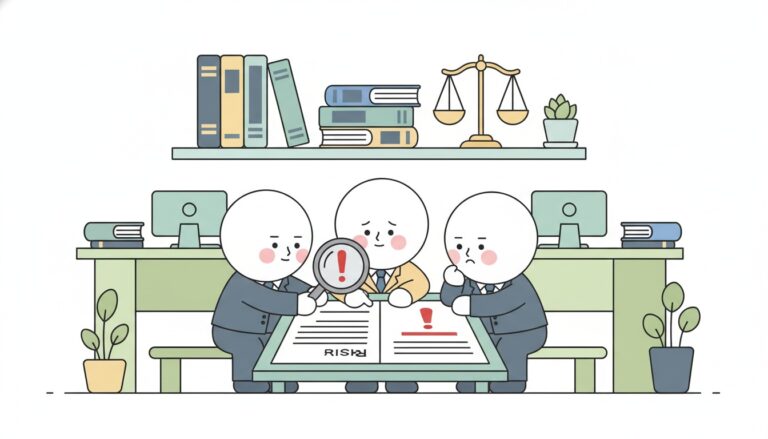
Situation: Manager Kim and New Employee Lee are looking at a new government regulation document. 📄
Employee Lee: 부장님, 큰일 났어요! 😰
(Bujangnim, keunil nasseoyo!)
[Manager, we are in big trouble!]
Manager Kim: 왜요? 무슨 일이에요?
(Waeyo? Museun irieyo?)
[Why? What happened?]
Employee Lee: 이번에 법이 바뀌었어요. 이거 위험해요.
(Ibeone beobi bakkwyeosseoyo. Igeo wiheomhaeyo.)
[The law changed this time. This is risky.]
Manager Kim: 정말요? 변호사님한테 다시 확인해 주세요.
(Jeongmaryo? Byeonhosanimhante dasi hwaginhae juseyo.)
[Really? Please check it again with the lawyer.]
Culture Tip: “Palli-Palli” in Crises 🏃♂️💨
In Korean corporate culture, when a risk or crisis (like a legal change) arises, the “Palli-Palli” (Hurry, Hurry) culture kicks in! 🚀
Speed is crucial. Reporting bad news immediately is better than hiding it. In K-Dramas, you often see employees running to their boss to report “큰일 났어요!” (Big trouble!). Also, relying on experts is important, so you will often hear people looking for a 변호사님 (Byeonhosanim – Lawyer) immediately to resolve the risk. 👨⚖️
Conclusion & Quiz
Great job! Today you learned how to sound professional during a crisis. 👏👏 Remember, if something goes wrong, stay calm and say “Please check again!”
📝 Mini Quiz!
- How do you say “The law has changed” in Korean?
- ( )
- True or False: “큰일 났어요” implies a good surprise.
- ( O / X )
- Fill in the blank: “Please check again” = _____ 확인해 주세요.
- ( )
⬇️ Answers
1. 법이 바뀌었어요 (Beobi bakkwyeosseoyo)
2. X (It means “Big trouble” or “Big problem”)
3. 다시 (Dasi)
See you next time! 안녕! 👋
Frequently Asked Questions (FAQ)
Q: What does "법이 바뀌었어요." mean in Korean and how do you pronounce it?
A: In Korean, "법이 바뀌었어요." is pronounced [Beobi bakkwyeosseoyo] and means: The law has changed.
Q: What does "큰일 났어요!" mean in Korean and how do you pronounce it?
A: In Korean, "큰일 났어요!" is pronounced [Keunil nasseoyo!] and means: We are in big trouble! / A big problem happened!
Q: What does "위험해요." mean in Korean and how do you pronounce it?
A: In Korean, "위험해요." is pronounced [Wiheomhaeyo] and means: It is dangerous / It is risky.
Q: What does "다시 확인해 주세요." mean in Korean and how do you pronounce it?
A: In Korean, "다시 확인해 주세요." is pronounced [Dasi hwaginhae juseyo] and means: Please check it again.






