

Introduction
Hello, everyone! 안녕하세요! This is your Korean tutor, Daily Hangul (매일한글)! 😊
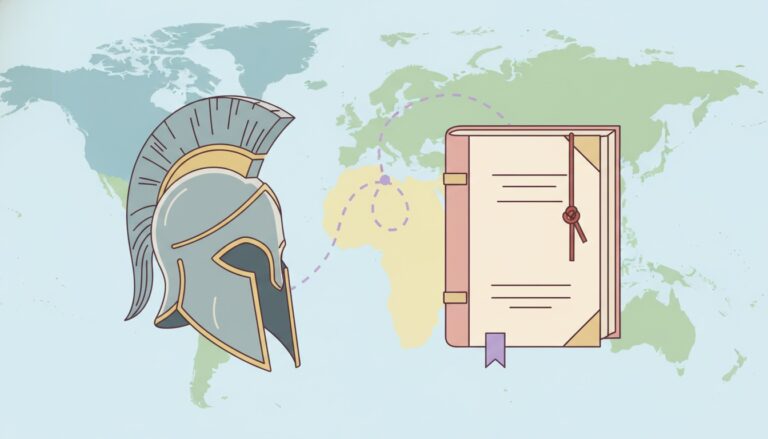
Today, we are going on a special time travel journey! 🕰️ We will look at a very famous historical figure, Alexander the Great, and learn Korean expressions related to history and culture.
“Wait, history? Isn’t that too hard?” No, not at all! 🙅♀️
If you like Sageuk (Korean Historical Dramas) like Kingdom or The Red Sleeve, the words we learn today will be super useful. We will talk about how different cultures meet and create something new, just like how K-Pop mixes Korean and Western styles! Let’s dive in! 🚀
Core Expressions
Here are 4 useful words related to history and cultural fusion.
1. 역사 (History)
- Pronunciation: [Yeoksa]
- English Meaning: History
- Detail: This is the most basic word for “history.” You will hear this a lot in titles of books or when talking about the past.
- 💡 Pronunciation Tip: Even though it is written as 역사, it is often pronounced like [역싸] (Yeokssa) with a stronger ‘s’ sound because of the ‘k’ sound before it. This is called ‘Tensification.’
2. 영웅 (Hero)
- Pronunciation: [Yeong-ung]
- English Meaning: Hero
- Detail: Alexander the Great was a hero to many. In K-dramas, the main character who saves the country is called a 영웅.
- 💡 Pronunciation Tip: Make sure to pronounce the ‘ng’ (ㅇ) sound at the end of both syllables clearly. It’s soft and nasal!
3. 문화 (Culture)
- Pronunciation: [Munhwa]
- English Meaning: Culture
- Detail: Hellenism was a mix of Greek and Eastern culture. Today, we use this word for everything: K-Culture, food culture (식문화), etc.
- 💡 Pronunciation Tip: The ‘h’ (ㅎ) is sometimes weak. In fast speech, it might sound a bit like [Muna].
4. 남기다 (To leave behind)
- Pronunciation: [Namgida]
- English Meaning: To leave (something) behind
- Detail: Alexander left a huge legacy. But you can also use this in daily life!
- “Please leave a message.” (메시지를 남겨 주세요.)
- “Do not leave food.” (음식을 남기지 마세요.)
Real Dialogue
Imagine Minji and Paul are walking through a history museum looking at ancient artifacts.
Minji: 폴, 이 영웅을 알아요? 알렉산더 대왕이에요.
(Pol, i yeong-ung-eul arayo? Alleksandeo daewang-ieyo.)
Paul, do you know this hero? It’s Alexander the Great.
Paul: 네! 그는 정말 대단한 역사를 만들었어요.
(Ne! Geuneun jeongmal daedanhan yeoksa-reul mandeureosseoyo.)
Yes! He created truly great history.
Minji: 맞아요. 동양과 서양의 문화가 만났어요.
(Majayo. Dongyang-gwa seoyang-ui munhwa-ga mannasseoyo.)
That’s right. Eastern and Western cultures met.
Paul: 그래서 멋진 유산을 남겼어요.
(Geuraeseo meotjin yusan-eul namgyeosseoyo.)
So he left behind a cool legacy.
Culture Tip: Sageuk (사극) 🏰
Did you know? Koreans love history! That’s why Sageuk (Historical Dramas) are so popular.
In these dramas, you will see a lot of “fusion” (퓨전 사극), just like Hellenism! Traditional Korean hats (Gat) might appear with modern storytelling. When you watch these dramas, listen for the word 역사 (History) and 영웅 (Hero). It will make watching them much more fun! 🍿
Conclusion & Quiz
Today we learned how to talk about history and culture using Alexander the Great as our inspiration!
- 역사 (Yeoksa) – History
- 영웅 (Yeong-ung) – Hero
- 문화 (Munhwa) – Culture
- 남기다 (Namgida) – To leave behind
📝 Mini Quiz
Fill in the blanks with the correct Korean word!
- BTS spreads Korean [ __________ ] to the world. (Hint: Culture)
- Admiral Yi Sun-sin is a great [ __________ ] of Korea. (Hint: Hero)
- Please [ __________ ] a comment on my blog! (Hint: Leave)
Answer Key:
1. 문화 (Munhwa)
2. 영웅 (Yeong-ung)
3. 남겨 주세요 (Namgyeo juseyo) / 남기다 (Namgida)
See you next time! 안녕! 👋
Frequently Asked Questions (FAQ)
Q: What does "역사 (History)" mean in Korean and how do you pronounce it?
A: In Korean, "역사 (History)" is pronounced [Yeoksa] and means: History
Q: What does "영웅 (Hero)" mean in Korean and how do you pronounce it?
A: In Korean, "영웅 (Hero)" is pronounced [Yeong-ung] and means: Hero
Q: What does "문화 (Culture)" mean in Korean and how do you pronounce it?
A: In Korean, "문화 (Culture)" is pronounced [Munhwa] and means: Culture
Q: What does "남기다 (To leave behind)" mean in Korean and how do you pronounce it?
A: In Korean, "남기다 (To leave behind)" is pronounced [Namgida] and means: To leave (something) behind







