

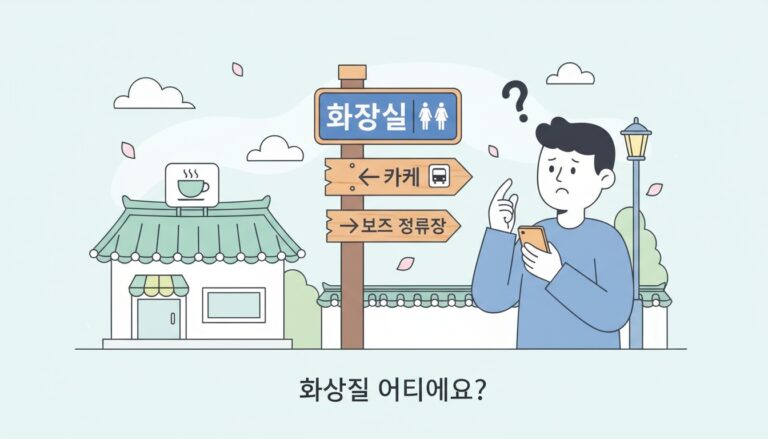
Annyeonghaseyo! 👋 It’s your Korean upgrade time with Daily Hangul!
Imagine this: You are traveling in Seoul, enjoying delicious (but spicy 🌶️) Tteokbokki, and suddenly… nature calls! 😱 Or maybe you’ve seen K-drama scenes where a character frantically runs around looking for a restroom after eating heavy food.
Today, we will learn the #1 Survival Phrase in Korea. Knowing this will save you from awkward situations and let you travel with confidence! Let’s dive in! 🚀
🔑 Key Expressions (3~5)
Here are the essential words you need to memorize today!
1. 화장실 (Hwajangsil)
- Pronunciation: [Hwajangsil]
- Meaning: Restroom / Toilet / Bathroom
- Explanation: This is the standard word for the restroom. It’s polite and used everywhere, from hotels to subway stations.
- 💡 Pronunciation Tip: Break it down into three beats: Hwa – Jang – Sil. The ‘Hwa’ sounds like the start of ‘Flower’.
2. 어디예요? (Eodiyeyo?)
- Pronunciation: [Eodiyeyo?]
- Meaning: Where is it?
- Explanation: You can put any place name before this phrase to ask for directions. It’s a magic phrase! ✨
- 💡 Pronunciation Tip: Connect the sounds smoothly. Instead of “Eodi-yeyo”, say it like “Eodiyeyo”. The intonation should go up at the end ↗️ because it’s a question.
3. 비밀번호 (Bimilbeonho)
- Pronunciation: [Bimilbeonho]
- Meaning: Password / Code
- Explanation: Why learn ‘password’ for a bathroom? (See the Culture Tip below! 😉) It combines Bimil (Secret) + Beonho (Number).
🗣️ Real-Life Dialogue
Situation: You are at a hip cafe in Hongdae. You need to use the restroom.
A (You): 저기요! 화장실 어디예요?
(Jeogiyo! Hwajangsil eodiyeyo?)
Excuse me! Where is the restroom?
B (Staff): 저쪽에 있어요.
(Jeojjoge isseoyo.)
It is over there.
A (You): 감사합니다. 아, 비밀번호 있어요?
(Gamsahamnida. Ah, bimilbeonho isseoyo?)
Thank you. Ah, is there a password?
B (Staff): 네, 영수증에 있어요.
(Ne, yeongsujeunge isseoyo.)
Yes, it is on the receipt.
🇰🇷 Culture Tip: The “Secret” Restroom Code 🔒
Did you know? In Korea, especially in cafes and restaurants located in commercial buildings, restrooms are often locked!
To open them, you might need a digital door lock code (password).
* Where to find it? Usually, it is written on the receipt (yeongsujeung) or taped to the wall near the counter / Wi-Fi password.
* The Key: Sometimes, instead of a code, you have to take a physical key hanging by the door. Often attached to a huge object like a frying pan or a doll so you don’t accidentally take it home! 🧸
📝 Wrap-up & Quiz
Today we learned how to survive a bathroom emergency in Korea! Don’t panic, just remember: “Hwajangsil eodiyeyo?”
Let’s test your skills!
- [Fill in the blank]
A: ___________ eodiyeyo? (Where is the restroom?) - [True or False]
In Korea, you might need a password to enter a cafe restroom. ( O / X )
[Answers]
1. 화장실 (Hwajangsil)
2. O (True! Always check the receipt!)
Frequently Asked Questions (FAQ)
Q: What does "화장실 (Hwajangsil)" mean in Korean and how do you pronounce it?
A: In Korean, "화장실 (Hwajangsil)" is pronounced [Hwajangsil] and means: Restroom / Toilet / Bathroom
Q: What does "어디예요? (Eodiyeyo?)" mean in Korean and how do you pronounce it?
A: In Korean, "어디예요? (Eodiyeyo?)" is pronounced [Eodiyeyo?] and means: Where is it?
Q: What does "비밀번호 (Bimilbeonho)" mean in Korean and how do you pronounce it?
A: In Korean, "비밀번호 (Bimilbeonho)" is pronounced [Bimilbeonho] and means: Password / Code







