

Introduction
Hello! It’s Daily Hangul (DailyHangul.com) here to upgrade your Korean skills! 🌟
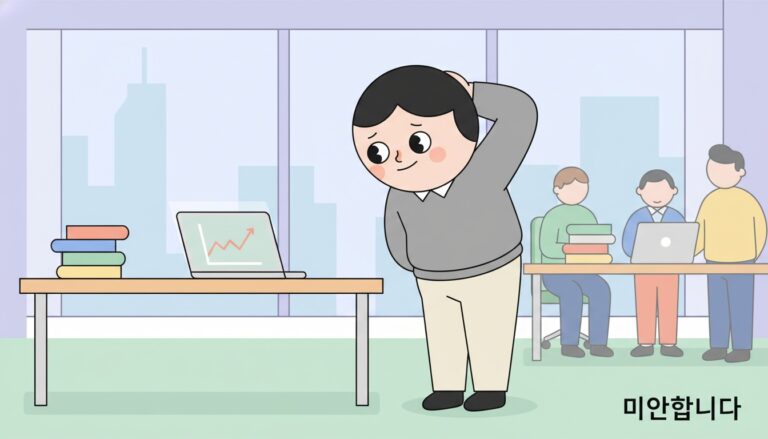
Have you ever watched a K-Drama where a new employee makes a big mistake at work and has to apologize to their boss? 😱 It happens to the best of us! Today, we are going to learn how to handle a tricky situation: dealing with an accidental mistake (like accidental plagiarism).
Maybe you copied a sentence for a report but forgot to change it, or you used a photo you weren’t supposed to. Don’t panic! In Korea, admitting your mistake quickly and politely is the key to forgiveness. Let’s learn how to say “It was a mistake” and “I’ll fix it” like a responsible adult! 💪
Core Expressions
Here are 4 essential phrases to help you navigate through a mistake.
1. 제 실수예요. (It was my mistake.)
- Pronunciation: [Je sil-su-ye-yo]
- English Meaning: It was my mistake.
- Detail: ‘실수’ (silsu) means ‘mistake’. Adding ‘제’ (je – my) and ending with ‘예요’ (yeyo – polite ending) makes it a polite admission of fault. It’s much better than making excuses!
- 💡 Pronunciation Tip: The ‘s’ in ‘sil’ sounds a bit soft, almost like ‘sh’ in ‘she’.
2. 고의가 아니었어요. (It wasn’t intentional.)
- Pronunciation: [Go-ui-ga a-ni-eo-sseo-yo]
- English Meaning: It wasn’t on purpose / It wasn’t intentional.
- Detail: If you are accused of copying something (plagiarism), this is crucial. ‘고의’ (goui) means ‘intention’. You are clarifying that it was an accident.
- 💡 Pronunciation Tip: When saying ‘아니었어요’ (a-ni-eo-sseo-yo), try to link the sounds smoothly. It sounds like a-ni-yuh-ssuh-yo.
3. 몰랐어요. (I didn’t know.)
- Pronunciation: [Mol-la-sseo-yo]
- English Meaning: I didn’t know.
- Detail: Use this when you genuinely didn’t know the rules (e.g., “I didn’t know I had to cite the source”). It’s a very common phrase in daily life too!
- 💡 Pronunciation Tip: Special Rule! 🚨 When ‘ㄹ’ (l) meets another ‘ㄹ’, it creates a strong ‘L’ sound. But here, the bottom ‘ㄹ’ and following ‘ㄹ’ make a strong, rolling L sound. Pronounce it as Molla-ssuh-yo.
4. 바로 수정할게요. (I will fix it right away.)
- Pronunciation: [Ba-ro su-jeong-hal-ge-yo]
- English Meaning: I will correct/fix it right away.
- Detail: In a Korean workplace (or school), apologizing is step one. Step two is offering a solution immediately. ‘수정하다’ means ‘to modify/correct’.
Real Conversation
Let’s see how this works in a university or office setting.
Situation: Min-su (Senior) notices that Jason (Junior) copied a text without changing it.
Min-su: 제이슨 씨, 이 문장 인터넷이랑 똑같아요.
(Jason, this sentence is exactly the same as the internet.)
[Jason-ssi, i mun-jang in-teo-net-i-rang ttok-ga-ta-yo]
Jason: 아, 정말요? 몰랐어요.
(Oh, really? I didn’t know.)
[A, jeong-mal-yo? Mol-la-sseo-yo]
Min-su: 출처를 안 적으면 표절이 될 수 있어요.
(If you don’t write the source, it can be plagiarism.)
[Chul-cheo-reul an jeo-geu-myeon pyo-jeol-i doel su i-sseo-yo]
Jason: 죄송합니다. 제 실수예요. 고의가 아니었어요.
(I’m sorry. It was my mistake. It wasn’t intentional.)
[Joe-song-ham-ni-da. Je sil-su-ye-yo. Go-ui-ga a-ni-eo-sseo-yo]
Jason: 지금 바로 수정할게요.
(I will fix it right away now.)
[Ji-geum ba-ro su-jeong-hal-ge-yo]
Culture Tip 🇰🇷
“Ppalli-Ppalli” (Hurry, Hurry) Culture in Apologies
In Korean culture, especially in professional settings, the speed of your response matters. If you make a mistake, don’t hide it! Admitting it quickly (쿨하게 인정하기 – Cool-ly admitting it) and offering a solution (like fixing the document) is seen as very professional.
Also, when saying “I’m sorry” (죄송합니다), a slight bow of the head shows sincerity. Body language speaks as loud as words in Korea! 🙇♂️
Conclusion & Quiz
Everyone makes mistakes! The important thing is how you handle them. Today we learned how to admit a mistake gracefully in Korean. Don’t be afraid to use these phrases if you slip up!
📝 Mini Quiz
Fill in the blanks with the correct Korean expression.
- A: You stepped on my foot!
B: Oh! Sorry! I didn’t do it on purpose. (______ 아니었어요.) -
A: Why is this report wrong?
B: Sorry, it was my ______ (mistake). -
A: The date is wrong here.
B: Okay, I will ______ (fix/correct) it right away.
Answers:
1. 고의가 (Go-ui-ga)
2. 실수 (Sil-su)
3. 수정할게요 (Su-jeong-hal-ge-yo)
Frequently Asked Questions (FAQ)
Q: What does "고의가 아니었어요. (It wasn't intentional.)" mean in Korean and how do you pronounce it?
A: In Korean, "고의가 아니었어요. (It wasn't intentional.)" is pronounced [Go-ui-ga a-ni-eo-sseo-yo] and means: It wasn't on purpose / It wasn't intentional.
Q: What does "몰랐어요. (I didn't know.)" mean in Korean and how do you pronounce it?
A: In Korean, "몰랐어요. (I didn't know.)" is pronounced [Mol-la-sseo-yo] and means: I didn't know.
Q: What does "바로 수정할게요. (I will fix it right away.)" mean in Korean and how do you pronounce it?
A: In Korean, "바로 수정할게요. (I will fix it right away.)" is pronounced [Ba-ro su-jeong-hal-ge-yo] and means: I will correct/fix it right away.







