

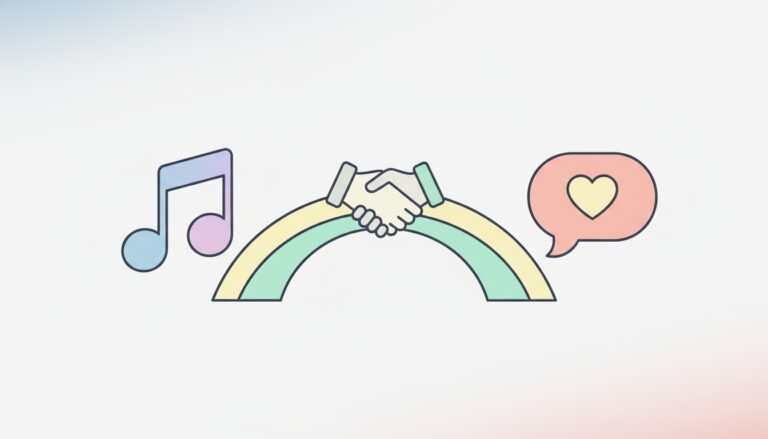
Unlock the Secret of Korean Words: Sound vs. Meaning! 🗝️
👋 Introduction
Annyeonghaseyo! (안녕하세요!) It’s your Korean booster, Daily Hangul! 😊
Have you ever wondered, “Why is a ‘tree’ called ‘namu’ (나무) in Korean?” 🤔 Today, we are going to dive into a very cool topic called “Philosophy of Language,” but don’t worry! We will make it super easy and fun.
Think of this as learning the secret code behind K-Dramas and K-Pop lyrics. Understanding how words are built (the sound vs. the meaning) will help you grasp Korean vocabulary much faster! Let’s become language masters today! 🚀
📚 Core Expressions
Here are 3 key concepts to understand the structure of Korean words. This is inspired by a famous linguist named Saussure, but we’ll keep it simple!
1. 기표 (Gipyo)
- Pronunciation: [Gi-pyo]
- English Meaning: Signifier (The Sound/Word)
- Explanation: This is the sound you hear or the letters you see. For example, when you hear the sound “Sa-gwa,” that sound itself is the Gipyo.
- 💡 Pronunciation Tip: The ‘G’ is soft like ‘Garden’. ‘Pyo’ sounds like the start of ‘Piano’.
2. 기의 (Giui)
- Pronunciation: [Gi-ui]
- English Meaning: Signified (The Meaning/Image)
- Explanation: This is the image that pops into your head when you hear the sound. If you hear “Sa-gwa,” and you imagine a crunchy red fruit 🍎, that image is the Giui.
- 💡 Pronunciation Tip: ‘Ui’ (의) is a tricky vowel! It sounds a bit like the ‘ue’ in ‘Tuesday’ but pull your lips back horizontally. Say “Gi-u-i” quickly.
3. 약속 (Yaksok)
- Pronunciation: [Yak-sok]
- English Meaning: Promise / Convention
- Explanation: Why does “Sa-gwa” mean 🍎? It’s just a promise between Korean speakers! Language is a social contract. If we all agreed to call it “Banana” tomorrow, the Gipyo would change!
- 💡 Pronunciation Tip: The ‘K’ in ‘Yak’ stops abruptly (don’t release a puff of air). It flows smoothly into ‘sok’.
🗣️ Real Conversation
Let’s see how two friends, Minji and Alex, talk about learning new words at a cafe.
Minji: 알렉스, 이 단어 발음이 어려워? (Alex, i daneo bareumi eoryeowo?)
Alex, is the pronunciation of this word difficult?
Alex: 응, ‘사랑’이라는 기표는 쉬운데, 느낌이 달라. (Eung, ‘Sarang’iraneun gipyoneun swiunde, neukkimi dalla.)
Yeah, the signifier (sound) ‘Sarang’ is easy, but the feeling is different.
Minji: 영어의 ‘Love’랑 기의는 같잖아! (Yeong-eoui ‘Love’rang giuineun gatjana!)
But the signified (meaning) is the same as ‘Love’ in English!
Alex: 맞아. 그냥 한국어의 약속이니까 외워야지. (Maja. Geunyang hangugeoui yaksokinikka oewoyaji.)
You’re right. It’s just a Korean promise (convention), so I have to memorize it.
Minji: 파이팅! (Paiting!)
Fighting! (You can do it!)
🇰🇷 Culture Tip: The Power of “Nunchi” (눈치)
In Western linguistics, the relationship between sound (Gipyo) and meaning (Giui) is fixed by a promise. But in Korea, there is a hidden third element called Context or Nunchi! 👀
Sometimes, the word “Ne” (Yes) can mean “I agree,” “I’m listening,” or even “I don’t really want to, but okay.” In Korea, understanding the situation is just as important as knowing the dictionary definition. So, when you watch K-Dramas, listen to the tone and look at the eyes of the actor—that’s where the real meaning often hides! 🎭
📝 Wrap-up & Quiz
Today we learned that words are made of a Sound (Gipyo) and a Meaning (Giui), connected by a social Promise (Yaksok). You are now thinking like a linguist! 🧠✨
Let’s test your knowledge!
- What is the Korean word for the “Sound” or “Word” itself? (Hint: G_p_o)
- What does “Yaksok” mean in English?
- (O/X) The word “Giui” refers to the mental image or meaning.
[Answers]
1. Gipyo (기표)
2. Promise (or Convention)
3. O (True)
Frequently Asked Questions (FAQ)
Q: What does "기표 (Gipyo)" mean in Korean and how do you pronounce it?
A: In Korean, "기표 (Gipyo)" is pronounced [Gi-pyo] and means: Signifier (The Sound/Word)
Q: What does "기의 (Giui)" mean in Korean and how do you pronounce it?
A: In Korean, "기의 (Giui)" is pronounced [Gi-ui] and means: Signified (The Meaning/Image)
Q: What does "약속 (Yaksok)" mean in Korean and how do you pronounce it?
A: In Korean, "약속 (Yaksok)" is pronounced [Yak-sok] and means: Promise / Convention







