

Introduction
Annyeonghaseyo! 👋 Hello, everyone! It’s your favorite Korean tutor, Daily Hangul! (DailyHangul.com) ✨
Have you ever watched K-dramas like Her Private Life or Mine? You often see glamorous art galleries and expensive paintings, right? 🖼️ But sometimes, people whisper, “Is that price real?” or “Is this authentic?”
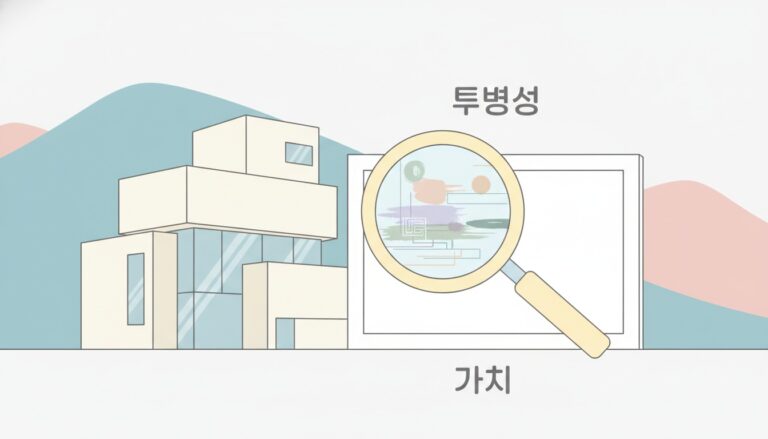
Today, we are going to dive into a slightly sophisticated but super useful topic: The Art Market and Valuation. Specifically, we will learn how to talk about “Transparency” and “Proposing Solutions.”
Don’t worry if it sounds hard! These expressions are actually used very often in daily life when you want to fix a problem or ask for honesty. Let’s upgrade your Korean to be as smart as a curator! 🧐💼
Key Expressions 🔑
Here are 3 key expressions to sound like a pro!
1. 투명하다 (Tumyeonghada)
- English Meaning: To be transparent / To be clear
- Detail: You can use this word for physical objects like clear glass or water, but in news or business (and art!), it means a system is honest and open with no secrets.
- 💡 Pronunciation Tip: [Tu-myeong-ha-da]. The ‘h’ sound in ‘ha’ is often weak. It flows smoothly like Tumyeong-ada.
2. 해결책 (Haegyeolchaek)
- English Meaning: Solution
- Detail: This is a combination of 해결 (solution/settlement) + 책 (plan/measure). When there is a problem, you propose a Haegyeolchaek!
- Example: “해결책이 필요해요.” (We need a solution.)
- 💡 Pronunciation Tip: [Hae-gyeol-chaek]. Make sure to pronounce the ‘L’ sound (ㄹ) in gyeol softly by touching your tongue to the roof of your mouth.
3. 공개하다 (Gonggaehada)
- English Meaning: To make public / To reveal
- Detail: If the art market is secretive, we need to reveal the prices, right? This verb is used when you open information to everyone.
- Example: “가격을 공개해 주세요.” (Please reveal the price.)
- 💡 Pronunciation Tip: [Gong-gae-ha-da]. Similar to the first tip, the ‘h’ can be soft.
Real-Life Dialogue 🗣️
Let’s see how two friends, Min-ji and Jason, talk about buying a painting at a gallery.
Min-ji: 이 그림 가격이 너무 비싼 것 같아.
(I think the price of this painting is too expensive.)
[I geurim gagyeogi neomu bissan geot gata.]
Jason: 맞아. 미술 시장은 더 투명해야 해.
(Right. The art market needs to be more transparent.)
[Maja. Misul sijangeun deo tumyeonghaeya hae.]
Min-ji: 사람들이 진짜 가치를 알 수 없어서 문제야.
(It’s a problem because people can’t know the real value.)
[Saramdeuri jinjja gachireul al su eopseoseo munjeya.]
Jason: 모든 정보를 공개하는 게 좋은 해결책일 거야.
(Making all information public would be a good solution.)
[Modeun jeongboreul gonggaehaneun ge joeun haegyeolchaegil geoya.]
Culture Tip 🇰🇷
Did you know? The “RM Tour” Effect! 💜
In Korea, the art market is booming! A huge reason for the younger generation’s interest in art is RM from BTS. He is known for visiting museums and galleries all over Korea. Fans created the term “RM Tour” to follow his footsteps.
Because so many young people are now interested in art, the demand for a transparent (투명한) market where prices and values are clear is growing stronger. If you visit a gallery in Seoul (like in Samcheong-dong or Hannam-dong), knowing these words will make you look very sophisticated!
Conclusion & Quiz 📝
Today we learned how to ask for honesty and propose solutions!
- 투명하다 (Transparent)
- 해결책 (Solution)
- 공개하다 (To reveal)
Let’s check if you remember! Try to fill in the blanks.
- We need a good [ ] to fix this problem.
(이 문제를 고치기 위해 좋은 _______이/가 필요해요.) -
The system must be [ ].
(시스템은 _______야 해요.)
See you next time! Annyeong! 👋
Answers:
1. 해결책 (Haegyeolchaek)
2. 투명해 (Tumyeonghae) / 투명하다 (Tumyeonghada)
Frequently Asked Questions (FAQ)
Q: What does "투명하다 (Tumyeonghada)" mean in Korean and how do you pronounce it?
A: In Korean, "투명하다 (Tumyeonghada)" is pronounced [Tip: [Tu-myeong-ha-da] and means: To be transparent / To be clear
Q: What does "해결책 (Haegyeolchaek)" mean in Korean and how do you pronounce it?
A: In Korean, "해결책 (Haegyeolchaek)" is pronounced [see lesson guide] and means: Solution
Q: What does "공개하다 (Gonggaehada)" mean in Korean and how do you pronounce it?
A: In Korean, "공개하다 (Gonggaehada)" is pronounced [see lesson guide] and means: To make public / To reveal







