

Introduction
Hello, everyone! It’s your favorite Korean tutor, Daily Hangul (매일한글)! 👋✨
Today, we have a very special and slightly sophisticated topic: “Neuroscience and Human Behavior.” Wait, don’t run away! 🏃♂️💨 I promise we aren’t going to memorize difficult medical terms.
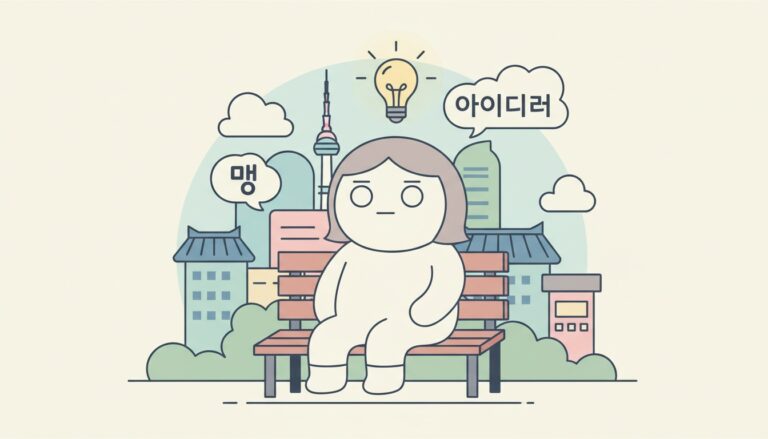
Have you ever watched a K-Drama where the main character is just staring into space, and suddenly—ding! 💡—they get a brilliant idea? That is actually the Default Mode Network (DMN) of the brain at work! In simple terms, your brain works creatively when you are resting.
Let’s learn how to talk about “zoning out,” “resting your brain,” and “getting ideas” in natural Korean. These phrases are super useful when you want to tell your friends, “I’m not lazy, I’m being creative!” 😉
Key Expressions
1. 멍 때리다 (Meong ttaerida)
- Pronunciation: [Meong ttaerida]
- English Meaning: To space out / To zone out
- Detail: This is one of the most popular slang expressions in Korea! ‘멍 (Meong)’ represents the sound or state of a blank mind, and ‘때리다 (ttaerida)’ literally means ‘to hit,’ but here it means ‘to do’ that action deeply. When your brain is in “Default Mode,” you are essentially doing this!
- 💡 Pronunciation Tip: Focus on the ‘ㄸ (tt)’ sound. It is a tense sound, so you need to build up pressure behind your teeth and release it sharply, like the ‘t’ in ‘stop’ (but stronger!).
2. 머리를 식히다 (Meorireul sikhida)
- Pronunciation: [Meorireul sikhida]
- English Meaning: To cool one’s head / To rest one’s brain
- Detail: When you study or work too hard, your brain gets “hot” (overloaded). You need to cool it down to think creatively again. You will hear this often in K-Dramas when a character goes for a walk or drinks coffee after a stressful meeting.
- 💡 Pronunciation Tip: When ‘ㄱ (k)’ meets ‘ㅎ (h)’ in ‘식히다’, they combine to make a strong ‘ㅋ (k)’ sound. So it sounds like [시키다 (sikhida)].
3. 아이디어가 떠오르다 (Aideoga tteooreuda)
- Pronunciation: [Aideoga tteo-o-reu-da]
- English Meaning: An idea comes up / An idea pops into one’s head
- Detail: ‘떠오르다 (tteooreuda)’ means ‘to float up’ or ‘to rise.’ Just like a bubble floating to the surface of the water, a creative idea floats up in your mind!
- 💡 Pronunciation Tip: The word ‘아이디어 (aidea)’ is basically the English word ‘Idea,’ but pronounced with a Korean accent. Make sure to pronounce every syllable clearly: A-I-DI-EO.
4. 창의적이다 (Changui-jeogida)
- Pronunciation: [Chang-ui-jeogida]
- English Meaning: To be creative
- Detail: This is a slightly more formal word, but essential when talking about talents or work. You can say, “I am creative” (저는 창의적이에요).
- 💡 Pronunciation Tip: The vowel ‘의 (ui)’ can be tricky. In this word, try to say ‘eu’ and ‘i’ quickly together. It sounds a bit like the ‘wee’ in ‘sweet’ but starting further back in the throat.
Real Conversation
Let’s see how two friends, Minji and Jason, talk about studying and taking a break.
Minji: 제이슨, 공부 안 해? 왜 가만히 있어? 😯
(Jason, aren’t you studying? Why are you staying still?)
Jason: 아, 나 지금 멍 때리는 중이야. 😐
(Ah, I am zoning out right now.)
Minji: 시간이 없잖아! 빨리 해야지!
(We have no time! You have to hurry!)
Jason: 아니야, 머리를 좀 식혀야 해. 그래야 좋은 아이디어가 떠오르거든. 🧠✨
(No, I need to cool my head a bit. That’s how good ideas pop up.)
Minji: 오… 너 생각보다 창의적이네? 😂
(Oh… You are more creative than I thought?)
Culture Tip: The “Space Out” Competition 🏆
Did you know Korea has a “Space Out Competition” (멍 때리기 대회)?
It sounds like a joke, but it’s a real event held every year at the Han River! Dozens of people sit on the grass and do absolutely nothing—no phones, no talking, no sleeping. They just ‘멍 때리다’.
The goal is to let the brain rest (activate the Default Mode Network!) to relieve stress and boost creativity. If you visit Korea in spring or fall, maybe you can participate and become the champion of doing nothing! 🥇
Conclusion & Quiz
Today we learned that doing nothing isn’t just being lazy—it’s essential for a creative (창의적인) brain! Next time you want to take a break, tell your Korean friends you are “cooling your head.”
📝 Mini Quiz
Try to fill in the blanks!
- I am zoning out. = 저는
______ 때리고 있어요. - I need to rest my brain (cool my head). = ______를 식혀야 해요.
- A good idea popped up! = 좋은 아이디어가 ______!
[Answers]
1. 멍 (Meong)
2. 머리 (Meori)
3. 떠올랐어요 (tteool-lat-seo-yo) / 떠올랐다 (tteool-lat-da)
See you next time! 안녕! 👋❤️
Frequently Asked Questions (FAQ)
Q: What does "멍 때리다 (Meong ttaerida)" mean in Korean and how do you pronounce it?
A: In Korean, "멍 때리다 (Meong ttaerida)" is pronounced [Meong ttaerida] and means: To space out / To zone out
Q: What does "머리를 식히다 (Meorireul sikhida)" mean in Korean and how do you pronounce it?
A: In Korean, "머리를 식히다 (Meorireul sikhida)" is pronounced [Meorireul sikhida] and means: To cool one's head / To rest one's brain
Q: What does "아이디어가 떠오르다 (Aideoga tteooreuda)" mean in Korean and how do you pronounce it?
A: In Korean, "아이디어가 떠오르다 (Aideoga tteooreuda)" is pronounced [Aideoga tteo-o-reu-da] and means: An idea comes up / An idea pops into one's head
Q: What does "창의적이다 (Changui-jeogida)" mean in Korean and how do you pronounce it?
A: In Korean, "창의적이다 (Changui-jeogida)" is pronounced [Chang-ui-jeogida] and means: To be creative







