

Hello! It’s Daily Hangul (DailyHangul.com), here to upgrade your Korean skills! 🌟
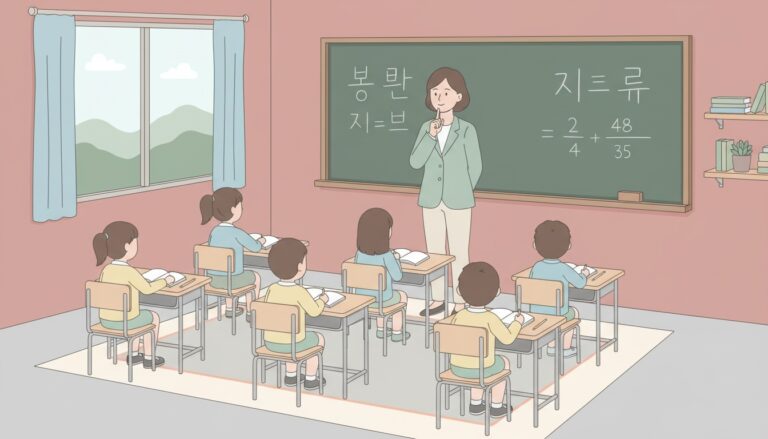
Have you ever watched a Korean school drama like True Beauty or All of Us Are Dead? 🏫 You often see a scene where the class is chaotic, and the teacher (or the class president!) shouts something to make everyone stop talking.
Today, we are going to learn essential expressions for Rules and Obligations in the classroom. Specifically, we will learn how to ask for silence and focus. These phrases are super useful not just in school, but also in libraries, movie theaters, or whenever you need a little peace and quiet! 🤫
Let’s dive into the world of Korean classroom etiquette! 📝
Core Expressions: 3 Essential Phrases 🗣️
1. 조용히 하세요
- Pronunciation: [Joyonghi haseyo]
- English Meaning: Please be quiet.
- Detail: This is the most standard and polite way to tell a group or a person to be quiet. You will hear this a lot from teachers in dramas!
- 💡 Pronunciation Tip: The letter ‘ㅎ’ (h) in ‘조용히‘ is often weak. When spoken naturally, it sounds more like [Joyong-i haseyo].
2. 떠들지 마세요
- Pronunciation: [Tteodeulji maseyo]
- English Meaning: Please don’t chat / Don’t make noise.
- Detail: While ‘Joyonghi haseyo’ is about silence, this phrase specifically targets chatting or talking loudly. The grammar point ‘-지 마세요’ means “Please do not ~”.
- 💡 Pronunciation Tip: The ‘ㄸ’ (tt) is a tense sound. Tense your throat slightly before saying it to make a sharp ‘T’ sound!
3. 집중해 주세요
- Pronunciation: [Jipjunghae juseyo]
- English Meaning: Please focus / Please pay attention.
- Detail: Used when you want someone to pay attention to the whiteboard or the speaker.
- 💡 Pronunciation Tip: ‘Jipjung’ means focus. Try to say it with energy!
Real-life Dialogue 💬
Imagine a classroom right before the exam starts. The teacher enters the noisy room.
Teacher: 여러분, 자리에 앉으세요. 수업 시작해요.
(Yeoreobun, jarie anjeuseyo. Sueop sijakhaeyo.)
Everyone, please sit down. Class is starting.
Students: (Still talking loudly) 🗣️🗣️
Teacher: 자, 다들 조용히 하세요!
(Ja, dadeul joyonghi haseyo!)
Okay, everyone please be quiet!
Student (Mina): 앗, 죄송합니다.
(At, joesonghamnida.)
Oops, I’m sorry.
Teacher: 뒤에 학생들, 떠들지 마세요. 여기 집중해 주세요.
(Dwie haksaengdeul, tteodeulji maseyo. Yeogi jipjunghae juseyo.)
Students in the back, please don’t chat. Please focus here.
Culture Tip: The “Study Cafe” Culture ☕📚
Did you know that Korean students study incredibly hard? Because of this, Study Cafes (스터디 카페) are everywhere in Korea!
Unlike regular cafes where you can chat, Study Cafes are designed for pure concentration. It is an unwritten rule (and often a written one!) to be extremely quiet there. If you visit one, remember today’s phrase: “조용히 하세요” (Be quiet) is the golden rule. If you make noise, you might get a sticky note from a neighbor asking for silence! 🤫
Wrap-up & Practice Quiz ✍️
Today we learned how to keep the peace in a Korean classroom! These phrases help you understand instructions and respect public etiquette.
Let’s test your knowledge!
- Fill in the blank:
To say “Please be quiet,” you say: “_________ 하세요.”
(Hint: Jo…) -
True or False:
“떠들지 마세요” (Tteodeulji maseyo) means “Please sing loudly.”
Answer Key:
1. 조용히 (Joyonghi)
2. False (It means “Please don’t chat/make noise”)
See you next time! 안녕! 👋
Frequently Asked Questions (FAQ)
Q: What does "조용히 하세요" mean in Korean and how do you pronounce it?
A: In Korean, "조용히 하세요" is pronounced [Joyonghi haseyo] and means: Please be quiet.
Q: What does "떠들지 마세요" mean in Korean and how do you pronounce it?
A: In Korean, "떠들지 마세요" is pronounced [Tteodeulji maseyo] and means: Please don't chat / Don't make noise.
Q: What does "집중해 주세요" mean in Korean and how do you pronounce it?
A: In Korean, "집중해 주세요" is pronounced [Jipjunghae juseyo] and means: Please focus / Please pay attention.







