

Introduction
Annyeonghaseyo! Hello, everyone! It’s your favorite Korean tutor, Daily Hangul! 👋✨
Did you know that about 70% of South Korea is covered in mountains? 🏔️ That means hiking and walking in the forest are huge parts of Korean life! Whether you are watching a K-Drama scene where the main characters go on a romantic walk, or you are planning a trip to Namsan Park in Seoul, knowing how to talk about nature is essential!
Today, we are going to learn how to express what we see and feel in a beautiful Korean forest. Get ready to breathe in some fresh air! 🌿🧘♀️
Key Expressions
Here are 3 essential expressions you must know when you are in nature!
1. 나무 (Namu)
- Pronunciation: [Namu]
- Meaning: Tree
- Details: This is the most basic word for the forest. In Korea, you will see a lot of pine trees (Sobaek-san, Seorak-san, etc.). If you see many trees, you can say “Namuga manayo” (There are many trees).
- 💡 Pronunciation Tip: The ‘u’ in ‘Namu’ sounds like the ‘u’ in ‘Moon’, but shorter. Don’t make it too long!
2. 다람쥐 (Daramjwi)
- Pronunciation: [Daramjwi]
- Meaning: Squirrel
- Details: Korean mountains are full of these cute little friends! 🐿️ If you spot one, you can point and say this word. It’s a very popular word in children’s songs too.
- 💡 Pronunciation Tip: The ‘jwi’ part can be tricky. It sounds a bit like ‘jwee’. Round your lips when saying ‘wi’!
3. 공기가 맑아요 (Gonggiga malgayo)
- Pronunciation: [Gonggiga malgayo]
- Meaning: The air is fresh / The air is clear.
- Details: ‘Gonggi’ means air, and ‘Malgayo’ means clear/clean. Use this when you take a deep breath in the forest and feel refreshed! It’s the perfect phrase for “Healing” (a popular concept in Korea).
- 💡 Pronunciation Tip: Look at the spelling 맑 (malg). When followed by a vowel (like -ayo), both the ‘l’ and ‘g’ sounds are pronounced. So it sounds like [Mal-ga-yo].
Real-life Conversation
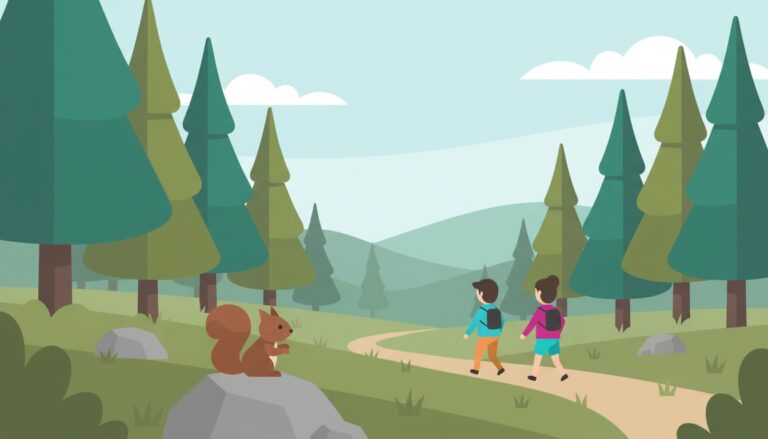
Imagine Minji and Alex are hiking lightly in a mountain near Seoul. Let’s listen! 🎧
Minji: 우와, 여기 나무가 정말 많아요! 🌳
(Uwa, yeogi namuga jeongmal manayo!)
Wow, there are so many trees here!
Alex: 네, 그래서 공기가 맑아요. 기분이 좋아요. 😌
(Ne, geuraeseo gonggiga malgayo. Gibuni joayo.)
Yes, that’s why the air is fresh. I feel good.
Minji: 앗! 저기 보세요. 다람쥐예요! 🐿️
(At! Jeogi boseyo. Daramjwiyeyo!)
Oh! Look over there. It’s a squirrel!
Alex: 정말 귀여워요!
(Jeongmal gwiyeowoyo!)
It’s really cute!
Culture Tip: “Deungsan” (Hiking) Fashion 🎒
In Korea, hiking (Deungsan) is not just a walk; it’s a national hobby! When you go to a Korean mountain on the weekend, you will be surprised. Even on small hills, many Koreans wear professional hiking gear from head to toe! Colorful jackets, hiking sticks, and backpacks are everywhere. 🧢🧥
Also, after hiking, it’s a tradition to eat yummy food like Pajeon (green onion pancake) and drink Makgeolli (rice wine) at the bottom of the mountain. If you visit Korea, you must try this “full course” experience!
Conclusion & Quiz
Great job today! Now you are ready to enjoy the beautiful nature in Korea. Don’t forget to look for a Daramjwi next time you are outside! 🐿️
📝 Mini Quiz
Let’s check what you remember! (Answers are at the bottom)
- How do you say “Tree” in Korean?
(A) Kkot (B) Namu -
Fill in the blank: “The air is fresh” = Gonggiga ______.
(A) Malgayo (B) Joayo -
(True/False) Koreans rarely wear professional gear when hiking.
See you next time! Annyeong! 👋
Answers: 1. (B), 2. (A), 3. False (They love professional gear!)
Frequently Asked Questions (FAQ)
Q: What does "나무 (Namu)" mean in Korean and how do you pronounce it?
A: In Korean, "나무 (Namu)" is pronounced [Namu] and means: Tree
Q: What does "다람쥐 (Daramjwi)" mean in Korean and how do you pronounce it?
A: In Korean, "다람쥐 (Daramjwi)" is pronounced [Daramjwi] and means: Squirrel
Q: What does "공기가 맑아요 (Gonggiga malgayo)" mean in Korean and how do you pronounce it?
A: In Korean, "공기가 맑아요 (Gonggiga malgayo)" is pronounced [Gonggiga malgayo] and means: The air is fresh / The air is clear.







