

Hello! It’s Daily Hangul! 👋
Hello, K-culture lovers! It’s your friendly Korean tutor, Daily Hangul! 🌟
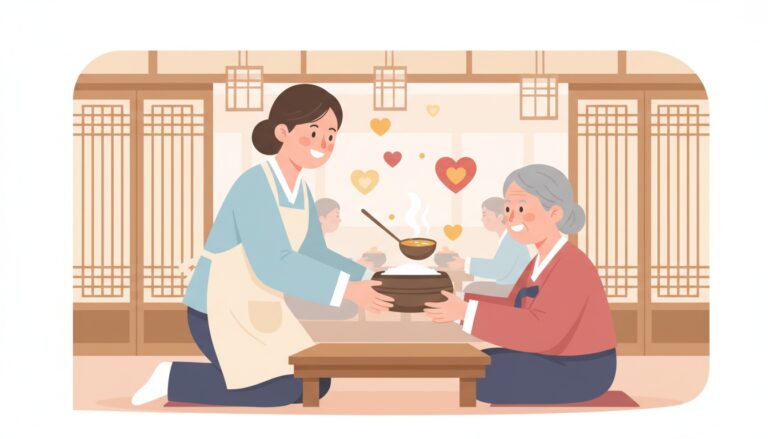
Have you ever seen K-drama scenes where the main characters volunteer at a community center? It’s a heartwarming way to experience the Korean spirit of Jeong (정 – affection/bonding). Today, we are going to learn essential expressions you can use when serving food at a soup kitchen (무료 급식소).
Even if you aren’t volunteering right now, these phrases are super useful when you invite guests to your home or serve food to elders! Let’s become a warm-hearted Korean speaker today! Let’s go! 🚀
🍚 Key Expressions
1. 어서 오세요 (Welcome / Come in)
- Pronunciation: [Eoseo oseyo]
- Meaning: Welcome.
- Detail: You will hear this everywhere in Korea, from restaurants to convenience stores. In a volunteering context, it shows a warm welcome to the people coming to eat. It’s polite and friendly!
- 💡 Pronunciation Tip: Connect the sounds smoothly! Instead of saying “Eoseo-Oseyo” separately, say it like “Eoseo-oseyo” in one breath. The ‘eo’ sounds like the ‘u’ in ‘run’.
2. 맛있게 드세요 (Enjoy your meal)
- Pronunciation: [Masitge deuseyo]
- Meaning: Please eat deliciously (Enjoy your meal).
- Detail: This is the magic phrase! You say this when you hand over the food tray. It’s the polite version of “Bon appétit.”
- 💡 Pronunciation Tip: Watch out for the ‘ㅅ’ (s) in ‘맛(mat)’. When followed by ‘이(i)’, it sounds like ‘sh’. So, it sounds closer to [Mashitge deuseyo].
3. 더 드릴까요? (Would you like more?)
- Pronunciation: [Deo deurilkkayo?]
- Meaning: Shall I give you more?
- Detail: ‘더 (Deo)’ means ‘more’. ‘드릴까요 (Deurilkkayo)’ is a polite way to ask “Shall I give?”. Use this if someone looks hungry or asks for extra rice!
- 💡 Pronunciation Tip: The double ‘ㄹ’ (ll) in ‘드릴(Deuril)’ should be rolled slightly, like the ‘l’ in ‘lily’.
4. 뜨거우니까 조심하세요 (It’s hot, so be careful)
- Pronunciation: [Tteugeounikka josimhaseyo]
- Meaning: It is hot, so please be careful.
- Detail: Korean soups are often served boiling hot! 🔥 This is a very caring phrase to ensure safety. ‘조심하세요 (Josimhaseyo)’ means ‘Please be careful’.
🗣️ Real-life Conversation
Situation: You are volunteering at a soup kitchen, serving lunch to an elderly person.
Volunteer (You): 어서 오세요! 여기 있습니다.
[Eoseo oseyo! Yeogi itseumnida.]
(Welcome! Here you go.)
Grandma: 아이고, 고마워요.
[Aigo, gomawoyo.]
(Oh my, thank you.)
Volunteer (You): 국이 뜨거우니까 조심하세요. 맛있게 드세요!
[Gugi tteugeounikka josimhaseyo. Masitge deuseyo!]
(The soup is hot, so please be careful. Enjoy your meal!)
Grandma: 네, 학생도 수고해요.
[Ne, haksaengdo sugohaeyo.]
(Yes, thank you for your hard work, student.)
Volunteer (You): 밥 더 드릴까요?
[Bap deo deurilkkayo?]
(Would you like more rice?)
🇰🇷 Culture Tip: The Power of Two Hands 🙌
In Korea, politeness is physical! When you are serving food, handing over a tray, or pouring water for someone older or someone you don’t know well, you must use two hands.
- How to do it: Hold the object with your right hand and lightly support your right wrist or elbow with your left hand. Or simply hold the tray with both hands.
- Why? It shows respect. If you serve food with one hand in a drama, the elders might click their tongues! 😲 Using two hands makes you look like a pro Korean learner!
📝 Wrap-up & Quiz
Today we learned how to share warmth through food! Serving others isn’t just about the meal; it’s about the kind words you say with it.
Let’s test your memory! (Answers are at the bottom)
- How do you say “Enjoy your meal” in Korean polite language?
( M________ D_______ ) -
True or False: When serving food to an elder, it is okay to use only one hand.
( O / X ) -
Fill in the blank: “It is hot, please be careful.”
= “뜨거우니까 _________.”
Happy Learning! See you next time! 안녕! 👋
Answers:
1. 맛있게 드세요 (Masitge deuseyo)
2. X (You should use two hands!)
3. 조심하세요 (Josimhaseyo)
Frequently Asked Questions (FAQ)
Q: What does "어서 오세요 (Welcome / Come in)" mean in Korean and how do you pronounce it?
A: In Korean, "어서 오세요 (Welcome / Come in)" is pronounced [Eoseo oseyo] and means: Welcome.
Q: What does "맛있게 드세요 (Enjoy your meal)" mean in Korean and how do you pronounce it?
A: In Korean, "맛있게 드세요 (Enjoy your meal)" is pronounced [Masitge deuseyo] and means: Please eat deliciously (Enjoy your meal).
Q: What does "더 드릴까요? (Would you like more?)" mean in Korean and how do you pronounce it?
A: In Korean, "더 드릴까요? (Would you like more?)" is pronounced [Deo deurilkkayo?] and means: Shall I give you more?
Q: What does "뜨거우니까 조심하세요 (It's hot, so be careful)" mean in Korean and how do you pronounce it?
A: In Korean, "뜨거우니까 조심하세요 (It's hot, so be careful)" is pronounced [Tteugeounikka josimhaseyo] and means: It is hot, so please be careful.







