

Panic at the Bank? Fix Errors Like a Pro! 🏦
Introduction
Hello! I’m Daily Hangul, your friendly guide to mastering Korean! 👋
Have you ever checked your bank account or a receipt and noticed the numbers didn’t match? 😱 It happens! In K-Dramas, this is usually the moment the main character realizes they are broke or suddenly rich! But in real life, it’s just a stressful moment we need to fix.
Today, we will learn how to politely request a correction when there is a mistake in your bank transaction or bill. Don’t worry, even if you are angry or confused, speaking politely (Honorifics) gets the problem solved faster in Korea! Let’s become a master of conflict resolution! 💪
Key Expressions
Here are 3 essential phrases to handle errors smoothly.
1. 뭔가 이상해요.
- Pronunciation: [Mwonga isanghaeyo]
- English: Something is strange / weird.
- Explanation: This is a soft way to start the conversation. Instead of saying “You made a mistake!” (which can sound aggressive), saying “Something is strange” invites the staff to look at the problem with you. It’s very commonly used in daily life.
- 💡 Pronunciation Tip: In 이상해요 (isanghaeyo), the ‘ㅎ’ (h) sound is often weak. It sounds more like [i-sang-ae-yo] when spoken quickly!
2. 다시 확인해 주세요.
- Pronunciation: [Dasi hwaginhae juseyo]
- English: Please check it again.
- Explanation: This is the most important phrase today! 다시 (dasi) means “again” and 확인해 주세요 (hwaginhae juseyo) means “please check/verify.” You can use this at a bank, a restaurant, or even at work.
- 💡 Pronunciation Tip: When saying 확인 (hwagin), emphasize the ‘in’. For 주세요 (juseyo), say it softly to sound polite.
3. 금액이 달라요.
- Pronunciation: [Geumaegi dallayo]
- English: The amount is different.
- Explanation: Use this when the money you see on the screen or paper is different from what you expected. 금액 (geumaek) means “amount of money.”
- 💡 Pronunciation Tip: Linking sound alert! 🔗 The ‘ㄱ’ in 금액 moves to the next block. So, 금액이 sounds like [Geu-mae-gi].
Real Conversation
Let’s see how to use these in a bank setting!
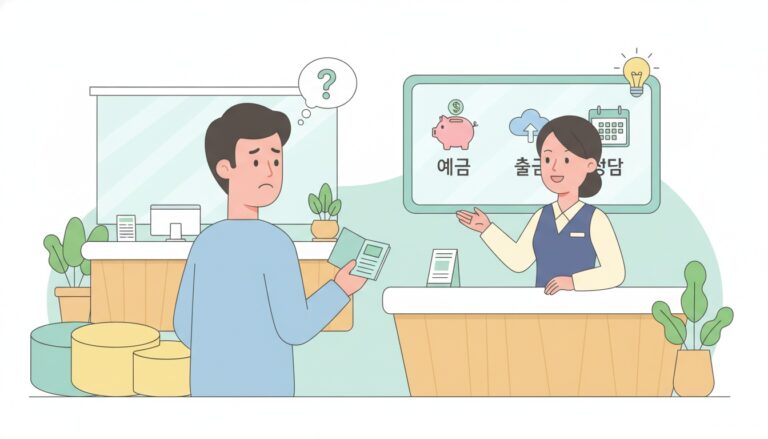
(At the bank counter)
🏦 Bank Teller: 안녕하세요, 무엇을 도와드릴까요?
(Annyeonghaseyo, mueoseul dowadeurilkkayo?)
Hello, how can I help you?
👤 You: 저기요, 통장 잔액이 뭔가 이상해요.
(Jeogiyo, tongjang janaegi mwonga isanghaeyo.)
Excuse me, something is strange with my bankbook balance.
🏦 Bank Teller: 아, 그래요? 잠시만요.
(A, geuraeyo? Jamsimanyo.)
Oh, really? Just a moment.
👤 You: 제가 입금한 금액이 달라요. 다시 확인해 주세요.
(Jega ipgeumhan geumaegi dallayo. Dasi hwaginhae juseyo.)
The amount I deposited is different. Please check it again.
🏦 Bank Teller: 죄송합니다. 전산 오류가 있었네요. 바로 수정해 드릴게요!
(Joesonghamnida. Jeonsan oryuga isseonneyo. Baro sujeonghae deurilgeyo!)
I apologize. There was a system error. I will correct it right away!
Culture Tip 🇰🇷
“Softness is Strength”
In Korea, when pointing out a mistake to a staff member (banker, server, clerk), it is culturally better to be indirect at first.
Instead of saying “This is wrong!” (이거 틀렸어요!), using “~인 것 같아요” (I think it is…) or “이상해요” (It’s strange) makes you sound like a sophisticated, polite native speaker. If you start shouting, the situation might get awkward quickly. A smile and a polite request usually solve bank errors in 5 minutes! 😊
Wrap-up & Quiz
Today we learned how to fix money mistakes without fighting! Remember, being polite is your superpower in Korea. 🦸♀️🦸♂️
Let’s practice! (Answers are at the bottom)
- Fill in the blank:
“Please check again.”
= 다시 _______ 주세요. (Dasi _______ juseyo.) -
True or False:
It is better to shout loudly when you see a mistake in Korea. ( O / X ) -
Translate this:
“Something is strange.”
= __________________.
Good job today! See you next time! 안녕! 👋
Answers:
1. 확인해 (hwaginhae)
2. X (Being polite/soft is better!)
3. 뭔가 이상해요 (Mwonga isanghaeyo)
Frequently Asked Questions (FAQ)
Q: What does "뭔가 이상해요." mean in Korean and how do you pronounce it?
A: In Korean, "뭔가 이상해요." is pronounced [Mwonga isanghaeyo] and means: a key conversational Korean expression covered in this lesson.
Q: What does "다시 확인해 주세요." mean in Korean and how do you pronounce it?
A: In Korean, "다시 확인해 주세요." is pronounced [Dasi hwaginhae juseyo] and means: a key conversational Korean expression covered in this lesson.
Q: What does "금액이 달라요." mean in Korean and how do you pronounce it?
A: In Korean, "금액이 달라요." is pronounced [Geumaegi dallayo] and means: a key conversational Korean expression covered in this lesson.







