

Hello! It’s Daily Hangul! (매일한글) 👋
Hello, K-Culture fans! Welcome back to Daily Hangul, where we upgrade your Korean skills for real life! 🚀
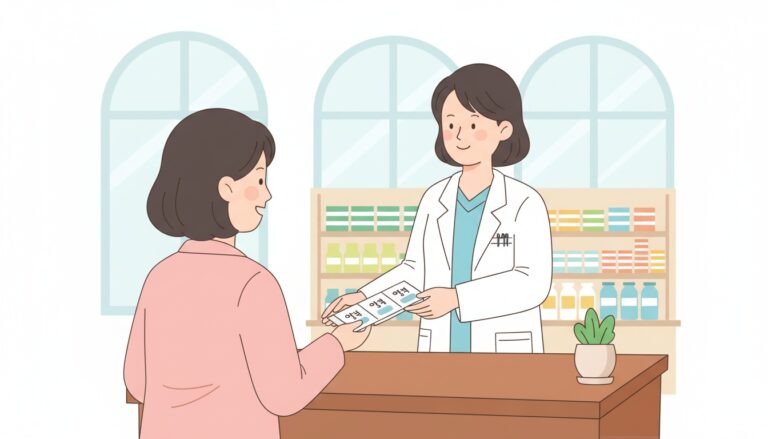
Have you ever gotten sick while traveling? It’s scary, right? In our last lesson, we visited the doctor. Today, we are going to the Pharmacy (약국, Yakguk) to get your medicine! 💊
In K-Dramas, you often see characters handing over a piece of paper and getting little paper packets of pills. Today, you will learn exactly what to say in that situation so you can get better fast! Let’s dive in! 💪
Key Expressions 🗣️
Here are the 4 most useful expressions when buying prescription medicine.
1. 처방전 여기 있어요. (Cheobangjeon yeogi isseoyo.)
- English: Here is the prescription.
- Meaning: After seeing a doctor, you get a paper called 처방전 (Prescription). You must give this to the pharmacist to get your specific medicine.
- 💡 Pronunciation Tip:
- Cheobangjeon: [Cheo-bang-jeon]
- Be careful with ‘Cheo’ (처). It sounds like the ‘chu’ in ‘church’ but with an ‘oh’ sound. Open your mouth vertically!
2. 식후 30분에 드세요. (Sikhu samsip-bune deuseyo.)
- English: Please take it 30 minutes after a meal.
- Meaning: This is the #1 phrase pharmacists say! 식후 (Sikhu) means ‘after a meal’. Most Korean medicines are prescribed to be taken after eating to protect your stomach.
- 💡 Pronunciation Tip:
- Sikhu: [Si-ku]
- Why [Si-ku]? When ‘k’ (ㄱ) meets ‘h’ (ㅎ), they combine to make a strong ‘K’ sound. This makes it flow smoother!
3. 어떻게 먹어요? (Eotteoke meogeoyo?)
- English: How should I take/eat this?
- Meaning: If you didn’t understand the pharmacist’s instructions, ask this! In Korean, we use the verb 먹다 (to eat) for medicine, not ‘take’.
- 💡 Pronunciation Tip:
- Eotteoke: [Eo-tteo-ke]
- Again, the ‘h’ (ㅎ) in ‘hye’ blends with ‘g’ (ㄱ) to make a strong ‘K’ sound. It sounds like “Ot-tok-kay”.
4. 영수증 주세요. (Yeongsujeung juseyo.)
- English: Please give me the receipt.
- Meaning: If you have travel insurance, you definitely need the 영수증 (receipt)! Always ask for this after paying.
- 💡 Pronunciation Tip:
- Yeongsujeung: [Yeong-su-jeung]
- ‘Jeung’ can be tricky. It’s like ‘June’ but with an ‘ng’ at the end.
Real-life Conversation 💬
Imagine you are at a local pharmacy near your hotel.
💊 Pharmacist: 어서 오세요. (Eoseo oseyo. / Welcome.)
👤 You: 안녕하세요. 처방전 여기 있어요. (Annyeonghaseyo. Cheobangjeon yeogi isseoyo.)
(Hello. Here is the prescription.)
💊 Pharmacist: (Checks paper) 네, 잠시만요. (Ne, jamsimanyo. / Okay, just a moment.)
(Pharmacist hands over the medicine bag)
💊 Pharmacist: 하루 세 번, 식후 30분에 드세요. (Haru se beon, sikhu samsip-bune deuseyo.)
(Take this 3 times a day, 30 minutes after a meal.)
👤 You: 네, 알겠습니다. 얼마예요? (Ne, algetseumnida. Eolmayeyo?)
(Okay, I understand. How much is it?)
💊 Pharmacist: 5,000원입니다. (O-cheon-won imnida. / It’s 5,000 won.)
👤 You: 여기요. 아, 영수증 주세요! (Yeogiyo. Ah, yeongsujeung juseyo!)
(Here you go. Ah, please give me the receipt!)
Culture Tip 🇰🇷
The Magic of “Yak-bong-ji” (Medicine Packets)
In many Western countries, you get plastic bottles with pills inside. But in Korea, the pharmacist (or a machine) sorts your pills for each dose into small paper or plastic packets! 🍬
If you have to take 3 pills at once, they are all wrapped together in one little bag. You just tear one packet open after every meal. It is super convenient and you never forget if you took your meds or not! This is called 약봉지 (Yak-bong-ji).
Conclusion & Quiz 📝
Great job! Now you can confidently buy medicine in Korea without being nervous. Remember, your health comes first!
Let’s check what you learned:
- What is the Korean word for “Prescription”? (Hint: C_______)
- Does 식후 (Sikhu) mean “Before a meal” or “After a meal”?
- (Fill in the blank) If you need a receipt for insurance, say: “_______ juseyo.”
Answers:
1. Cheobangjeon (처방전)
2. After a meal
3. Yeongsujeung (영수증)
See you in the next lesson! Stay healthy! 안녕! 👋
Frequently Asked Questions (FAQ)
Q: What does "처방전 여기 있어요. (Cheobangjeon yeogi isseoyo.)" mean in Korean and how do you pronounce it?
A: In Korean, "처방전 여기 있어요. (Cheobangjeon yeogi isseoyo.)" is pronounced [Tip:] and means: After seeing a doctor, you get a paper called 처방전 (Prescription). You must give this to the pharmacist to get your specific medicine.
Q: What does "식후 30분에 드세요. (Sikhu samsip-bune deuseyo.)" mean in Korean and how do you pronounce it?
A: In Korean, "식후 30분에 드세요. (Sikhu samsip-bune deuseyo.)" is pronounced [Tip:] and means: This is the #1 phrase pharmacists say! 식후 (Sikhu) means 'after a meal'. Most Korean medicines are prescribed to be taken after eating to protect your stomach.
Q: What does "어떻게 먹어요? (Eotteoke meogeoyo?)" mean in Korean and how do you pronounce it?
A: In Korean, "어떻게 먹어요? (Eotteoke meogeoyo?)" is pronounced [Tip:] and means: If you didn't understand the pharmacist's instructions, ask this! In Korean, we use the verb 먹다 (to eat) for medicine, not 'take'.
Q: What does "영수증 주세요. (Yeongsujeung juseyo.)" mean in Korean and how do you pronounce it?
A: In Korean, "영수증 주세요. (Yeongsujeung juseyo.)" is pronounced [Tip:] and means: If you have travel insurance, you definitely need the 영수증 (receipt)! Always ask for this after paying.







