

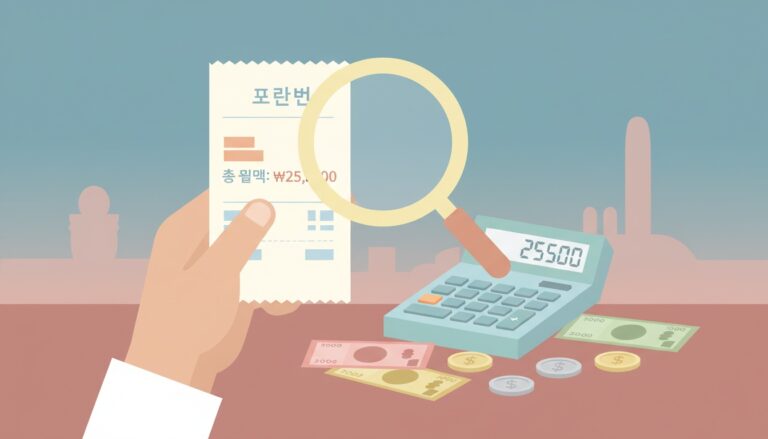
Annyeonghaseyo! 👋 Welcome to Daily Hangul!
Hello, K-culture lovers! It’s your friendly Korean tutor, Daily Hangul! 🍎
Have you ever watched a K-drama scene where the main character treats their friends to a fancy dinner in Gangnam, or checks out of a luxury hotel? 🏨 Sometimes, the bill can be a little surprising!
Today, we are going to learn how to be a smart shopper and traveler in Korea. We will learn how to ask if the service charge or tax is included in the price. This is super useful when you are budgeting for your trip! Let’s dive in! 🚀
🔑 Key Expressions
Here are 3 essential phrases to help you understand your bill perfectly!
1. Is the service charge included?
- Korean: 봉사료 포함인가요?
- Pronunciation: [Bongsaryo pohamingayo?]
- English Meaning: Is the service charge included?
- Detail:
- Bongsaryo (봉사료) means “service charge.”
- Poham (포함) means “included.”
- Ingayo? (인가요?) is a polite way to ask “Is it?”
- Use this at hotels or high-end restaurants to check if the extra fee is already in the bill.
💡 Pronunciation Tip:
When you say 포함인가요 (Pohamingayo), the bottom consonant ‘ㅁ’ (m) in ‘함’ carries over to the next vowel ‘인’. So it sounds more like [Po-ha-min-ga-yo]. Say it smoothly! 🌊
2. Is tax separate?
- Korean: 세금은 별도인가요?
- Pronunciation: [Segeumeun byeoldoingayo?]
- English Meaning: Is tax separate (excluded)?
- Detail:
- Segeum (세금) means “tax.”
- Byeoldo (별도) means “separate” or “excluded.”
- Usually, VAT (Value Added Tax) is included in Korean price tags, but it’s good to ask in special places!
3. Please give me the receipt.
- Korean: 영수증 주세요.
- Pronunciation: [Yeongsujeung juseyo]
- English Meaning: Please give me the receipt.
- Detail:
- Yeongsujeung (영수증) is “receipt.”
- Juseyo (주세요) is the magic word for “Please give me.”
- You might hear this often in K-dramas when detectives are looking for clues! 🕵️♂️
💬 Real-life Conversation
Imagine you are checking out at a nice hotel front desk. 🛎️
Clerk: 여기 계산서입니다. (Yeogi gyesanseoimnida.)
Here is the bill.
You: 금액이 생각보다 많네요. 봉사료 포함인가요? (Geumaegi saenggakboda manneyo. Bongsaryo pohamingayo?)
The amount is higher than I thought. Is the service charge included?
Clerk: 네, 봉사료와 세금 모두 포함입니다. (Ne, bongsaryo-wa segeum modu pohamimnida.)
Yes, service charge and tax are both included.
You: 아, 알겠습니다. 영수증 주세요. (Ah, algetseumnida. Yeongsujeung juseyo.)
Ah, I understand. Please give me the receipt.
🇰🇷 Culture Tip: Tipping in Korea
Here is a very important tip! Korea generally has a “No Tipping” culture. 🙅♂️💰
Unlike in the US or some European countries, you do not need to leave a tip at cafes, restaurants, or taxis. The price you see on the menu is usually the final price you pay!
However, in luxury hotels or high-end restaurants, a 10% service charge and 10% tax might be added to your bill automatically. That is exactly why asking “Bongsaryo pohamingayo?” is a pro move! 😉
📝 Wrap-up & Quiz
Great job today! Now you can check your bills with confidence like a local. Let’s see if you remember the key words!
Quiz: Fill in the blanks!
- “Is the service charge included?”
= ________ 포함인가요? (________ pohamingayo?) -
“Please give me the receipt.”
= ________ 주세요. (________ juseyo.)
Try to answer before looking down! 👇
.
.
.
✅ Answers:
1. 봉사료 (Bongsaryo)
2. 영수증 (Yeongsujeung)
See you next time with more useful Korean! Annyeong! 👋❤️
Frequently Asked Questions (FAQ)
Q: What does "Is the service charge included?" mean in Korean and how do you pronounce it?
A: In Korean, "Is the service charge included?" is pronounced [Bongsaryo pohamingayo?] and means: Is the service charge included?
Q: What does "Is tax separate?" mean in Korean and how do you pronounce it?
A: In Korean, "Is tax separate?" is pronounced [Segeumeun byeoldoingayo?] and means: Is tax separate (excluded)?
Q: What does "Please give me the receipt." mean in Korean and how do you pronounce it?
A: In Korean, "Please give me the receipt." is pronounced [Yeongsujeung juseyo] and means: Please give me the receipt.







