

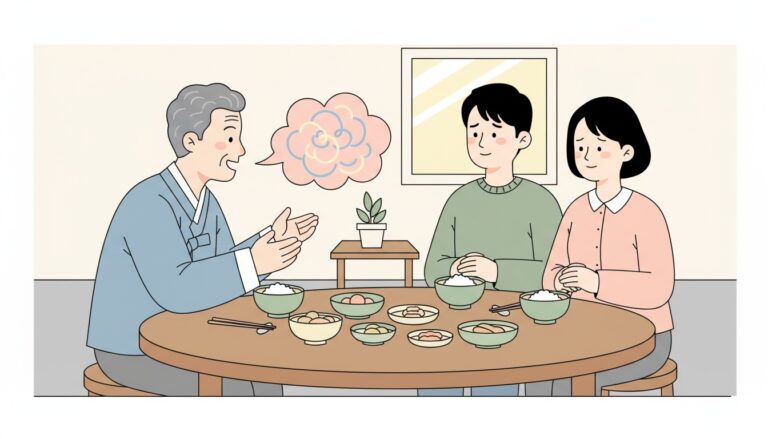
🗣️ Handling Generation Gaps in Korea!
Introduction
Hello! It’s Daily Hangul here to upgrade your Korean skills! 🚀
Have you ever watched a K-Drama like Reply 1988 or a family weekend drama? You often see scenes where the whole family is eating dinner, and suddenly the dad or uncle starts talking about politics, making the atmosphere awkward! 😅
In Korea, the Generation Gap regarding social and political views is a real thing. Today, we will learn how to describe this situation and how to politely express that your opinion might be different. These phrases are super useful for understanding Korean culture and protecting your peace during conversations! Let’s dive in! 🇰🇷✨
Key Expressions
1. 세대 차이 (Generation gap)
- Pronunciation: [Sede chai]
- Meaning: Generation gap
- Detail: This is the most common word to describe the differences in thinking between older and younger people. If you feel a disconnect with someone older, you can say “We feel the Sede chai.”
- 💡 Pronunciation Tip: The ‘ch’ in ‘Chai’ is aspirated, so let a little burst of air out! It sounds like the ‘ch’ in ‘change’.
2. 생각이 달라요 (My thoughts are different)
- Pronunciation: [Saenggagi dallayo]
- Meaning: My thoughts are different / I disagree.
- Detail: In Korea, saying “You are wrong” to an older person is considered rude. Instead, use this softer expression. It acknowledges their opinion while stating yours is different. It’s a very polite way to disagree.
- 💡 Pronunciation Tip: ‘Saeng-gak’ (thought) + ‘i’ (particle). When spoken fast, the ‘k’ sound moves to the next syllable, sounding like [Saeng-ga-gi].
3. 다른 이야기 해요 (Let’s talk about something else)
- Pronunciation: [Dareun iyagi haeyo]
- Meaning: Let’s talk about something else / Let’s change the topic.
- Detail: When the conversation about politics or social issues gets too heated or uncomfortable, you can use this phrase to steer the conversation to a happier topic!
- 💡 Pronunciation Tip: ‘Haeyo’ is the polite ending. Make sure to say it gently with a smile to avoid sounding annoyed! 😊
Real-life Dialogue
Situation: A family gathering where an Uncle (A) starts complaining about young people’s political views to his Nephew (B).
A (Uncle): 요즘 젊은 사람들은 정치를 너무 몰라.
(Yojeum jeolmeun saramdeureun jeongchireul neomu molla.)
Young people these days don’t know anything about politics.
B (Nephew): 삼촌, 저희는 그냥 생각이 달라요.
(Samchon, jeohuineun geunyang saenggagi dallayo.)
Uncle, we just have different thoughts.
A (Uncle): 에이, 우리 때는 말이야…
(Ei, uri ttaeneun mariya…)
Hey, back in my day…
B (Nephew): 아, 우리 다른 이야기 해요! 밥 먹읍시다!
(Ah, uri dareun iyagi haeyo! Bap meogeupsida!)
Ah, let’s talk about something else! Let’s eat!
Cultural Tip 🍯
“Latte is Horse” (라떼는 말이야)
Have you heard this funny Konglish phrase? It sounds like “Latte is horse,” but it’s actually a pun on the Korean phrase “Na-tte-neun mariya” (나 때는 말이야), which means “Back in my day…”.
Older generations often use this to lecture younger people about how hard they worked or their political views. If someone starts a sentence with this, young Koreans imply they are being a “Kkondae” (an old-fashioned, condescending person). Knowing this pun will make you instant friends with young Koreans! ☕🐴
Conclusion & Quiz
Today we learned how to handle the Generation Gap in Korean conversations! Remember, being polite is key in Korean culture, even when you disagree. 😉
📝 Mini Quiz
1. How do you say “Generation Gap” in Korean?
( )
2. True or False: Saying “You are wrong” is the best way to disagree with an older person in Korea.
( O / X )
Drop your answers in the comments! See you next time! 👋
Answers:
1. 세대 차이 (Sede chai)
2. X (It is better to say “My thoughts are different” – 생각이 달라요)
Frequently Asked Questions (FAQ)
Q: What does "세대 차이 (Generation gap)" mean in Korean and how do you pronounce it?
A: In Korean, "세대 차이 (Generation gap)" is pronounced [Sede chai] and means: Generation gap
Q: What does "생각이 달라요 (My thoughts are different)" mean in Korean and how do you pronounce it?
A: In Korean, "생각이 달라요 (My thoughts are different)" is pronounced [Saenggagi dallayo] and means: My thoughts are different / I disagree.
Q: What does "다른 이야기 해요 (Let's talk about something else)" mean in Korean and how do you pronounce it?
A: In Korean, "다른 이야기 해요 (Let's talk about something else)" is pronounced [Dareun iyagi haeyo] and means: Let's talk about something else / Let's change the topic.







