

Hello! This is Daily Hangul (DailyHangul.com), here to upgrade your Korean skills! 🌟
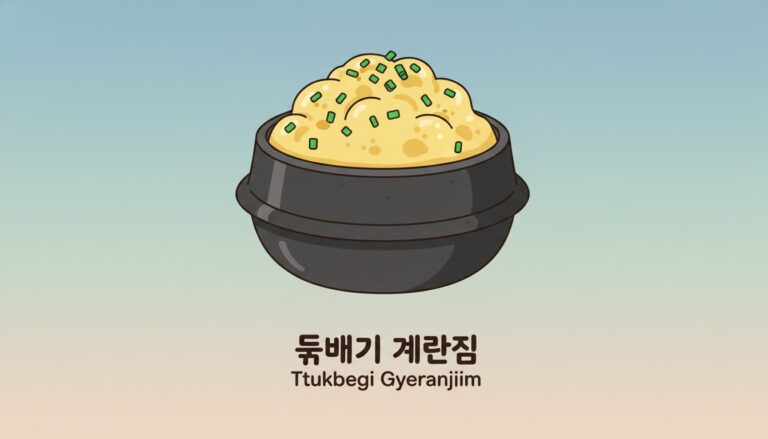
Have you ever been to a Korean BBQ restaurant or watched a K-drama where the characters are eating a steaming, fluffy yellow dish from a black pot? That delicious dish is called Gyeranjjim (계란찜), or Korean Steamed Eggs! 🥚✨
Today, we are going to learn how to explain a simple recipe for this popular comfort food. Whether you want to impress your friends or just understand what your favorite actor is cooking, these expressions are super useful. Let’s become K-Chefs today! 👩🍳👨🍳
🍳 Key Expressions for Cooking
Here are 4 essential phrases to describe the cooking process!
1. 계란을 풀다
- Pronunciation: [Gyeraneul pulda]
- English Meaning: To whisk/beat the eggs
- Explanation: ‘계란’ (Gyeran) means egg, and ‘풀다’ (pulda) means to untie or solve, but in cooking, it means to whisk or beat ingredients until smooth.
- 💡 Pronunciation Tip: When you say 계란을, the ‘n’ sound in ‘ran’ moves over to the next syllable. So it sounds like [Gye-ra-neul]! Smooth like the eggs, right?
2. 섞다
- Pronunciation: [Seokda]
- English Meaning: To mix
- Explanation: Use this verb when you combine ingredients like water and eggs together. You will hear this a lot in cooking videos.
- 💡 Pronunciation Tip: The double consonant ‘ㄲ’ (kk) at the bottom makes a strong ‘k’ sound. When combined with ‘다’, it sounds harder like [Seok-tta].
3. 소금을 넣다
- Pronunciation: [Sogeumeul neota]
- English Meaning: To put in salt / To add salt
- Explanation: ‘소금’ (Sogeum) is salt. ‘넣다’ (neota) is the general verb for ‘to put in’ or ‘to add’.
- 💡 Pronunciation Tip: In 넣다, the ‘ㅎ’ (h) meets the ‘ㄷ’ (d) and combines to make a ‘t’ sound. So it is pronounced [Neo-ta].
4. 약한 불로 익히다
- Pronunciation: [Yakan bullo ikida]
- English Meaning: To cook on low heat
- Explanation: ‘약한 불’ (Yakan bul) means weak fire/low heat. ‘익히다’ (ikida) means to cook or to make something ripe.
- 💡 Pronunciation Tip: In 약한, the ‘k’ and ‘h’ combine to make a breezy ‘k’ sound [Ya-kan]. Also, 불로 is pronounced with a flowing ‘l’ sound like [Bul-lo].
💬 Real Conversation: Making Gyeranjjim
Let’s see how Minji teaches Alex how to make this dish!
Alex: 이 요리 어떻게 만들어요?
(How do you make this dish?)
Minji: 아주 쉬워요. 먼저 계란을 푸세요.
(It’s very easy. First, please whisk the eggs.)
Alex: 그 다음에는요?
(And then?)
Minji: 물하고 소금을 넣고 섞으세요.
(Add water and salt, and mix them.)
Alex: 얼마나 끓여요?
(How long do I boil it?)
Minji: 10분 정도 약한 불로 익히세요.
(Cook it on low heat for about 10 minutes.)
🇰🇷 Culture Tip: Ttukbaegi (뚝배기)
Did you notice the black pot usually used for Gyeranjjim? It’s called a Ttukbaegi (뚝배기)! 🍲
It’s a traditional Korean earthenware pot that retains heat very well. That’s why the eggs stay hot and fluffy until you finish eating. In Korea, when you order spicy food like Ddeokbokki or Chicken Feet, Gyeranjjim is often served as a side dish to help cool down your tongue! 🔥➡️❄️
📝 Wrap-up & Quiz
Great job! Now you can explain a simple recipe in Korean. Cooking is a great way to practice language because you use action verbs!
Let’s test your knowledge! (Answers below)
- Fill in the blank: To whisk the eggs = 계란을 [ ______ ].
- Fill in the blank: To add salt = [ ______ ]을 넣다.
- True or False: ‘약한 불’ means ‘High Heat’. ( O / X )
Happy Cooking and Studying! See you next time! 👋
Answers:
1. 풀다 (pulda)
2. 소금 (Sogeum)
3. X (It means Low Heat)
Frequently Asked Questions (FAQ)
Q: What does "계란을 풀다" mean in Korean and how do you pronounce it?
A: In Korean, "계란을 풀다" is pronounced [Gyeraneul pulda] and means: To whisk/beat the eggs
Q: What does "섞다" mean in Korean and how do you pronounce it?
A: In Korean, "섞다" is pronounced [Seokda] and means: To mix
Q: What does "소금을 넣다" mean in Korean and how do you pronounce it?
A: In Korean, "소금을 넣다" is pronounced [Sogeumeul neota] and means: To put in salt / To add salt
Q: What does "약한 불로 익히다" mean in Korean and how do you pronounce it?
A: In Korean, "약한 불로 익히다" is pronounced [Yakan bullo ikida] and means: To cook on low heat







