

Introduction
Hello, everyone! It’s Daily Hangul (DailyHangul.com), here to upgrade your Korean skills! 😊
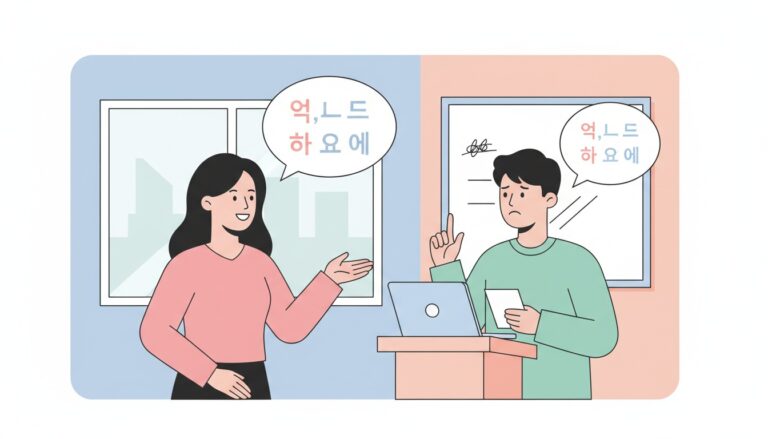
Have you ever seen a scene in a K-Drama where the main character is super nervous before a big presentation at work or university? 🎤 And then, their friend or crush steps in to give them warm advice and courage? Today, we are going to learn exactly how to be that supportive friend!
We will cover how to give advice and make suggestions for someone preparing for a presentation. These expressions are super useful not just for business, but for helping anyone who is worried or stressed. Let’s become the “supportive colleague” in your own K-Drama life! 💼✨
Core Expressions
Here are 3 essential expressions to calm someone down and give helpful tips.
1. 긴장하지 마세요
- Pronunciation: [Ginjanghaji maseyo]
- English Meaning: Please don’t be nervous.
- Explanation:
- ‘긴장하다’ (ginjanghada) means “to be nervous.”
- ‘~지 마세요’ (~ji maseyo) is a polite way to say “Please don’t do X.”
- You will hear this constantly in Korean variety shows when contestants are about to start a game!
💡 Pronunciation Tip:
In 긴장 (ginjang), both ‘g’ and ‘j’ are soft sounds. When saying 마세요 (maseyo), keep your tone gentle to sound comforting, not commanding.
2. 연습하는 게 어때요?
- Pronunciation: [Yeonseuphaneun ge eottaeyo?]
- English Meaning: How about practicing?
- Explanation:
- ‘연습하다’ (yeonseuphada) means “to practice.”
- ‘~는 게 어때요?’ (~neun ge eottaeyo?) is the magic phrase for “How about doing…?” It’s a soft and polite suggestion.
💡 Pronunciation Tip:
When saying 연습하는 (yeonseuphaneun), the ‘p’ (ㅂ) sound in ‘seup’ flows into the ‘h’ sound, making it sound a bit softer, almost like [yeon-seu-pa-neun].
3. 천천히 말해 보세요
- Pronunciation: [Cheoncheonhi malhae boseyo]
- English Meaning: Try speaking slowly.
- Explanation:
- ‘천천히’ (cheoncheonhi) means “slowly.”
- ‘~아/어 보세요’ (~a/eo boseyo) means “Try doing…” or “Give … a try.”
- This is perfect for encouraging someone to attempt a solution.
💡 Pronunciation Tip:
In 천천히 (cheoncheonhi), the ‘h’ (ㅎ) is often very weak. It often sounds like [cheon-cheo-ni] in fast, casual speech.
Real Dialogue
Let’s see how Minji (nervous about her presentation) and Daniel (helpful colleague) talk in the office.
Minji: 내일 발표 때문에 너무 걱정돼요.
(Naeil balpyo ttaemune neomu geokjeongdwaeyo.)
I’m so worried about tomorrow’s presentation.
Daniel: 에이, 긴장하지 마세요. 민지 씨는 잘할 거예요.
(Ei, ginjanghaji maseyo. Minji-ssi-neun jalhal geoyeyo.)
Hey, don’t be nervous. You will do well, Minji.
Minji: 자꾸 실수를 해요. 어떡하죠?
(Jakku silsureul haeyo. Eotteokhajyo?)
I keep making mistakes. What should I do?
Daniel: 대본을 천천히 읽어 보세요.
(Daeboneul cheoncheonhi ilgeo boseyo.)
* Try reading the script slowly. *
Minji: 네, 그래야겠어요. 고마워요.
(Ne, geuraeyagesseoyo. Gomawoyo.)
Yes, I should do that. Thank you.
Daniel: 그리고 물을 좀 마시는 게 어때요?
(Geurigo mureul jom masineun ge eottaeyo?)
And how about drinking some water?
Culture Tip: “Fighting!” (화이팅 / 파이팅)
In the dialogue, Daniel encouraged Minji. In Korea, the ultimate word for encouragement is “Fighting!” (pronounced Hwaiting or Paiting).
Even though it comes from English, it doesn’t mean you want to fight someone! 🥊 It means “Good luck!”, “Cheer up!”, or “You can do it!”
Before a presentation, an exam, or a performance, Koreans always shout “Hwaiting!” while pumping their fist in the air. Next time your friend has a big day, say “Hwaiting!” to them. They will feel the K-Energy! 💪
Conclusion & Practice
Today we learned how to calm nerves and give advice using ~지 마세요, ~는 게 어때요?, and ~아/어 보세요. Now you can be the supportive friend in your own story!
Let’s check what you remember! 👇
📝 Practice Quiz
- Complete the sentence: “Don’t be nervous.”
= 긴장하__ ______. -
True or False: “Yeonseuphaneun ge eottaeyo?” means “Don’t practice.”
( O / X ) -
Which word do Koreans shout to say “Good luck” or “You can do it”?
( A. Fighting / B. Sleeping )
See you next time! 안녕! 👋
Answers:
1. 지 마세요 (ji maseyo)
2. X (It means “How about practicing?”)
3. A (Fighting / Hwaiting)
Frequently Asked Questions (FAQ)
Q: What does "긴장하지 마세요" mean in Korean and how do you pronounce it?
A: In Korean, "긴장하지 마세요" is pronounced [Ginjanghaji maseyo] and means: Please don't be nervous.
Q: What does "연습하는 게 어때요?" mean in Korean and how do you pronounce it?
A: In Korean, "연습하는 게 어때요?" is pronounced [Yeonseuphaneun ge eottaeyo?] and means: How about practicing?
Q: What does "천천히 말해 보세요" mean in Korean and how do you pronounce it?
A: In Korean, "천천히 말해 보세요" is pronounced [Cheoncheonhi malhae boseyo] and means: Try speaking slowly.







