

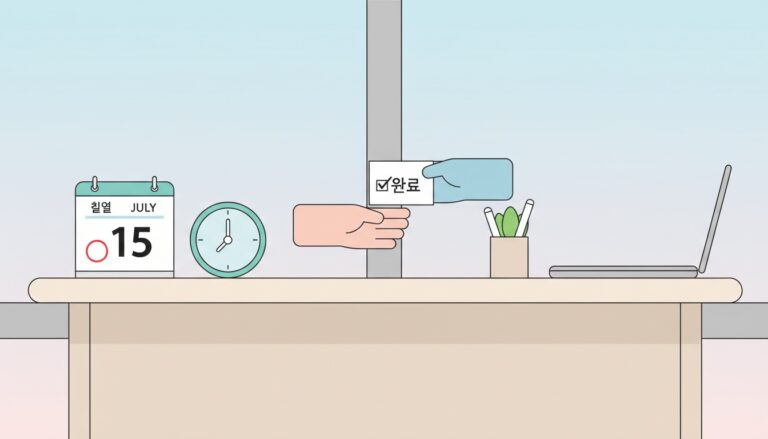
Introduction
Hello! It’s Daily Hangul, here to upgrade your Korean skills! 😊
Have you ever watched a K-Drama where the main characters try to set up a date or a crucial business meeting? You often hear them say, “See you at 2 PM!” Today, we are going to learn how to propose a date and time for a meeting.
Whether you are arranging a study session with Korean friends or a business meeting in Seoul, these expressions are essential. Let’s learn how to take the lead and suggest a time like a pro! 💼📅
Core Expressions
Here are 3 key expressions to propose a time and ask for availability.
1. 언제 시간 되세요? (When do you have time?)
- Pronunciation: [Eonje sigan doeseyo?]
- Meaning: When do you have time? / When are you free?
- Detail: This is a polite way to ask for someone’s availability.
- ‘언제’ (Eonje) means “when”.
- ‘시간’ (Sigan) means “time”.
- ‘되세요?’ (Doeseyo?) is a polite honorific form of “does it work?”.
- 💡 Pronunciation Tip: In ‘되세요’, the ‘되’ sounds similar to the English word “day” but shorter, like “dwe”.
2. [Time/Day] 어때요? (How about [Time/Day]?)
- Pronunciation: [[Time/Day] eottaeyo?]
- Meaning: How about [Time/Day]?
- Detail: Use this to propose a specific time. You can put any time or day before “어때요?”
- Example: 내일 어때요? (Naeil eottaeyo?) = How about tomorrow?
- Example: 2시 어때요? (Dusi eottaeyo?) = How about 2 o’clock?
- 💡 Pronunciation Tip: When saying ‘어때요’, emphasize the double ‘ㄸ’ (tt). It is a tense sound, so tense your tongue slightly more than a regular ‘t’.
3. [Time/Day] 괜찮아요. ( [Time/Day] is fine.)
- Pronunciation: [[Time/Day] gwaenchannayo.]
- Meaning: [Time/Day] is fine/okay.
- Detail: This is how you accept a proposal or state your available slot.
- Example: 금요일 괜찮아요. (Geumyoil gwaenchannayo) = Friday is fine.
- 💡 Pronunciation Tip: Essential! ‘괜찮아요’ is written as ‘gwaenchanayo’ but the ‘ㅎ’ (h) is silent! It sounds like [Gwaen-cha-na-yo]. Say it smoothly!
Real-life Conversation
Let’s see how two colleagues, Minji and Daniel, set up a meeting time.
Minji: 다니엘 씨, 회의 언제 시간 되세요?
(Daniel-ssi, hoe-ui eonje sigan doeseyo?)
Daniel, when do you have time for the meeting?
Daniel: 음, 저는 오후 2시 어때요?
(Eum, jeoneun ohu dusi eottaeyo?)
Hmm, as for me, how about 2 PM?
Minji: 미안해요. 2시는 바빠요. 3시는 어때요?
(Mianhaeyo. Dusineun bappayo. Sesineun eottaeyo?)
Sorry. I’m busy at 2. How about 3 o’clock?
Daniel: 네, 3시 괜찮아요. 그때 봐요!
(Ne, sesi gwaenchannayo. Geuttae bwayo!)
Yes, 3 o’clock is fine. See you then!
Culture Tip: Korean Punctuality 🕒
In a business setting or formal meetings in Korea, punctuality is respect.
While you might hear about “Korean Time” (being slightly late for casual meetups), in a professional setting, it is polite to arrive 5 to 10 minutes early.
Also, if you are setting a time with a superior (like a boss or a senior professor), it is polite to ask “언제 괜찮으세요?” (When are you available?) first
Frequently Asked Questions (FAQ)
Q: What does "언제 시간 되세요? (When do you have time?)" mean in Korean and how do you pronounce it?
A: In Korean, "언제 시간 되세요? (When do you have time?)" is pronounced [Eonje sigan doeseyo?] and means: When do you have time? / When are you free?
Q: What does "[Time/Day] 어때요? (How about [Time/Day]?)" mean in Korean and how do you pronounce it?
A: In Korean, "[Time/Day] 어때요? (How about [Time/Day]?)" is pronounced [Time/Day] and means: How about [Time/Day]?
Q: What does "[Time/Day] 괜찮아요. ( [Time/Day] is fine.)" mean in Korean and how do you pronounce it?
A: In Korean, "[Time/Day] 괜찮아요. ( [Time/Day] is fine.)" is pronounced [Time/Day] and means: [Time/Day] is fine/okay.







