

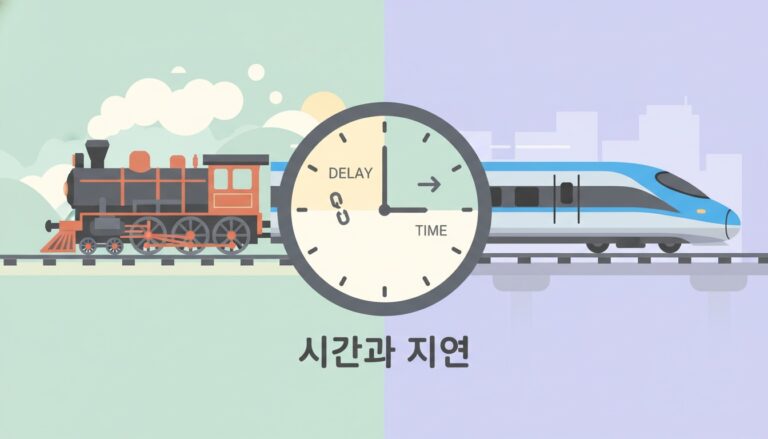
Why So Late? Explaining Reasons in Korean 🏭
Introduction
Annyeonghaseyo! (Hello!) It’s your favorite Korean tutor, Daily Hangul! 👋
Today, we are going to look at a slightly more intellectual topic! Have you ever watched a historical K-Drama or a documentary and wondered, “Why did things change so slowly back then?” 🤔
Even though the topic is “The Industrial Revolution and Social Change,” don’t worry! We won’t bore you with hard history lessons. Instead, we will learn how to explain reasons and causes like a pro. These expressions are super useful whether you are discussing history, explaining why you were late to work, or talking about why your favorite K-Pop group is the best! Let’s dive in! 🚀
Core Expressions
1. 늦어지다 (To become late / To be delayed)
- Pronunciation: [Neujeojida]
- English Meaning: To become late, to be delayed
- Detail: This comes from the adjective 늦다 (to be late) combined with ~어지다 (to become). You use this when a process or an event happens later than expected. It’s perfect for saying, “Industrialization was delayed.”
- 💡 Pronunciation Tip: When you say 늦 (Neut), the bottom ‘ㅈ’ sounds like a ‘t’. But when followed by a vowel like in ‘어’, it flows back to its original ‘j’ sound. So it sounds like [Neu-jeo-ji-da]!
2. ~기 때문에 (Because of…)
- Pronunciation: [~gi ttaemune]
- English Meaning: Because of / Due to
- Detail: This is a very logical way to say “because.” It sounds a bit more formal and persuasive than just saying “~서 (seo).” If you want to sound smart while debating or explaining a reason, use this!
- 💡 Pronunciation Tip: The ‘ㄸ’ (tt) in 때문에 is a tense sound. Tense up your tongue and make a sharp, strong ‘T’ sound without letting air out!
3. 부족하다 (To be insufficient / To lack)
- Pronunciation: [Bujokhada]
- English Meaning: To be insufficient, to lack
- Detail: Why was the revolution delayed? Usually, something was missing! Capital, technology, or resources. You can say “Money is bujokhada.”
- 💡 Pronunciation Tip: Here is a cool rule! When ‘ㄱ’ (k) meets ‘ㅎ’ (h), they combine to make a strong ‘ㅋ’ (k) sound. So, you pronounce it naturally as [Bujokada].
Real Conversation 🗣️
Let’s see how Minji and Alex discuss history using these words. Alex is explaining why industrialization was late in some regions (like Russia or Japan).
Minji: 왜 그 나라들은 산업화가 늦어졌어?
([Wae geu naradeureun saneophwaga neujeojyeosseo?])
English: Why was industrialization delayed in those countries?
Alex: 기술과 돈이 부족했기 때문이야.
([Gisulgwa doni bujokaetgi ttaemuniya.])
English: It is because they lacked technology and money.
Minji: 아, 그래서 변화가 느렸구나.
([Ah, geuraeseo byeonhwaga neuryeotguna.])
English: Ah, so the change was slow.
Alex: 맞아. 하지만 나중에는 정말 빨라졌어!
([Maja. Hajiman najungeneun jeongmal ppallajyeosseo!])
English: Right. But later, it became really fast!
Culture Tip 🇰🇷
The Miracle on the Han River (한강의 기적)
Speaking of industrialization, did you know Korea is famous for its incredibly fast growth? 🏙️
While we learned the word 늦어지다 (to be delayed) today, modern Korean history is all about 빨리빨리 (Ppalli-ppalli / Hurry-hurry)! After the Korean War, Korea transformed from a poor nation to a global economic power in just a few decades. This rapid growth is called the “Miracle on the Han River.” So, while Korea started late, it definitely caught up fast! 🚄
Wrap-up & Quiz 📝
Great job today! You learned how to explain causes and delays. Now you can sound like a history expert in Korean! 😎
Let’s test your skills! (Fill in the blanks)
- The bus was delayed because of the snow.
= 눈(snow) ______ 버스가 늦어졌어요.
(Hint: Because of ~) -
We cannot buy it because money is lacking.
= 돈이 ______ 살 수 없어요.
(Hint: To be insufficient)
[Answers]
1. 때문에 (ttaemune)
2. 부족해서 (bujokaeseo) or 부족하기 때문에 (bujokhagi ttaemune)
See you next time! Annyeong! 👋
Frequently Asked Questions (FAQ)
Q: What does "늦어지다 (To become late / To be delayed)" mean in Korean and how do you pronounce it?
A: In Korean, "늦어지다 (To become late / To be delayed)" is pronounced [Neujeojida] and means: To become late, to be delayed
Q: What does "~기 때문에 (Because of...)" mean in Korean and how do you pronounce it?
A: In Korean, "~기 때문에 (Because of...)" is pronounced [~gi ttaemune] and means: Because of / Due to
Q: What does "부족하다 (To be insufficient / To lack)" mean in Korean and how do you pronounce it?
A: In Korean, "부족하다 (To be insufficient / To lack)" is pronounced [Bujokhada] and means: To be insufficient, to lack







