

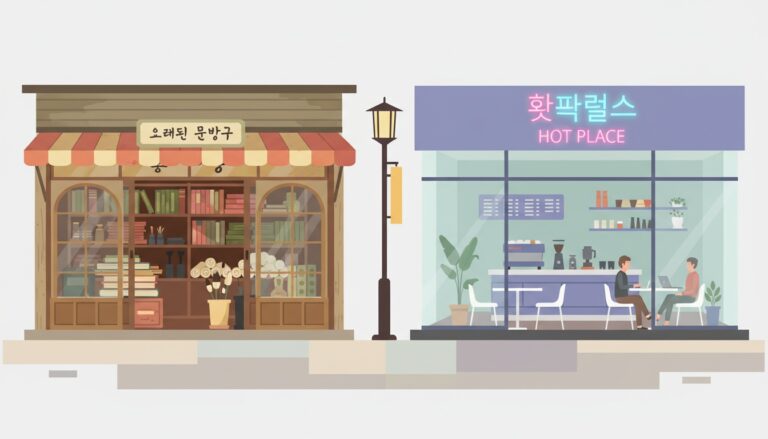
Hello! Daily Hangul here! 👋
Annyeonghaseyo! (안녕하세요!) It’s your favorite Korean tutor, Daily Hangul! 🍎
Have you ever visited a quiet, charming neighborhood in Seoul, only to come back a year later and find it completely changed? Or maybe you watched the K-Drama “Itaewon Class” and saw how the main character struggled with building owners raising the rent? 🏢💸
Today, we are going to talk about a slightly serious but very common topic in Korea: Gentrification. Don’t worry, we will make it easy and fun! By the end of this lesson, you’ll be able to discuss how neighborhoods change just like a local Seoulite!
Let’s level up your Korean! 🚀
🔑 Key Expressions
Here are 4 useful expressions to talk about changing neighborhoods and real estate.
1. 젠트리피케이션 (Jenteuripikeisyeon)
- English: Gentrification
- Detail: Since this is a difficult economic concept, Koreans often use the English loanword directly! It refers to when a neighborhood becomes popular, rent rises, and original residents are pushed out.
- 💡 Pronunciation Tip: In Korean, ‘f’ sounds are often replaced with ‘p’ (ㅍ). So strictly speaking, it sounds like “Gen-teu-ri-pi-kei-syeon”.
2. 월세가 오르다 (Wolsega oreuda)
- English: The monthly rent goes up
- Detail: In Korea, most people pay rent monthly (Wolse). When a place becomes a “Hot Place,” the Wolse usually skyrockets!
- Wolse (월세) = Monthly rent
- Oreuda (오르다) = To go up / rise
- 💡 Pronunciation Tip: When saying Wolse, make your lips round like a ‘W’. For Oreuda, the ‘R’ is a soft flap, like the ‘dd’ in ‘ladder’.
3. 핫플레이스 / 핫플 (Hatpeulleiseu / Hatpeul)
- English: Hot Place (Trendy spot)
- Detail: This is Konglish (Korean-English)! It refers to a very trendy area with nice cafes and restaurants. Young Koreans shorten it to Hatpeul (핫플). While Hatpeuls are fun, they often cause gentrification.
- 💡 Pronunciation Tip: The ‘t’ (ㅅ) at the end of ‘Hat’ stops abruptly. It sounds like “Hat-Peul”, not “Hot-eu-Peul”.
4. 옛날 모습이 사라지다 (Yennal moseubi sarajida)
- English: The old look disappears
- Detail: You use this when you miss how a neighborhood used to look before it became fancy.
- Yennal (옛날) = The old days / The past
- Sarajida (사라지다) = To disappear
🗣️ Real-life Conversation
Let’s see how two friends, Minji and Jason, talk about a changing neighborhood (like Seongsu-dong or Ikseon-dong).
Minji: 여기 진짜 많이 변했다! 예전에는 조용했는데.
(Yeogi jinjja mani byeonhaetda! Yejeoneneun joyonghaenneunde.)
Minji: This place has changed so much! It used to be quiet.
Jason: 맞아. 요즘 여기가 완전 핫플이잖아.
(Maja. Yojeum yeogiga wanjeon hatpeurijana.)
Jason: Right. This place is a total Hot Place these days.
Minji: 그래서 월세가 많이 올랐대.
(Geuraeseo wolsega mani ollatdae.)
Minji: That’s why I heard the monthly rent went up a lot.
Jason: 아쉽다. 옛날 모습이 사라져서 좀 슬퍼.
(Aswipda. Yennal moseubi sarajyeoseo jom seulpeo.)
Jason: That’s a shame. I’m a bit sad that the old look has disappeared.
🇰🇷 Culture Tip: The Speed of Change in Seoul
Did you know that trends in Korea move at light speed? ⚡
Areas like Hongdae, Garosu-gil, and Itaewon became famous, rents went up, and artists or small shop owners moved to cheaper areas nearby (like Yeonnam-dong or Seongsu-dong). Then, those new areas become “Hot Places” again!
If you find a quiet, cool cafe in a small alleyway in Seoul, visit it often! It might become a crowded franchise next year due to gentrification. Being able to say “Ah, the rent here is too expensive” (여기 월세 너무 비싸요) will make you sound like a true local!
📝 Wrap-up & Quiz
Today we learned how to talk about the changing real estate market in simple Korean! Don’t be afraid to use the word “Hatpeul” next time you find a trendy spot!
Let’s check what you learned! (Answers are at the bottom)
- What is the Korean word for “Monthly Rent”?
( A. Jeonse / B. Wolse ) -
How do Koreans shorten “Hot Place”?
( ) -
True or False: “Jenteuripikeisyeon” is a word used in Korea.
( O / X )
See you next time! Annyeong! 👋
(Quiz Answers: 1. B, 2. Hatpeul (핫플), 3. O)
Frequently Asked Questions (FAQ)
Q: What does "젠트리피케이션 (Jenteuripikeisyeon)" mean in Korean and how do you pronounce it?
A: In Korean, "젠트리피케이션 (Jenteuripikeisyeon)" is pronounced [Tip: In Korean, 'f' sounds are often replaced with 'p' (ㅍ] and means: a key conversational Korean expression covered in this lesson.
Q: What does "핫플레이스 / 핫플 (Hatpeulleiseu / Hatpeul)" mean in Korean and how do you pronounce it?
A: In Korean, "핫플레이스 / 핫플 (Hatpeulleiseu / Hatpeul)" is pronounced [Tip: The 't' (ㅅ] and means: a key conversational Korean expression covered in this lesson.







