

Introduction
Hello! It’s Daily Hangul (DailyHangul.com), here to upgrade your Korean skills! 👋✨
We all love our friends, right? But sometimes, even close friends can make jokes that cross the line. Have you ever watched a K-Drama where the main character finally stands up for themselves and says, “Hey, that’s not funny!”? It’s a cool moment! 😎
Today, we are going to learn how to react when a friend makes a rude joke or teases you too much. These expressions will help you protect your feelings while sounding natural—just like a native speaker! Let’s dive in! 🚀
Key Expressions
1. 하지 마! (Stop it!)
- Pronunciation: [Haji ma]
- English Meaning: Stop it / Don’t do that.
- Detail: This is the most direct and common way to tell someone to stop an action. Since we are talking to a friend, this is in Banmal (casual language). It is short, powerful, and effective.
- 💡 Pronunciation Tip: The ‘j’ in ‘ji’ is soft, like the ‘j’ in ‘jam’. Don’t stress it too hard! It flows smoothly: Ha-ji-ma.
2. 장난이 심해. (The joke is too much.)
- Pronunciation: [Jangnani simhae]
- English Meaning: You’re crossing the line / This joke is too severe.
- Detail: ‘장난 (Jangnan)’ means ‘joke’ or ‘prank’, and ‘심해 (simhae)’ means ‘severe’ or ‘too much’. Use this when a friend thinks they are being funny, but you actually feel hurt or annoyed.
- 💡 Pronunciation Tip: Watch out for the liaison! The final ‘n’ in ‘Jangnan‘ moves to the next vowel sound. So it sounds more like [Jang-na-ni] simhae.
3. 기분 나빠. (I feel bad / It’s offensive.)
- Pronunciation: [Gibun nappa]
- English Meaning: I’m in a bad mood / That hurts my feelings.
- Detail: Koreans often express their feelings directly in close relationships. ‘기분 (Gibun)’ is mood/feeling, and ‘나빠 (nappa)’ means bad. Telling your friend exactly how you feel is the best way to stop them.
- 💡 Pronunciation Tip: The ‘pp’ in ‘nappa’ is a tense double consonant. It sounds stronger and higher in pitch than a regular ‘p’. Imagine holding your breath for a split second before popping the ‘p’ sound!
Real Conversation
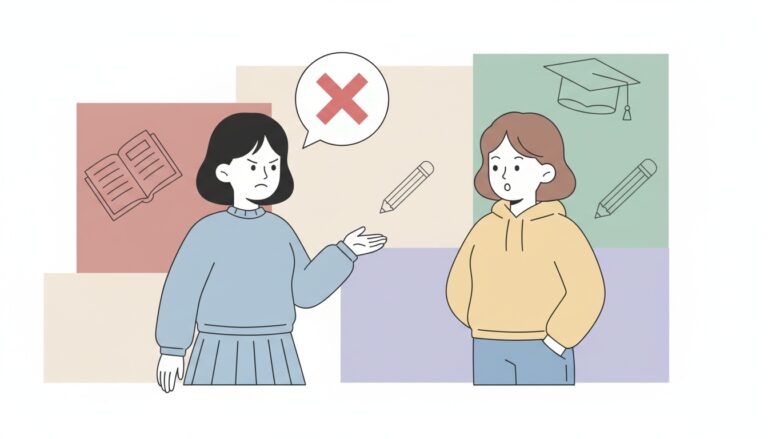
Situation: Min-su is teasing Su-jin about her new haircut, but Su-jin doesn’t like it.
Min-su: 머리 스타일이 왜 그래? 가발 같아! ㅋㅋㅋ
(Meori seutairi wae geurae? Gabal gata!)
Why is your hair style like that? It looks like a wig! Hahaha.
Su-jin: 야, 하지 마. 재미없어.
(Ya, haji ma. Jaemieopseo.)
Hey, stop it. It’s not funny.
Min-su: 에이, 농담이야. 왜 정색해?
(Ei, nongdamiya. Wae jeongsaekhae?)
Hey, it’s just a joke. Why so serious?
Su-jin: 장난이 심해. 나 진짜 기분 나빠.
(Jangnani simhae. Na jinjja gibun nappa.)
You’re crossing the line. I really feel bad.
Culture Tip 🇰🇷
“Nunchi (눈치)” is Key!
In Korea, reading the atmosphere, or having Nunchi, is very important. While close friends often tease each other (sometimes about appearance), it is crucial to notice if the other person is uncomfortable.
If you use the expressions above with a serious face 😐, a Korean friend will usually realize immediately that they made a mistake and apologize. Expressing your discomfort clearly is considered a healthy part of a close friendship in modern Korea!
Conclusion & Quiz 📝
Great job today! Now you know how to set boundaries with your Korean friends. Don’t be afraid to say “Haji ma!” when you need to! 💪
Let’s practice! (Answers are at the bottom)
- Fill in the blank:
Friend: (Pokes you repeatedly)
You: “____ __!” (Stop it!) -
True or False:
“Gibun nappa” means “I am very happy.”
( True / False )
See you next time! 안녕! (Annyeong!) 👋
Answers:
1. 하지 마 (Haji ma)
2. False (It means “I feel bad” or “I’m offended”)
Frequently Asked Questions (FAQ)
Q: What does "하지 마! (Stop it!)" mean in Korean and how do you pronounce it?
A: In Korean, "하지 마! (Stop it!)" is pronounced [Haji ma] and means: Stop it / Don't do that.
Q: What does "장난이 심해. (The joke is too much.)" mean in Korean and how do you pronounce it?
A: In Korean, "장난이 심해. (The joke is too much.)" is pronounced [Jangnani simhae] and means: You're crossing the line / This joke is too severe.
Q: What does "기분 나빠. (I feel bad / It's offensive.)" mean in Korean and how do you pronounce it?
A: In Korean, "기분 나빠. (I feel bad / It's offensive.)" is pronounced [Gibun nappa] and means: I'm in a bad mood / That hurts my feelings.







