

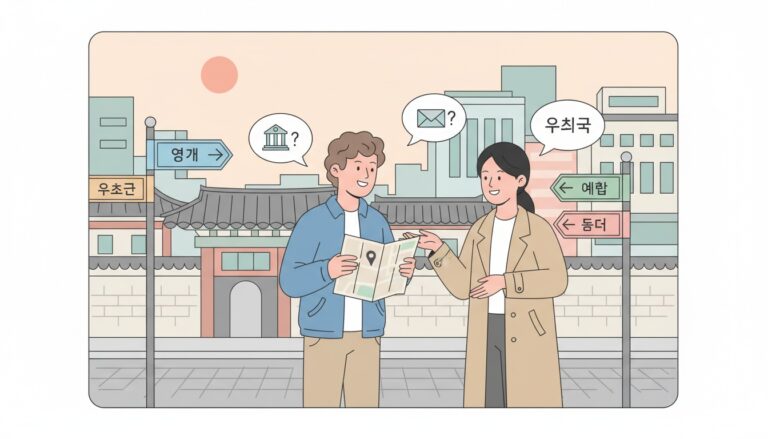
Hello! It’s Daily Hangul! (매일한글) 👋
Hello, everyone! It’s your friendly Korean tutor, Daily Hangul! 🌟 Are you ready to upgrade your Korean skills today?
Imagine you are traveling in Seoul. You need to exchange money at a bank or send a postcard to your family from a post office. But wait… you don’t know where they are! 😱
Don’t worry! In K-Dramas, looking for a place is often how the main characters meet their destiny. 😉 Today, we will learn how to ask for directions so you can solve problems (and maybe meet new friends) like a pro!
Let’s get started! 🚀
🔑 Key Expressions
Here are the 4 most useful expressions for finding your way!
1. 은행이 어디에 있어요? (Where is the bank?)
- Pronunciation: [Eunhaeng-i eodie isseoyo?]
- English Meaning: Where is the bank?
- Detail:
- 은행 (Eunhaeng) means “Bank”.
- 어디에 있어요? (Eodie isseoyo?) is the magic phrase for “Where is it?” You can put any place name before this!
- 💡 Pronunciation Tip:
- When saying 은행이, the final consonant ‘ㅇ’ (ng) flows into the next vowel. It sounds smooth like [Eun-haeng-nge].
2. 우체국 (Post Office)
- Pronunciation: [Ucheguk]
- English Meaning: Post Office
- Detail:
- If you want to find a post office, just replace ‘Bank’ with this word: “우체국이 어디에 있어요?”
3. 쭉 가세요. (Please go straight.)
- Pronunciation: [Jjuk gaseyo]
- English Meaning: Please go straight.
- Detail:
- You will hear this a lot! 쭉 (Jjuk) is a fun sound word (onomatopoeia) that describes moving in a straight line continuously.
- 💡 Pronunciation Tip:
- 쭉 (Jjuk) uses a tense double consonant (jj). Pronounce it strongly and sharply, almost like you are spitting out the ‘J’!
4. 오른쪽에 / 왼쪽에 있어요. (It’s on the right / left.)
- Pronunciation: [Oreunjjog-e / Oenjjog-e isseoyo]
- English Meaning: It is on the right / It is on the left.
- Detail:
- 오른쪽 (Oreunjjok) = Right side 👉
- 왼쪽 (Oenjjok) = Left side 👈
🗣️ Real-life Dialogue
Let’s see how this works in a real situation on the street!
(A: Tourist / B: Helpful Local)
A: 실례합니다. 이 근처에 은행이 어디에 있어요?
(Sillyehamnida. I geuncheo-e eunhaeng-i eodie isseoyo?)
[Excuse me. Where is the bank near here?]
B: 아, 저기 편의점 보이죠? 쭉 가세요.
(Ah, jeogi pyeonuijeom boijyo? Jjuk gaseyo.)
[Ah, do you see that convenience store over there? Please go straight.]
A: 네, 쭉 가요. 그리고요?
(Ne, jjuk gayo. Geurigoyo?)
[Yes, go straight. And then?]
B: 거기서 오른쪽으로 가세요. 그러면 은행이 있어요.
(Geogiseo oreunjjok-euro gaseyo. Geureomyeon eunhaeng-i isseoyo.)
[Go right from there. Then the bank will be there.]
A: 감사합니다!
(Gamsahamnida!)
[Thank you!]
🇰🇷 Culture Tip: “Naver Map” is your best friend! 🗺️
Did you know that Google Maps doesn’t work perfectly in Korea for walking directions? 😲 Due to local regulations, Google Maps often cannot give precise navigation.
To travel like a local, download Naver Map or KakaoMap. These apps are essential for finding bus stops, subway exits, and of course, banks and post offices!
Also, before asking a stranger, it’s polite to start with “실례합니다 (Sil-lye-ham-ni-da)”, which means “Excuse me.” Koreans are very helpful if you approach them politely! 😊
📝 Practice Quiz
Let’s check what we learned today!
- Fill in the blank:
If you are looking for the post office, you say:
“________이/가 어디에 있어요?” (Where is the post office?) -
Translate to Korean:
“Please go straight.”
= ________ ________. -
True or False:
Google Maps is the best app to use for walking directions in Korea.
( True / False )
🔑 Answer Key
- 우체국 (Ucheguk)
- 쭉 가세요 (Jjuk gaseyo)
- False (Use Naver Map or KakaoMap!)
Great job today! Now you won’t get lost in Korea. See you next time! 안녕! 👋
Frequently Asked Questions (FAQ)
Q: What does "은행이 어디에 있어요? (Where is the bank?)" mean in Korean and how do you pronounce it?
A: In Korean, "은행이 어디에 있어요? (Where is the bank?)" is pronounced [Eunhaeng-i eodie isseoyo?] and means: Where is the bank?
Q: What does "우체국 (Post Office)" mean in Korean and how do you pronounce it?
A: In Korean, "우체국 (Post Office)" is pronounced [Ucheguk] and means: Post Office
Q: What does "쭉 가세요. (Please go straight.)" mean in Korean and how do you pronounce it?
A: In Korean, "쭉 가세요. (Please go straight.)" is pronounced [Jjuk gaseyo] and means: Please go straight.
Q: What does "오른쪽에 / 왼쪽에 있어요. (It's on the right / left.)" mean in Korean and how do you pronounce it?
A: In Korean, "오른쪽에 / 왼쪽에 있어요. (It's on the right / left.)" is pronounced [Oreunjjog-e / Oenjjog-e isseoyo] and means: It is on the right / It is on the left.






