

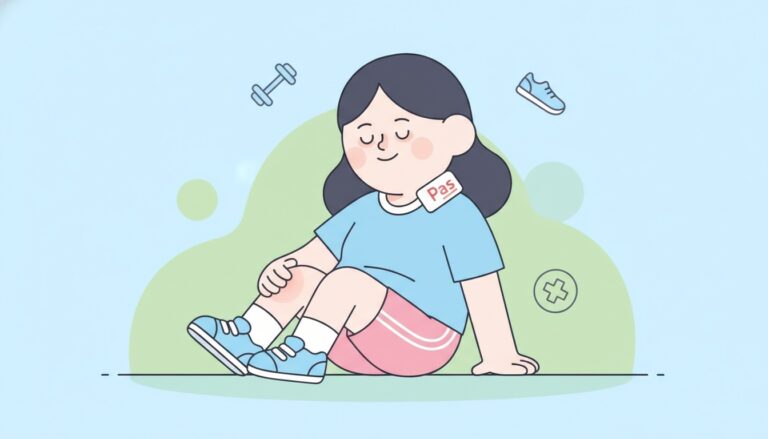
Ouch! “My Whole Body Aches” After Gym 🏋️♀️
👋 Hello! This is Daily Hangul!
안녕하세요! (Annyeonghaseyo!) It’s your friendly Korean tutor, Daily Hangul! 😊
Did you start working out to get a body like a K-pop idol or a K-drama star? 💪 That’s amazing! But we all know the next day is the hardest… waking up and feeling like you can’t move!
Today, we will learn how to talk about that muscle pain after an intense workout. These phrases are super useful when you want to explain to your Korean friends why you are walking like a penguin today! 🐧
Let’s dive in! Start! (시작!)
📚 Key Expressions
Here are 3 essential expressions to describe your post-workout pain.
1. 온몸이 쑤셔요
- Pronunciation: [Onmomi ssusyeoyo]
- English Meaning: My whole body aches / I’m sore all over.
- Detail:
- 온몸 (Onmom) means “whole body.”
- 쑤셔요 (Ssusyeoyo) comes from the verb describing a tingling, poking, or aching pain inside the muscles.
- You can use this when you have the flu, but also after a full-body workout!
- 💡 Pronunciation Tip: Connect the sounds! Don’t say “On-mom-i.” Say it smoothly like [On-mo-mi].
2. 알 배겼어요
- Pronunciation: [Al baegyeosseoyo]
- English Meaning: My muscles are knotted / I have muscle cramps.
- Detail:
- This is a very funny and native Korean expression! 🤣
- 알 (Al) literally means “egg.”
- When your calf or arm muscles get swollen and hard after exercise, Koreans say it looks like there is an egg inside your muscle. Use this for DOMS (Delayed Onset Muscle Soreness)!
3. 못 걷겠어요
- Pronunciation: [Mot geotgesseoyo]
- English Meaning: I can’t walk.
- Detail:
- Did you do “Leg Day”? Then you need this phrase.
- 못 (Mot) means “cannot.”
- 걷겠어요 (Geotgesseoyo) is the future/intention form of “to walk.”
- 💡 Pronunciation Tip: This is tricky! The ㄷ in 걷 meets the ㄱ in 겠, making a strong sound.
- Say it like: [Mot geot-kkes-seo-yo] (The ‘k’ sound becomes strong and tensed!).
🗣️ Real-life Conversation
Situation: Min-su sees Jason walking slowly and awkwardly at a cafe.
Min-su: 제이슨, 어디 아파요? 왜 그렇게 걸어요?
([Jeiseun, eodi apayo? Wae geureoke georeoyo?])
(Jason, are you sick? Why are you walking like that?)
Jason: 어제 헬스장에서 운동을 너무 많이 했어요.
([Eoje helseujang-eseo undong-eul neomu mani haesseoyo.])
(I exercised too much at the gym yesterday.)
Min-su: 아, 근육통이군요!
([Ah, geunyuktong-igunyo!])
(Ah, it’s muscle pain!)
Jason: 네, 다리에 알 배겼어요. 진짜 못 걷겠어요. 😭
([Ne, darie al baegyeosseoyo. Jinjja mot geotgesseoyo.])
(Yes, I have knots in my legs. I really can’t walk.)
🎭 Culture Tip & Drama Context
🩹 The Magic of “Pas” (파스)
If you watch K-Dramas, have you ever seen a character putting a white or beige patch on their neck or shoulders? That is called “Pas” (파스)!
In Korea, when we have muscle pain (근육통 – Geunyuktong), we don’t just take pills. We stick these cool/hot patches directly on the skin. If you tell a Korean friend “온몸이 쑤셔요,” they might run to the convenience store and buy you a Pas. It’s a sign of caring (Jeong/정)! ❤️
📝 Wrap-up & Quiz
Today we learned how to complain about workout pain like a native Korean! Don’t give up on your exercise, even if it hurts! 화이팅 (Hwaiting)! 🔥
Pop Quiz! (Answers at the bottom)
- Fill in the blank: “My whole body aches.”
= ( )이 쑤셔요. -
True or False: “Al baegyeosseoyo” (알 배겼어요) literally means “I have an egg in my muscle.”
( True / False ) -
How do you say “I cannot walk” in Korean?
( A. 안 걸어요 / B. 못 걷겠어요 )
⬇️ Answers
1. 온몸 (Onmom)
2. True
3. B
Frequently Asked Questions (FAQ)
Q: What does "온몸이 쑤셔요" mean in Korean and how do you pronounce it?
A: In Korean, "온몸이 쑤셔요" is pronounced [Onmomi ssusyeoyo] and means: My whole body aches / I'm sore all over.
Q: What does "알 배겼어요" mean in Korean and how do you pronounce it?
A: In Korean, "알 배겼어요" is pronounced [Al baegyeosseoyo] and means: My muscles are knotted / I have muscle cramps.
Q: What does "못 걷겠어요" mean in Korean and how do you pronounce it?
A: In Korean, "못 걷겠어요" is pronounced [Mot geotgesseoyo] and means: I can't walk.







