

Monday Blues? 😴 Fixing Your ‘Social Jetlag’ in Korean!
1. Intro
Annyeonghaseyo! It’s your energy booster, Daily Hangul! 👋
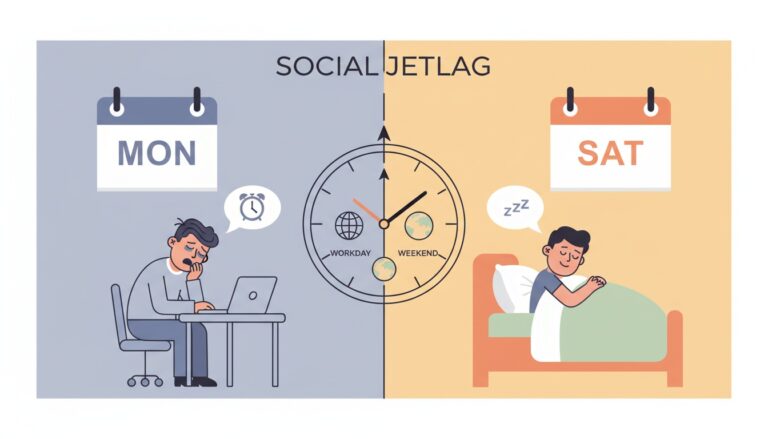
Do you ever feel super tired on Monday morning, even though you slept A LOT during the weekend? That is called “Social Jetlag.” It happens when your sleep schedule on workdays is totally different from your weekends.
In Korea, where people work hard and play hard, this is a very common topic! You often see K-Drama characters looking exhausted on Mondays or waking up past noon on Sundays. Today, let’s learn how to talk about this sleepy struggle in Korean! Let’s go! 🚀
2. Core Expressions
Here are 3 must-know expressions to describe your sleep habits and tiredness!
1️⃣ 늦잠 (Neut-jam)
- Pronunciation: [Neut-jam]
- English Meaning: Sleeping in / Oversleeping
- Detail: This is a combination of ‘늦’ (late) and ‘잠’ (sleep). It is used when you wake up much later than usual, intentionally or accidentally.
- 💡 Pronunciation Tip: The bottom consonant ‘ㅈ’ in ‘늦’ sounds like a ‘t’ when it’s at the end of a syllable block. So it sounds like Neut, not Neuj.
2️⃣ 몰아 자다 (Mol-a ja-da)
- Pronunciation: [Mora jada]
- English Meaning: To catch up on sleep (Binge sleeping)
- Detail: Literally, it means “to sleep in a bunch/drive.” Koreans use this when they don’t sleep enough during the week and try to sleep all at once on the weekend to recover.
- 💡 Pronunciation Tip: When ‘ㄹ’ (l/r) is followed by a vowel like ‘아’ (a), the sound carries over! So instead of Mol-a, it sounds smoother like [Mo-ra].
3️⃣ 월요병 (Wo-ryo-byeong)
- Pronunciation: [Woryobyeong]
- English Meaning: Monday Blues (Monday Sickness)
- Detail: ‘월요일’ is Monday and ‘병’ is sickness. Social jetlag is the main cause of this! If you watch Korean variety shows, you will hear this word every week!
3. Real Dialogue
Let’s see how Min-su and Ji-eun talk about their tired Monday morning at the office.
Min-su: 피곤해 보여요, 지은 씨.
(You look tired, Ji-eun.)
Ji-eun: 네, 완전 월요병이에요.
(Yes, it’s totally the Monday Blues.)
Min-su: 주말에 늦잠 안 잤어요?
(Didn’t you sleep in on the weekend?)
Ji-eun: 잠을 몰아 잤는데, 더 졸려요.
(I binge-slept, but I’m even more sleepy.)
4. Culture Tip & K-Drama Vibes 📺
🔥 The “Bulgeum” (Burning Friday) Effect
Why is Social Jetlag so common in Korea? It’s partly due to the culture of “Bulgeum” (불금), which stands for “Burning Friday.”
In many K-Dramas, you see friends drinking and hanging out late on Friday nights to relieve stress. Because they stay up late on Friday, they sleep in (늦잠) on Saturday, pushing their body clock back. By the time Sunday night comes, they can’t fall asleep early, making Monday morning (and 월요병) extremely painful!
To avoid social jetlag, experts say we should wake up at the same time every day… but that’s hard, right? 😉
5. Wrap-up & Quiz
Today we learned why we are so tired on Mondays! Try to use “Mol-a ja-da” next time you plan a lazy Sunday.
📝 Mini Quiz
- What is the Korean word for “Monday Blues”?
( Hint: W_ _ _ _ _ _ _ _ _ ) - True or False: “Neut-jam” means waking up very early.
( True / False )
Fighting (Hwaiting) for your sleep health! See you next time! 😴✨
[Answers]
1. 월요병 (Woryobyeong)
2. False (It means sleeping in/oversleeping)






