

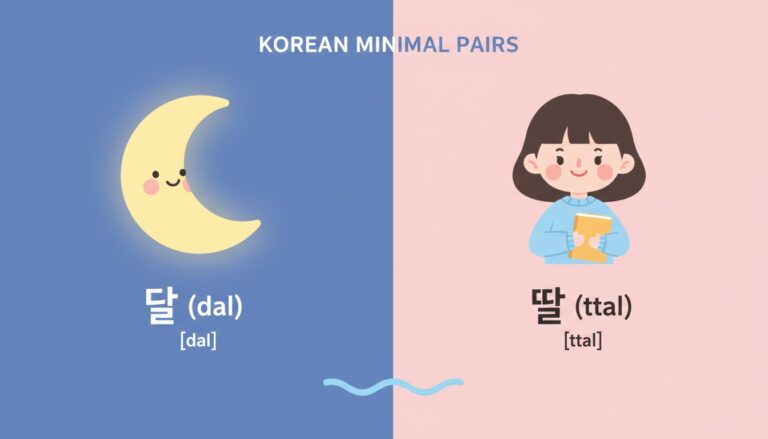
🌙 “Moon” or “Daughter”? Master Korean Sounds with Minimal Pairs!
1. Introduction
Hello, K-Culture fans! 👋 Welcome back to Daily Hangul, your best friend for learning Korean!
Have you ever watched a K-Drama and thought two words sounded exactly the same, but the subtitles showed totally different meanings? 🤔
Today, we are going to put on our “Linguist Glasses” 🤓! In linguistics, we use something called “Minimal Pairs” to understand the sound system of a language. Simply put, these are words that differ by only one sound but have completely different meanings.
If you master this, you won’t accidentally ask for a “daughter” (딸) when you want to look at the “moon” (달)! Let’s upgrade your hearing and speaking skills so you can sound just like your favorite actors! 🎬✨
2. Core Expressions: The Magic of One Sound
Here are three famous sets of words that often confuse beginners. Let’s analyze the difference!
1. 달 vs. 딸 vs. 탈
These three words differ only in the first consonant sound!
A. 달
* Pronunciation: [Dal]
* English Meaning: Moon 🌙
* Detail: This uses a soft, plain ‘D/T’ sound. It’s gentle and relaxed.
B. 딸
* Pronunciation: [Ttal]
* English Meaning: Daughter 👧
* Detail: This is a Tense Sound (Double Consonant). You need to tense your throat and tongue. It sounds sharper and higher in pitch than ‘Dal’.
C. 탈
* Pronunciation: [Tal]
* English Meaning: Mask 🎭 (or trouble/accident)
* Detail: This is an Aspirated Sound. You must burst a lot of air out of your mouth. Try holding a tissue in front of your face; it should move when you say this!
💡 Pronunciation Tip:
* Dal (Moon): Soft, low pitch. No air burst.
* Ttal (Daughter): Tense, high pitch. Like the ‘t’ in “stop”.
* Tal (Mask): Airy! Like the ‘t’ in “top”.
2. 물 vs. 불 vs. 풀
Another classic trio involving water, fire, and grass!
A. 물
* Pronunciation: [Mul]
* English Meaning: Water 💧
* Detail: Starts with an ‘M’ sound. Very soft.
B. 불
* Pronunciation: [Bul]
* English Meaning: Fire 🔥
* Detail: Starts with a ‘B/P’ sound. It is soft but distinct from ‘M’.
C. 풀
* Pronunciation: [Pul]
* English Meaning: Grass / Glue 🌿
* Detail: Strong ‘P’ sound with a burst of air (Aspiration).
3. 자다 vs. 차다 vs. 짜다
Verbs can be minimal pairs too!
A. 자다
* Pronunciation: [Jada]
* English Meaning: To sleep 😴
* Detail: Soft ‘J’ sound.
B. 차다
* Pronunciation: [Chada]
* English Meaning: To kick (or to be cold) ⚽
* Detail: Aspirated ‘Ch’ sound. Lots of air!
C. 짜다
* Pronunciation: [Jjada]
* English Meaning: To be salty 🧂
* Detail: Tense ‘JJ’ sound. Very sharp.
3. Real Conversation: Don’t Make This Mistake! 😆
Imagine you are on a romantic date walking by the Han River.
Min-su: 와, 오늘 밤 달이 진짜 예쁘다.
(Wa, oneul bam dal-i jinjja yeppeuda.)
Wow, the moon is really pretty tonight.
Lisa: 응? 딸? 누구 딸?
(Eung? Ttal? Nugu ttal?)
Huh? Daughter? Whose daughter?
Min-su: (Laughing) 아니, 딸 말고 달! 저기 하늘에!
(Ani, ttal malgo dal! Jeogi haneul-e!)
No, not daughter, moon! Up there in the sky!
Lisa: 아~ 달! 발음이 너무 어려워요.
(Ah~ Dal! Bareum-i neomu eoryeowoyo.)
Ah~ Moon! Pronunciation is too hard.
Min-su: 괜찮아. 내가 가르쳐 줄게. 불고기 먹으러 갈까?
(Gwaenchana. Naega gareuchyeo julge. Bulgogi meogeureo galkka?)
It’s okay. I’ll teach you. Shall we go eat Bulgogi?
4. Culture Tip & K-Drama Vibes 📺
Did you know?
In Korean, changing just one small sound changes the entire meaning, which is why “Minimal Pairs” are so important.
Drama Scene:
Have you noticed in K-Dramas like Squid Game or The Glory, when characters get really angry, they often use Tense Sounds (Double Consonants like ㄲ, ㄸ, ㅃ, ㅆ, ㅉ)?
- Example: “가!” (Ga! – Go!) vs “까?!” (Kka?! – Shall we do it/fight?!).
The tense sounds carry more energy and intensity. So, mastering the difference between Plain (Low energy), Aspirated (Airy), and Tense (High tension) sounds will make your Korean sound much more natural and emotional! 🎭
5. Wrap-up & Practice Quiz 📝
Today we learned how to analyze Korean sounds using Minimal Pairs! Remember, listening carefully to the “air” and “tension” in the sound is the key.
Let’s test your knowledge!
-
Which word means “Fire”?
(A) 물 [Mul] (B) 불 [Bul] -
If you want to say






