

1. Title
Ouch! How to Tell a Doctor You’re Sick in Korean 🏥
2. Intro
Hello, K-Learners! Welcome back to Daily Hangul, your best friend for learning Korean! 🌟
Have you ever gotten sick while traveling? It’s scary, right? Or maybe you’ve seen a K-Drama scene where the main character faints, and everyone rushes them to the hospital! 🚑
Today, we are going to learn essential phrases to use at a hospital or pharmacy. Being able to explain where it hurts is crucial for your safety and health. Don’t worry, I’ll make it super easy so you can get the help you need (and maybe some sympathy too! 😉). Let’s dive in!
3. Key Expressions
Here are the top 3 expressions you need to know when you are feeling unwell.
1. 여기가 아파요.
- Pronunciation: [Yeogiga apayo]
- Meaning: It hurts here.
- Explanation: This is the ultimate survival phrase! If you don’t know the name of the body part in Korean, just point to the spot and say this. “Yeogi” means “here” and “apayo” means “it hurts.”
- 💡 Pronunciation Tip: Connect the sounds! It sounds like “Yeo-gi-ga-a-pa-yo.” Keep the flow smooth like a wave. 🌊
2. [Body Part] + 아파요.
- Example: 머리가 아파요. (My head hurts.)
- Pronunciation: [Meoriga apayo]
- Meaning: My [Body Part] hurts.
- Explanation: To be more specific, put the body part before “apayo.”
- Merori = Head 💆
- Bae = Stomach 🤰
- Mok = Throat 🧣
- 💡 Pronunciation Tip: When saying 배 (Bae), open your mouth wide like the ‘a’ in ‘apple’. It is a short, crisp sound!
3. 열이 나요.
- Pronunciation: [Yeori nayo]
- Meaning: I have a fever.
- Explanation: In K-Dramas, when someone is sick, they always touch their forehead, right? That’s checking for “Yeol” (fever). “Nayo” means “coming out” or “occurring.”
- 💡 Pronunciation Tip: Liaison Rule! The ‘L’ sound in 열 (Yeol) moves over to the next vowel. So instead of “Yeol-i”, it sounds like [Yeo-ri].
4. Real-life Dialogue
Let’s see how this works at a local clinic (Byeong-won)!
(Situation: You visit a doctor because you feel terrible.)
🩺 Doctor (A): 안녕하세요. 어디가 아파요?
(Annyeonghaseyo. Eodiga apayo?)
Hello. Where does it hurt?
🤧 You (B): 목이 아파요. 그리고 열이 나요.
(Mogi apayo. Geurigo yeori nayo.)
My throat hurts. And I have a fever.
🩺 Doctor (A): 언제부터 아팠어요?
(Eonjebuteo apasseoyo?)
Since when have you been sick?
🤧 You (B): 어제부터요.
(Eojebuteoyo.)
Since yesterday.
5. Culture Tip & Drama Scene 🎬
Did you know? 🇰🇷
In Korea, going to the doctor is very accessible and affordable compared to many other countries. You don’t always need an appointment for small clinics!
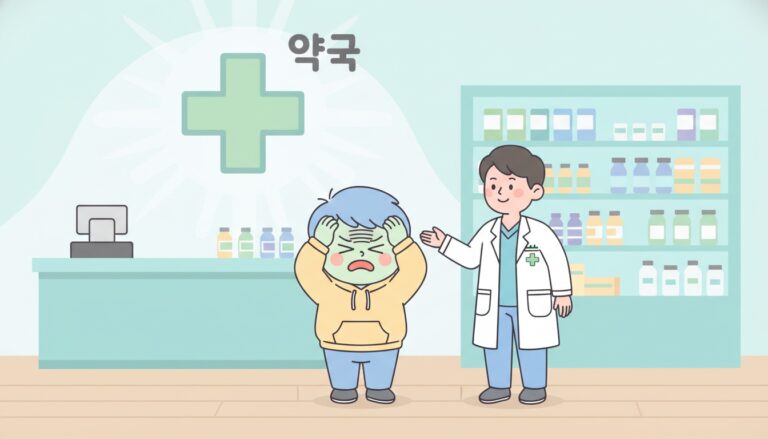
Also, if your symptoms are mild, you can visit a Pharmacy (약국 – Yakguk). Look for the sign with a big “약” (Yak) or a generic cross symbol. In dramas, you often see characters buying a small glass bottle drink called Ssanghwa-tang (쌍화탕) when they have a cold. It’s a traditional herbal medicine drink that tastes warm and bittersweet! 🍵
6. Conclusion & Practice
Great job today! Now you know how to express pain in Korean. I hope you stay healthy, but keep these phrases in your pocket just in case! 💪
📝 Mini Quiz!
- Fill in the blank: “My head hurts” = _______가 아파요. (Hint: Head)
- True or False: If you don’t know the word for a body part, you can point and say “Yeogiga apayo.”
See you next time! Stay healthy! (건강하세요!) 👋
Answer Key:
1. 머리 (Meori)
2. True (O)
Frequently Asked Questions (FAQ)
Q: What does "[Body Part] + 아파요." mean in Korean and how do you pronounce it?
A: In Korean, "[Body Part] + 아파요." is pronounced [Meoriga apayo] and means: My [Body Part] hurts.
Q: What does "열이 나요." mean in Korean and how do you pronounce it?
A: In Korean, "열이 나요." is pronounced [Yeori nayo] and means: I have a fever.







