

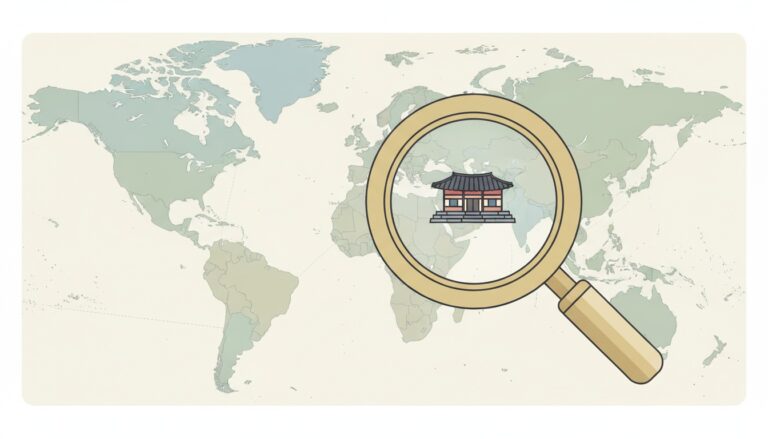
🌏 Whose History Is It? The Truth Behind ‘Discovery’
1. Introduction
Hello, K-Culture fans! 👋 Welcome back to Daily Hangul, where we make learning Korean fun and meaningful! 😊
Today, we are going to dive into a slightly deeper but very interesting topic: History and Discovery.
You often hear in history books that someone “discovered” a new land. But wait… if people were already living there, was it really a discovery? 🤔 In modern Korea and around the world, we are learning to look at history from different perspectives!
If you watch historical K-Dramas (Sageuk) like Mr. Sunshine or Pachinko, you know how important it is to know “Who is telling the story?” Let’s learn how to express these thoughts in Korean!
2. Key Expressions (핵심 표현)
1) 발견하다 (To discover)
- Pronunciation: [Bal-gyeon-ha-da]
- Meaning: To discover / To find
- Detail: This is the standard verb used when finding something new. However, nowadays we ask: “Did they discover it, or just visit it?”
- 💡 Pronunciation Tip: When saying 발견하다, the ‘ㅎ’ (h) sound is often weak. It flows like [Bal-gyeon-nada] in fast speech!
2) 원래 (Originally / From the start)
- Pronunciation: [Won-lae] -> Actual Sound: [Wol-lae]
- Meaning: Originally / Actually
- Detail: This is a super common word! You use it to correct someone or state a fact that was true from the beginning.
- Example: “It was originally mine!” (원래 내 거야!)
- 💡 Pronunciation Tip: This is a classic example of Liquidization. When ‘ㄴ’ (n) meets ‘ㄹ’ (l), the ‘n’ turns into an ‘l’ sound. So strictly say [Wol-lae], not [Won-lae]!
3) 살고 있었어요 (Was living)
- Pronunciation: [Sal-go i-sseo-sseo-yo]
- Meaning: (Someone) was living (there)
- Detail: To argue against “discovery,” you can say people were already living there. This uses the grammar -고 있다 (progressive form).
4) 관점 (Point of view / Perspective)
- Pronunciation: [Gwan-jeom]
- Meaning: Perspective
- Detail: A slightly more advanced word, but very useful when discussing history or serious plots in dramas. “Your perspective is different from mine.”
3. Real-Life Conversation (실전 대화)
Let’s imagine two friends discussing a history documentary.
Minji: 콜럼버스가 아메리카를 발견했어요?
(Col-lum-beo-seu-ga A-me-ri-ka-reul bal-gyeon-hae-sseo-yo?)
Minji: Did Columbus discover America?
Jason: 음, 아니요. 거기에는 원래 사람들이 살고 있었어요.
(Eum, a-ni-yo. Geo-gi-e-neun wol-lae sa-ram-deul-i sal-go i-sseo-sseo-yo.)
Jason: Hmm, no. People were originally living there.
Minji: 아! 관점이 다르네요.
(Ah! Gwan-jeom-i da-reu-ne-yo.)
Minji: Ah! The perspective is different.
Jason: 맞아요. 역사는 누가 쓰느냐에 따라 달라요.
(Ma-ja-yo. Yeok-sa-neun nu-ga sseu-neu-nya-e tta-ra dal-la-yo.)
Jason: That’s right. History changes depending on who writes it.
4. Culture Tip & K-Drama Moment 🎬
Did you know?
In Korea, history (역사, Yeoksa) is a very sensitive and important subject. Koreans strongly value the “correct understanding of history” (올바른 역사 인식).
If you watch the hit drama Mr. Sunshine (미스터 션샤인), you will see many characters fighting to protect their land from outsiders who claim to be “modernizing” or “discovering” it. The main characters often fight to show that their country already existed with its own beautiful culture.
Using the word 원래 (Originally) shows you understand the true nature of a situation, not just what it looks like on the outside. It makes your Korean sound very natural and sharp! ✨
5. Wrap-up & Quiz (마무리 및 연습 문제)
Today we learned how to talk about discovery and truth! History isn’t just about dates; it’s about the people who lived there originally (원래).
📝 Mini Quiz!
- How do you pronounce 원래 (Originally)?
A. [Won-lae]
B. [Wol-lae] -
Fill in the blank: “People were already ______ there.”
사람들이 이미 [ ? ] 있었어요.
(Hint: Living)
See you next time! 안녕! 👋
Answers:
1. B [Wol-lae]
2. 살고 (Sal-go)
Frequently Asked Questions (FAQ)
Q: What does "원래 (Originally / From the start)" mean in Korean and how do you pronounce it?
A: In Korean, "원래 (Originally / From the start)" is pronounced [Won-lae] and means: Originally / Actually
Q: What does "살고 있었어요 (Was living)" mean in Korean and how do you pronounce it?
A: In Korean, "살고 있었어요 (Was living)" is pronounced [Sal-go i-sseo-sseo-yo] and means: (Someone) was living (there)
Q: What does "관점 (Point of view / Perspective)" mean in Korean and how do you pronounce it?
A: In Korean, "관점 (Point of view / Perspective)" is pronounced [Gwan-jeom] and means: Perspective







