

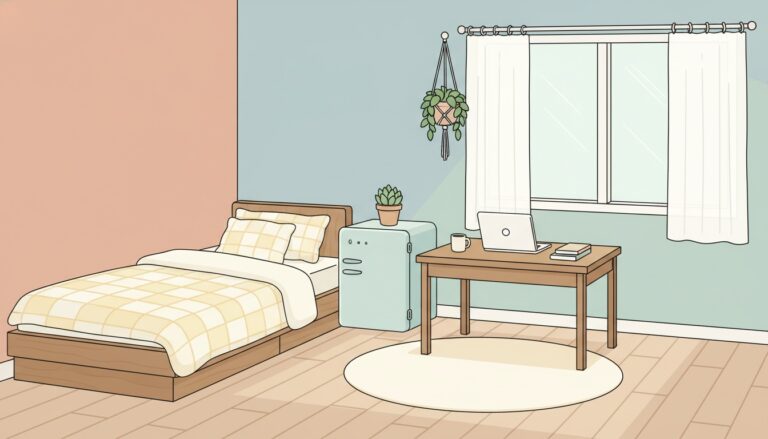
🏠 “Room Tour” Time! What’s in Your House?
1. Introduction
Hello, everyone! It’s your friendly Korean tutor, Daily Hangul! 👋✨
Have you ever watched a Korean vlog or a K-Drama where the main character shows off their new apartment? In Korea, we call this a “Room Tour” (랜선 집들이). Today, we are going to learn how to describe what furniture and appliances you have in your house!
Imagine a friend comes to your place and asks, “Do you have a TV?” or “Where is the bathroom?” After this lesson, you will be able to answer confidently! Let’s master the art of saying “I have” and “I don’t have” in Korean! Let’s go! 🚀
2. Key Expressions
Here are the essential words and grammar points to describe your room. 🛋️
1️⃣ 침대 (Chim-dae)
- English: Bed
- Explanation: This is a must-know word! In the past, many Koreans slept on the floor (Yo/요), but nowadays, most houses have a 침대.
- 💡 Pronunciation Tip: It sounds straightforward: [Chim-dae]. Make sure to pronounce the ‘ae’ (애) clearly, like the ‘a’ in ‘apple’.
2️⃣ 냉장고 (Naeng-jang-go)
- English: Refrigerator
- Explanation: Another essential item! Korea has a unique culture of having a separate “Kimchi Refrigerator” (김치 냉장고), but the general one is just 냉장고.
- 💡 Pronunciation Tip: [Naeng-jang-go]. The ‘ng’ (ㅇ) sound is soft, like in ‘song’.
3️⃣ ~이/가 있어요 (i/ga isseoyo)
- English: I have… / There is…
- Explanation: This is the magic phrase! Use it to say something exists.
- If the word ends with a consonant (batchim): add 이 있어요 (e.g., 침대가 있어요 – Bed ends in vowel).
- Wait! 침대 ends in a vowel, so we use 가. (e.g., 텔레비전이 있어요 – TV ends in consonant).
- 💡 Pronunciation Tip: When saying 있어요, the ‘ss’ (ㅆ) sound moves to the next block. So it sounds like [i-sseo-yo]. This is called a “liaison.”
4️⃣ ~이/가 없어요 (i/ga eopseoyo)
- English: I don’t have… / There isn’t…
- Explanation: The opposite of 있어요. Use this when something is missing.
- 💡 Pronunciation Tip: [eop-sseo-yo]. The ‘ps’ (ㅄ) simplifies, and the ‘ss’ sound carries over. It sounds a bit like “Op-so-yo.”
3. Real-life Conversation
Let’s see how Min-su and Sarah talk about Sarah’s new studio apartment! 🗣️
Min-su: 와! 방이 정말 예뻐요. 텔레비전이 있어요?
(Wa! Bang-i jeongmal yeppeoyo. Tellebijeon-i isseoyo?)
Wow! Your room is really pretty. Do you have a TV?
Sarah: 아니요, 텔레비전은 없어요. 하지만 노트북이 있어요.
(Aniyo, tellebijeon-eun eopseoyo. Hajiman noteubuk-i isseoyo.)
No, I don’t have a TV. But I have a laptop.
Min-su: 아, 그래요? 그럼 침대는 어디에 있어요?
(A, geuraeyo? Geureom chimdae-neun eodie isseoyo?)
Ah, really? Then where is the bed?
Sarah: 침대는 저기에 있어요.
(Chimdae-neun jeogie isseoyo.)
The bed is over there.
4. Culture Tip & K-Drama Vibes 📺
Did you know about “Full Option” (풀옵션)?
If you watch K-Dramas where the main character moves into a small studio (often called a “One-room” / 원룸), you might notice they don’t bring much furniture. That’s because many rentals in Korea are “Full Option.”
This means the house already comes with essential appliances like a washing machine (세탁기), refrigerator (냉장고), air conditioner (에어컨), and sometimes even a gas stove. It’s super convenient for students and foreigners living in Korea! So, if you are moving to Korea, check if your room is “Full Option”! 😉
5. Wrap-up & Quiz
Today, we learned how to talk about furniture and say whether we have it or not! Now you can describe your room to your Korean friends. 🏠
📝 Mini Quiz!
Try to answer these questions to test your skills:
- How do you say “I have a bed” in Korean?
(Hint: 침대 + 가 + ???) - True or False: 냉장고 means “Washing Machine”.
- Fill in the blank: To say “I don’t have,” you use _______.
Good luck! See you in the next lesson! 안녕! 👋
[Answers]
1. 침대가 있어요 (Chimdae-ga isseoyo)
2. False (It means Refrigerator)
3. 없어요 (Eopseoyo)






