

Shopping in Korea: Paying with Cash Like a Pro! 💸
👋 Introduction
Annyeonghaseyo! (Hello!) It’s your friendly Korean tutor, Daily Hangul! 🇰🇷✨
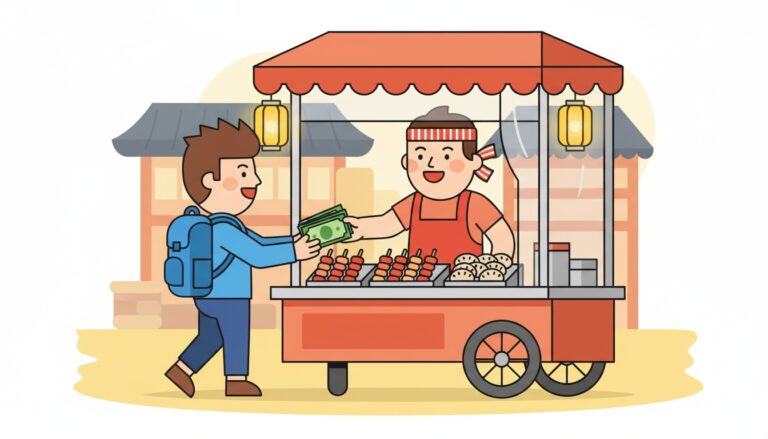
Have you ever watched a K-Drama where the main character buys delicious Tteokbokki (spicy rice cakes) or Bungeoppang (fish-shaped pastry) from a street stall? 🍢😋 In those situations, you can’t usually use a credit card!
Even though Korea is becoming a “cashless society,” carrying a little bit of cash (Won) is essential for enjoying traditional markets and street food. Today, let’s learn how to pay with cash confidently! Are you ready? Let’s go! 🚀
🗣️ Key Expressions
Here are 3 must-know expressions for cash payments!
1. 얼마예요? (How much is it?)
- Pronunciation: [Eolmayeyo?]
- English Meaning: How much is it?
- Detail: This is the most important phrase for shopping! You can point at anything and ask this. It is polite and can be used with anyone.
- 💡 Pronunciation Tip: Connect the sounds smoothly! Instead of saying “Eol-ma-ye-yo” separately, say it like “Eol-ma-ye-yo”. The ‘R/L’ sound at the bottom of ‘얼’ flows into the next syllable.
2. 현금 돼요? (Is cash okay?)
- Pronunciation: [Hyeongeum dwaeyo?]
- English Meaning: Can I pay with cash? / Is cash accepted?
- Detail: 현금 (Hyeongeum) means “Cash.” Some modern automated kiosks are “Card Only,” so it’s good to ask this at small shops.
- 💡 Pronunciation Tip: ‘Hyeongeum’ can be tricky! The ‘eu’ in ‘geum’ is pronounced like the ‘oo’ in “book” but with your lips stretched horizontally like a smile 😬.
3. 여기 있어요. (Here it is.)
- Pronunciation: [Yeogi isseoyo.]
- English Meaning: Here it is. / Here you go.
- Detail: Use this phrase when handing the money to the seller. It sounds very natural and polite!
- 💡 Pronunciation Tip: Connect the ‘s’ sound! ‘Is-seo-yo’ sounds like “I-sseo-yo” with a strong ‘S’ sound.
💬 Real Conversation
Imagine you are at a souvenir shop in Insadong! 🎁
A: Tourist (You)
B: Shop Owner
A: 안녕하세요! 이거 얼마예요?
(Annyeonghaseyo! Igeo eolmayeyo?)
Hi! How much is this?
B: 오천 원이에요.
(Ocheon wonieyo.)
It is 5,000 won.
A: 아, 네. 혹시 현금 돼요?
(A, ne. Hoksi hyeongeum dwaeyo?)
Ah, okay. By any chance, is cash okay?
B: 네, 그럼요!
(Ne, geureomyo!)
Yes, of course!
A: 여기 있어요.
(Yeogi isseoyo.)
Here it is.
B: 감사합니다!
(Gamsahamnida!)
Thank you!
🇰🇷 Culture Tip & K-Drama Vibes
💡 Cash vs. Card in Korea
In many K-Dramas, you might see characters paying with their phones (Samsung Pay) or cards at convenience stores. Korea is highly digital! 💳📱
However, at Traditional Markets (Sijang) or Street Food Carts (Pojangmacha), cash is still King! 👑 Sometimes, if you pay with cash, the owner might even give you a small discount or extra service (called Service/Seobiseu in Korean). So, keeping some 1,000 won and 10,000 won bills in your pocket is a great travel tip!
📝 Wrap-up & Quiz
Great job today! Now you can buy all the street food you want! 🌭 Let’s check what you remembered.
Mini Quiz:
- How do you say “Cash” in Korean?
(Hint: H_ _ _ _ _ _ m) - Fill in the blank: “_______ isseoyo.” (Here it is.)
See you next time! Annyeong! 👋
Answers:
1. Hyeongeum (현금)
2. Yeogi (여기)
Frequently Asked Questions (FAQ)
Q: What does "얼마예요? (How much is it?)" mean in Korean and how do you pronounce it?
A: In Korean, "얼마예요? (How much is it?)" is pronounced [Eolmayeyo?] and means: How much is it?
Q: What does "현금 돼요? (Is cash okay?)" mean in Korean and how do you pronounce it?
A: In Korean, "현금 돼요? (Is cash okay?)" is pronounced [Hyeongeum dwaeyo?] and means: Can I pay with cash? / Is cash accepted?
Q: What does "여기 있어요. (Here it is.)" mean in Korean and how do you pronounce it?
A: In Korean, "여기 있어요. (Here it is.)" is pronounced [Yeogi isseoyo.] and means: Here it is. / Here you go.







