

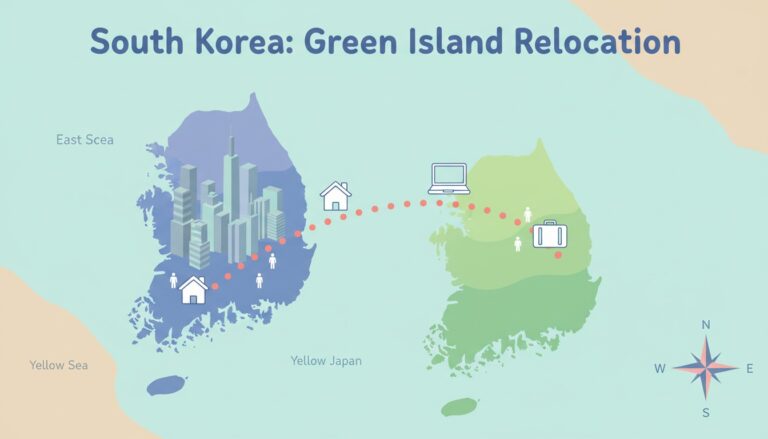
Why Did People Move? 🏠 Talking About Pandemic Changes in Korean!
1. Intro
Hello, everyone! It’s your favorite Korean tutor, Daily Hangul (매일한글)! 😊
Have you noticed how our lives changed during the pandemic? In many K-Dramas recently, you might see characters working from home or even moving from the busy city of Seoul to the peaceful countryside. Today, we are going to look at a slightly more advanced but super useful topic: How the pandemic changed where people live.
Don’t worry! We will break down this complex social topic into easy, bite-sized expressions. By the end of this post, you’ll be able to talk about social changes like a pro! Let’s dive in! 🚀
2. Core Expressions (핵심 표현)
Here are 3 key words to help you discuss population movement and lifestyle changes.
1. 재택근무 (Jaetaek-geunmu)
- Meaning: Remote work / Working from home
- Pronunciation: [Jae-taek-geun-mu]
- Explanation: This is a combination of 재택 (being at home) and 근무 (work). It became a buzzword during the pandemic. You will hear this constantly in modern office dramas!
- 💡 Pronunciation Tip: The ‘k’ in taek and ‘g’ in geun flow together. It sounds a bit like
[Jae-tek-keun-mu]when said fast.
2. 이사하다 (Isahada)
- Meaning: To move (house)
- Pronunciation: [I-sa-ha-da]
- Explanation: This is the standard verb for moving your residence. If you want to say “I moved to Seoul,” you say “서울로 이사했어요.”
- 💡 Pronunciation Tip: The ‘h’ sound in ‘ha’ is often weak. It flows smoothly like
[I-sa-a-da]in fast speech.
3. 영향 (Yeonghyang)
- Meaning: Influence / Impact
- Pronunciation: [Yeong-hyang]
- Explanation: When we talk about social changes, we often say “It had a big impact.” In Korean, we say “영향이 커요” (The impact is big).
- 💡 Pronunciation Tip: Make sure to pronounce the ‘ng’ (ㅇ) sound clearly at the end of both syllables!
3. Real Conversation (실전 대화)
Let’s see how two friends, Min-su and Lisa, talk about their friend who moved recently.
Min-su: 리사, 지민 씨가 제주도로 이사했어. 들었어?
(Lisa, Jimin moved to Jeju Island. Did you hear?)
[Lisa, Jimin-ssi-ga Jeju-do-ro isahasseo. Deureosseo?]
Lisa: 정말? 서울을 좋아했잖아. 왜 갔어?
(Really? She liked Seoul. Why did she go?)
[Jeongmal? Seo-ur-eul joa-haet-ja-na. Wae gasseo?]
Min-su: 코로나 때문에 재택근무를 시작했거든.
(Because of COVID, she started remote work.)
[Corona ttaemune jaetaek-geunmu-reul sijakhaet-geodeun.]
Lisa: 아, 팬데믹이 영향을 많이 줬구나.
(Ah, the pandemic had a big impact.)
[Ah, pandemic-i yeonghyang-eul mani jwot-guna.]
4. Culture Tip & Drama Context 🎬
Have you heard of “Workation”?
In Korea, a new trend called 워케이션 (Workation)—a mix of Work and Vacation—exploded during the pandemic. Since people could do 재택근무 (remote work), many young Koreans moved temporarily to places like Jeju Island or Gangwon Province to enjoy nature while working.
In recent dramas, you might see the main character escaping the stressful city to run a bookstore or cafe in a small seaside town. This reflects the real demographic change where people are seeking a better “Work-Life Balance” (워라밸 – Worabel) outside of crowded Seoul!
5. Wrap-up & Quiz 📝
Today we learned how to talk about moving and the impact of the pandemic. You are now ready to discuss society issues in Korean! Great job! 👏👏
Pop Quiz!
Fill in the blanks with the correct words: [ 이사 / 영향 / 재택근무 ]
- I work from home these days. = 요즘 ( ) 해요.
- I am moving to a new house. = 새 집으로 ( ) 가요.
- The weather has a big impact. = 날씨가 ( )을 줘요.
[Answers]
1. 재택근무
2. 이사
3. 영향
See you next time! 안녕! 👋
Frequently Asked Questions (FAQ)
Q: What does "이사하다 (Isahada)" mean in Korean and how do you pronounce it?
A: In Korean, "이사하다 (Isahada)" is pronounced [I-sa-ha-da] and means: To move (house)
Q: What does "영향 (Yeonghyang)" mean in Korean and how do you pronounce it?
A: In Korean, "영향 (Yeonghyang)" is pronounced [Yeong-hyang] and means: Influence / Impact






