

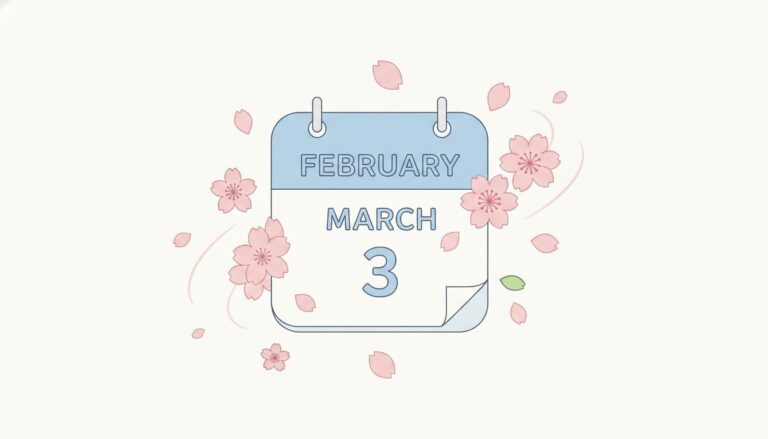
When is Spring? Mastering Korean Dates! 🌸
👋 Hello, K-Culture Lovers!
Hello everyone! It’s your friendly Korean tutor, Daily Hangul! 😊
Are you planning a trip to Korea to see the beautiful cherry blossoms in spring or the white snow in winter? Or maybe you want to understand when your favorite K-Drama character says, “Let’s meet on that day.”
To do any of these, you need to know how to talk about dates! specifically, the start of a season. In Korea, asking “When does it start?” is super useful. Let’s master it today so you don’t miss out on any fun events! 📅
📚 Core Expressions
Here are the key phrases you need to talk about dates and seasons.
1. 3월 (March)
- Pronunciation: [Sam-wol]
- English Meaning: March
- Detail: In Korean, months are very easy! You just say the Sino-Korean number + 월 (wol) which means “moon” or “month.”
- 3 (Sam) + Month (Wol) = 3월 (Sam-wol).
2. 1일 (1st day)
- Pronunciation: [I-ril]
- English Meaning: 1st day / One day
- Detail: Just like months, use Sino-Korean numbers + 일 (il) for the day.
- 1 (Il) + Day (Il) = 1일 (Il-il).
3. 언제예요? (When is it?)
- Pronunciation: [Eon-je-ye-yo?]
- English Meaning: When is it?
- Detail: This is a magic phrase! You can use it to ask about birthdays, concert dates, or holidays.
4. ~에 시작해요 (It starts on…)
- Pronunciation: [~e si-ja-kae-yo]
- English Meaning: It starts on/at…
- Detail: ‘~에’ (-e) is a particle that marks time or location. Put the date first, then add ‘에’.
💡 Pronunciation Tip (Honey Tip! 🍯)
Did you notice the pronunciation of 3월 and 1일 changed?
– 3월 is written as Sam-wol but sounds like [Sa-mwol] because the ‘m’ sound slides over.
– 1일 is written as Il-il but sounds like [I-ril].
This is called Liaison (linking sounds). It makes your Korean sound smooth and natural, just like a native speaker!
🗣️ Real Conversation
Let’s see how friends talk about the beginning of spring! 🌸
A: 봄은 언제예요?
(Bomeun eonjeyeyo?)
Meaning: When is spring?
B: 3월 1일에 시작해요.
(Samwol irire sijakaeyo.)
Meaning: It starts on March 1st.
A: 와! 꽃 보러 가요!
(Wa! Kkot boreo gayo!)
Meaning: Wow! Let’s go see flowers!
B: 좋아요! 같이 가요.
(Joayo! Gachi gayo.)
Meaning: Good! Let’s go together.
🇰🇷 Culture Tip & K-Drama Vibes
1. The Order of Dates
In English, you might say “1st of March.” But in Korea, we always go from Big to Small.
– Year ➡️ Month ➡️ Day
– So, it is 3월 1일 (March 1st), not 1일 3월.
2. Four Distinct Seasons
Korea has four very distinct seasons. K-Dramas love using seasons to set the mood!
– Spring (봄): Romance & Cherry Blossoms (Think of the drama Goblin!)
– Summer (여름): Horror or Youth vibes.
– Autumn (가을): Sentimental & Ballads.
– Winter (겨울): First snow (First snow is very romantic in Korea!).
📝 Wrap-up & Quiz
Today we learned how to say dates using Sino-Korean numbers! Remember: Number + Wol (Month) and Number + Il (Day).
Let’s test your skills!
- How do you say “March” in Korean? (Hint: 3 + Moon)
( ______ ) - True or False: In Korea, you say the Day before the Month. (e.g., Day-Month)
( ______ )
See you next time! 안녕! (An-nyeong!) 👋
👇 Answers
1. 3월 (Sam-wol)
2. False (It is Month-Day, e.g., 3월 1일)
Frequently Asked Questions (FAQ)
Q: What does "3월 (March)" mean in Korean and how do you pronounce it?
A: In Korean, "3월 (March)" is pronounced [Sam-wol] and means: March
Q: What does "1일 (1st day)" mean in Korean and how do you pronounce it?
A: In Korean, "1일 (1st day)" is pronounced [I-ril] and means: 1st day / One day
Q: What does "언제예요? (When is it?)" mean in Korean and how do you pronounce it?
A: In Korean, "언제예요? (When is it?)" is pronounced [Eon-je-ye-yo?] and means: When is it?
Q: What does "~에 시작해요 (It starts on...)" mean in Korean and how do you pronounce it?
A: In Korean, "~에 시작해요 (It starts on...)" is pronounced [~e si-ja-kae-yo] and means: It starts on/at...







