

🥢 Street Food Survival: “Chopsticks, Please!”
1. Introduction
Hello, K-Culture lovers! Welcome back to Daily Hangul, your best friend for learning Korean! 🇰🇷✨
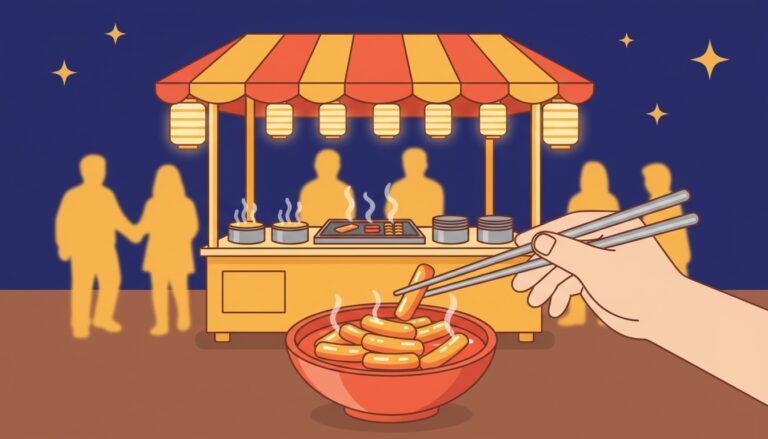
Imagine this: You are standing in front of a delicious Korean street food stall (Pojangmacha). The smell of spicy Tteokbokki (spicy rice cakes) is calling your name. You ordered it, but wait… how do you eat it? 😱
In many K-Dramas, you see characters standing by the street, enjoying hot food with a cup of broth. To do that, you need the right tools! Today, we will learn how to ask for chopsticks or forks so you can enjoy your food like a local. Are you ready? Let’s go! 🚀
2. Key Expressions
Here are the 3 most essential phrases you need to know when asking for utensils!
1. 젓가락 주세요 (Please give me chopsticks)
- Pronunciation: [Jeotgarak juseyo]
- Meaning: Please give me chopsticks.
- Explanation: This is the magic phrase! “Jeotgarak” means chopsticks, and “Juseyo” means “please give me.”
- 💡 Pronunciation Tip: The bottom letter ‘ㅅ’ in ‘젓’ sounds like a ‘t’ when it stands alone. So it sounds like [Jeot-ga-rak]. Try to say it rhythmically!
2. 포크 있어요? (Do you have a fork?)
- Pronunciation: [Pokeu isseoyo?]
- Meaning: Do you have a fork?
- Explanation: If you are not comfortable using chopsticks yet, don’t worry! Many places have forks. You can simply ask, “Pokeu (Fork) isseoyo (do you have)?”
- 💡 Pronunciation Tip: In Korean, there is no ‘F’ sound. So “Fork” becomes “Po-keu” (포크). It sounds cute, right? 😉
3. 여기요! (Excuse me!)
- Pronunciation: [Yeogiyo!]
- Meaning: Excuse me! / Over here!
- Explanation: Before you ask for anything, you need to get the owner’s attention. Raise your hand slightly and say this cheerfully.
- 💡 Pronunciation Tip: Pronounce it clearly as [Yeo-gi-yo]. Raising your pitch at the end makes it sound more polite and friendly! 🎵
3. Real-life Conversation
Let’s see how these expressions work in a real situation at a street food stall!
Situation: You bought some Sundae (blood sausage) and need chopsticks.
- You (A): 여기요! 순대 나왔어요? (Excuse me! Is the Sundae ready?)
- [Yeogiyo! Sundae nawasseoyo?]
- Owner (B): 네, 여기 있습니다. (Yes, here it is.)
- [Ne, yeogi isseumnida.]
- You (A): 아, 젓가락 주세요. (Ah, please give me chopsticks.)
- [Ah, jeotgarak juseyo.]
- Owner (B): 자, 여기요. 맛있게 드세요! (Here you go. Enjoy your meal!)
- [Ja, yeogiyo. Masitge deuseyo!]
- You (A): 감사합니다! (Thank you!)
- [Gamsahamnida!]
4. Cultural Tip & K-Drama Vibes 📺
Did you know? The “Self-Service” Culture!
In many Korean restaurants and street stalls, you might see a sign that says “물은 셀프 (Mul-eun Self)”. This means “Water is self-service.”
Often, utensils (chopsticks and spoons) are hidden in a drawer attached to the side of your table or in a lid-covered box on top of the table. So, before you shout “Jeotgarak juseyo,” take a quick look around or under the table edge! If you find it yourself, you’ll look like a true Korean expert! 😎
5. Wrap-up & Quiz
Great job today! Now you can confidently order utensils and enjoy your street food. No more hungry waiting! 🍢
📝 Mini Quiz
- How do you say “Fork” in Korean style pronunciation?
(A) Fork
(B) Pokeu -
Fill in the blank: If you want chopsticks, you say “_______ juseyo.”
(A) Jeotgarak
(B) Spoon -
(True/False) If you see a drawer on the side of the table, utensils might be inside.
Answers:
1. (B) Pokeu
2. (A) Jeotgarak
3. True
Frequently Asked Questions (FAQ)
Q: What does "포크 있어요? (Do you have a fork?)" mean in Korean and how do you pronounce it?
A: In Korean, "포크 있어요? (Do you have a fork?)" is pronounced [Pokeu isseoyo?] and means: Do you have a fork?
Q: What does "여기요! (Excuse me!)" mean in Korean and how do you pronounce it?
A: In Korean, "여기요! (Excuse me!)" is pronounced [Yeogiyo!] and means: Excuse me! / Over here!







