

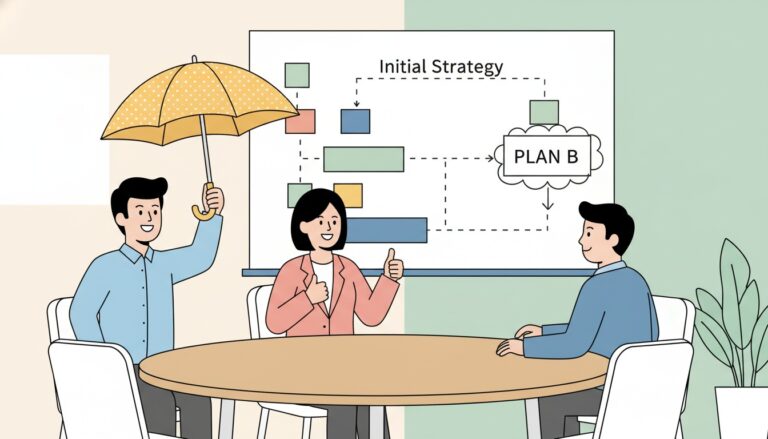
🏢 Crisis Mode! Handling “What Ifs” at Work in Korean
1. Introduction
Hello, Daily Hangul family! 👋 Welcome back! I’m your friendly Korean tutor, Daily Hangul.
Today, we are going to dive into the office life! Have you ever watched K-dramas like “Start-Up” or “Misaeng”? You often see characters panicking right before a big deadline, shouting, “What do we do?!” 😱
Even if you are a beginner, knowing how to talk about planning and handling risks makes you look super professional. Today, we will learn simple yet powerful expressions to establish a “Risk Response Plan” (or just… a Plan B!). Let’s level up your Business Korean! 💼✨
2. Core Expressions (핵심 표현)
Here are 3 key phrases to help you manage risks like a K-Drama CEO!
1️⃣ 혹시 몰라서 준비했어요.
- Pronunciation: [Hoksi mollaseo junbi-haesseoyo]
- Meaning: I prepared it just in case.
- Detail: This is the golden phrase of a reliable employee! ‘혹시 (Hoksi)’ means ‘by any chance’ or ‘maybe’, and ‘몰라서 (mollaseo)’ comes from ‘not knowing’. Together, it means “I didn’t know what might happen, so… (just in case).” Use this when you show your backup plan!
- 💡 Pronunciation Tip: In ‘준비 (Junbi)’, pronounce the ‘J’ softly, like the ‘j’ in ‘jar’, not ‘z’.
2️⃣ 플랜 B가 있어요?
- Pronunciation: [Peullaen-bi-ga isseoyo?]
- Meaning: Do you have a Plan B?
- Detail: Good news! Koreans use the English word “Plan” (플랜) very often in business settings. This is a perfect way to ask about risk management without learning difficult words like ‘contingency plan’.
- 💡 Pronunciation Tip: Koreans add a vowel sound to end consonants. So ‘Plan’ becomes ‘Peul-laen’ (플랜). Make sure to pronounce the ‘L’ sound clearly!
3️⃣ 제가 확인해 볼게요.
- Pronunciation: [Jega hwagin-hae bolgeyo]
- Meaning: I will check.
- Detail: When a problem (risk) pops up, you don’t need to solve it instantly. You just need to tell your boss or team that you will investigate. ‘확인 (Hwagin)’ means ‘check’ or ‘confirm’. It’s the most used word in a Korean office!
- 💡 Pronunciation Tip: When saying ‘확인해 (Hwagin-hae)’, the ‘h’ sound in ‘hae’ often becomes weak in fast speech, sounding like [Hwagine] because of the liaison rule. It makes you sound very natural!
3. Real Dialogue (실전 대화)
Let’s see how Team Leader Kim and New Employee Lee handle a potential risk for an outdoor event. 🌦️
(In the meeting room)
👩💼 Manager Kim: 내일 행사 준비 다 됐어요?
(Naeil haengsa junbi da dwaesseoyo?)
Is everything ready for tomorrow’s event?
👨💻 Employee Lee: 네! 그런데… 내일 비가 올 수도 있어요.
(Ne! Geureonde… naeil biga ol sudo isseoyo.)
Yes! But… it might rain tomorrow.
👩💼 Manager Kim: 진짜요? 그럼 플랜 B가 있어요?
(Jinjja-yo? Geureom Peullaen-bi-ga isseoyo?)
Really? Then, do you have a Plan B?
👨💻 Employee Lee: 네, 걱정 마세요. 혹시 몰라서 우산을 준비했어요.
(Ne, geokjeong maseyo. Hoksi mollaseo usaneul junbi-haesseoyo.)
Yes, don’t worry. I prepared umbrellas just in case.
👩💼 Manager Kim: 오, 대박! 잘했어요.
(Oh, daebak! Jal-haesseoyo.)
Oh, wow! Good job.
4. Culture Tip & Drama Vibes 🎭
🇰🇷 The “Pogo” (Reporting) Culture
In Korean office culture, which you might see in dramas like “What’s Wrong with Secretary Kim,” reporting (보고 – Pogo) effectively is crucial. If there is a risk, you must report it immediately. Hiding a problem is considered worse than the problem itself!
Also, phrases like “혹시 몰라서… (Just in case…)” are seen as a sign of Sense (센스). If you have “Sense,” it means you are quick-witted and prepared. Being called a person with “Sense” is a huge compliment in Korea! 👍
5. Wrap-up & Quiz 📝
Today we learned how to be a prepared professional in Korean! Dealing with risks doesn’t have to be scary if you know the right words.
Let’s check your understanding!
- How do you say “Do you have a Plan B?” in Korean?
- ( ? )
- Fill in the blank: “_______ 몰라서 준비했어요.” (I prepared it just in case.)
- A) 지금 (Jigeum)
- B) 혹시 (Hoksi)
Keep practicing, and don’t be afraid of mistakes! Fighting! (파이팅!) 🔥
(Answers: 1. 플랜 B가 있어요? / 2. B)







