

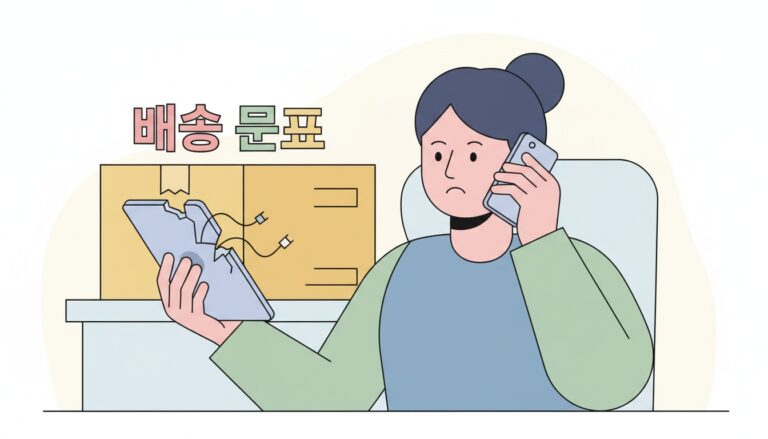
📦 Received a Defective Item? How to Complain Politely!
1. Introduction
Annyeonghaseyo! It’s your favorite Korean tutor, Daily Hangul! 👋😊
Have you ever ordered something online in Korea (like from Coupang or Gmarket), waited excitedly for the delivery 🚚, but opened the box to find the item was broken or didn’t work? 😱
It’s frustrating, but don’t worry! In Korea, getting a solution is usually very fast if you know the right words. Today, we will learn how to give constructive feedback to customer service. Instead of just getting angry, we will learn how to explain the problem clearly and ask for a solution politely. This is how you handle it like a K-Drama main character who knows their rights! ✨
2. Key Expressions 🔑
Here are the 3 most useful phrases when you need to report a defective product.
1. 제품에 문제가 있어요.
- Pronunciation: [Jepume munjega isseoyo]
- English: There is a problem with the product.
- Detail: This is the best “opener” for your conversation. It is polite and objective. Instead of saying “It’s bad!”, you are stating a fact.
- 💡 Pronunciation Tip: Connect the sounds! 제품에 sounds like [제푸메 / Je-pu-me]. This linking makes your Korean sound much smoother.
2. 작동이 안 돼요.
- Pronunciation: [Jakdong-i an dwaeyo]
- English: It doesn’t work / It’s not functioning.
- Detail: Use this for electronics or gadgets. If it’s a physical item (like a cup) that is broken, you can say “깨져서 왔어요” (It arrived broken).
- 💡 Pronunciation Tip: 작동 (Operation/Function) is pronounced [Jak-dong]. When you add 이, it flows as [Jak-dong-i].
3. 교환해 주시겠어요?
- Pronunciation: [Gyohwan-hae jusigesseoyo?]
- English: Could you please exchange it?
- Detail: This is a constructive request. If you want your money back instead, say “환불해 주시겠어요?” (Could you please refund it?). Using ~주시겠어요? is very polite and professional.
3. Real-life Conversation 🗣️
Let’s see how to use these in a real phone call with a Customer Service (CS) agent.
(📞 Phone Call)
👩💼 CS Agent: 안녕하세요, 무엇을 도와드릴까요? (Hello, how may I help you?)
👤 You: 안녕하세요. 오늘 택배를 받았는데, 제품에 문제가 있어요. (Hello. I received the package today, but there is a problem with the product.)
👩💼 CS Agent: 아, 죄송합니다. 어떤 문제인가요? (Ah, I apologize. What is the problem?)
👤 You: 전원을 켰는데 작동이 안 돼요. (I turned on the power, but it doesn’t work.)
👩💼 CS Agent: 불편을 드려 죄송합니다. 어떻게 처리해 드릴까요? (Sorry for the inconvenience. How should we handle this for you?)
👤 You: 새 제품으로 교환해 주시겠어요? (Could you please exchange it for a new one?)
4. Culture Tip & K-Drama Vibes 🇰🇷
💡 The Magic Word: “A/S”
In Korea, we use the Konglish term “A/S” (After Service) to talk about repairs, warranties, or customer service support. If you buy electronics in Korea, checking the “A/S center” location is very important!
Also, Korean customer service is famous for being “Ppalli-ppalli” (Fast-fast) 🚀. If you complain politely using the phrases above, they will often send a replacement immediately—sometimes even before they pick up the broken one! Being polite (using honorifics) gets you the best service.
5. Wrap-up & Quiz 📝
Great job today! Now you don’t have to panic if your online shopping goes wrong. You can calmly explain the issue and get a new one! 😎
Let’s check your understanding!
Q1. Fill in the blank:
To say “There is a problem,” you say: “__________에 문제가 있어요.”
(Hint: Product)
Q2. True or False:
If you want your money back, you should ask for “교환” (Gyohwan).
⬇️ Answers
.
.
.
1. 제품 (Jepum)
2. False (You should ask for 환불 / Hwanbul. ‘Gyohwan’ is exchange!)
Frequently Asked Questions (FAQ)
Q: What does "작동이 안 돼요." mean in Korean and how do you pronounce it?
A: In Korean, "작동이 안 돼요." is pronounced [Jakdong-i an dwaeyo] and means: a key conversational Korean expression covered in this lesson.
Q: What does "교환해 주시겠어요?" mean in Korean and how do you pronounce it?
A: In Korean, "교환해 주시겠어요?" is pronounced [Gyohwan-hae jusigesseoyo?] and means: a key conversational Korean expression covered in this lesson.







